Making Veterans Faster Than We Care For Them: The War, the Count, and the System Waiting for Them
Why This Matters for NY-23
Every war produces veterans. The question a district like this one should ask is whether the system that will care for them is being built up or worn down at the same time the war is producing them.
Between February 2025 and July 2026, six things happened at once:
- American forces entered a conflict with Iran that Congress never authorized, that the House twice voted to end, and that the administration declared “terminated” in May while the strikes continued. He voted against all five Iran resolutions, and against two on Lebanon.
- The Defense Department’s public count of wounded service members went down while officials described roughly a hundred new injuries.
- A bill advanced that would tighten the disability ratings future claimants receive for two of the most commonly claimed conditions.
- VA cancelled the backstop that kept veterans behind on VA-backed mortgages out of foreclosure, and took thirteen months to stand up the replacement Congress authorized. Foreclosures on VA loans hit their highest rate in a decade.
- The VA workforce that processes disability claims shrank, with facilities barred from refilling vacancies.
- VA research staffing — the thing that eventually proves a war made people sick — declined for the second straight year.
Rep. Langworthy cast recorded votes on the first, third, and sixth. This page documents all six, and it documents the places where the criticism of him is wrong — including on the fourth, where there is no vote of his to point to at all.
Two Corrections, Before Anything Else
Both of these cut in his favor, and both need to be said first, because an entry that gets them wrong can be dismissed entirely.
He has no PACT Act votes. The Honoring our PACT Act became law on August 10, 2022 (P.L. 117-168). Langworthy’s term began on January 3, 2023. The filibuster fight people remember from the summer of 2022 happened before he held office. He did not vote for the PACT Act, he did not vote against it, and he did not vote on the cloture motions that delayed it. Anyone claiming otherwise is wrong.
He voted to increase toxic exposure funding, not cut it. The Cost of War Toxic Exposures Fund — the account that pays for PACT Act care — was funded at 100% of the request in FY2026 and grows in the FY2027 House bill:
| Fiscal year | Toxic Exposures Fund |
|---|---|
| FY2026 enacted | $52,676,000,000 |
| FY2027 House bill | $54,593,000,000 |
| Change | +$1,917,000,000 (+3.6%) |
Langworthy voted YES on that bill, H.R. 8469 (Roll Call 175, May 15, 2026, passed 400–15). PACT Act funding was not cut.
Sources: P.L. 117-168; VA FY2027 Budget in Brief; clerk.house.gov Roll Call 175.
A. The War That Is Making the Next Generation of Veterans
Operation Epic Fury began February 28, 2026. The Department of War’s own page states: “On Feb. 28, 2026, the U.S. military commenced Operation Epic Fury under the direction and direct orders of the president of the United States.” American forces are still striking Iran today, though whether that is legally the same operation is now contested by the administration itself — see “The operation was declared over in May” below. A ceasefire period collapsed in early July, and Central Command completed a further wave of strikes on July 13, 2026 (the Department’s own news item that day is headlined “Centcom Completes Another Wave of Strikes Against Iran”).
There is no authorization for the use of military force covering it. The President notified Congress on March 2, 2026, which started the War Powers Resolution’s 60-day clock, and the administration has rested the operation on broad Article II authority.
A point that cuts in the administration’s favor and should not be skipped: it has not argued that the 60-day clock is unconstitutional. Vice President JD Vance separately called the War Powers Resolution “fundamentally a fake and unconstitutional law” in January 2026, before this operation began — but that is his statement, not the legal position the administration has taken on Epic Fury.
The House voted seven times on war powers resolutions in this period — five on Iran, two on Lebanon. Langworthy voted No every time.
| Roll call | Date | Measure | Result | His vote |
|---|---|---|---|---|
| 85 | Mar. 5, 2026 | H.Con.Res. 38 (Iran) | Failed 212–219 | Nay |
| 114 | Apr. 16, 2026 | H.Con.Res. 40 (Iran) | Failed 213–214 | Nay |
| 170 | May 14, 2026 | H.Con.Res. 75 (Iran) | Failed on a tie, 212–212 | Nay |
| 199 | Jun. 3, 2026 | H.Con.Res. 86 (Iran) | PASSED 215–208 | Nay |
| 201 | Jun. 4, 2026 | H.Con.Res. 84 (Lebanon) | Failed 92–324 | Nay |
| 232 | Jun. 30, 2026 | H.Con.Res. 108 (Lebanon) | Failed 189–235 | Nay |
| 282 | Jul. 23, 2026 | H.Con.Res. 89 (Iran) | PASSED 214–208 | Nay |
On May 14 the measure failed on a 212–212 tie. One vote the other way would have carried it.
Update, September 17, 2026: there is now an eighth vote in this series — Roll 307, September 15, 2026, on H.Con.Res. 93, which passed 220–204 with Langworthy voting Nay. See the update at the end of this entry.
H.Con.Res. 86 passed both chambers. The Senate agreed to it 50–48 on June 23, 2026, with Republicans Cassidy, Collins, Murkowski and Paul voting yes.
The part that must be stated precisely, because it is the weak point of the easy version
These are concurrent resolutions, and they almost certainly cannot compel the President to do anything.
Section 5(c) of the War Powers Resolution says the President shall withdraw forces when Congress adopts a concurrent resolution. But a concurrent resolution is never presented to the President for signature, and in INS v. Chadha (1983) the Supreme Court held that congressional action carrying legal effect requires both bicameralism and presentment. That provision has been widely regarded as a dead letter ever since.
The vehicle that would bind — a joint resolution — was taken up repeatedly in the Senate in 2026 and never adopted. Ten distinct Iran war powers joint resolutions drew eleven roll calls; the Senate never reached a merits vote on any of them, because every roll call was on a motion to discharge or to proceed. One motion to discharge did carry, 50–47 on May 19, 2026 (S.J.Res. 185), but its motion to proceed then failed 47–50 in June. The most recent discharge attempt failed 47–49 on July 23, 2026, the same day the House passed H.Con.Res. 89.
In plain language: Congress has now said twice, in both chambers once, that the Iran war should end. It said so using the only instrument available to it that the President can lawfully ignore, because the instrument that would bind him cannot get through the Senate. Langworthy voted against all five Iran measures, and against both Lebanon measures as well.
Whether the concurrent resolutions bind is genuinely contested. Rep. Gregory Meeks argued on the House floor on July 22, 2026 that the already-adopted resolution carried legal force, telling colleagues that “the Trump administration was required to end its hostilities against Iran” and that “a dual-Chamber concurrent resolution has never been struck down by the courts, certainly not in the war powers context” (172 Cong. Rec. H5162). In the same debate Rep. Pramila Jayapal said Congress had passed a resolution that “has the force of law.” The administration has not accepted that the resolutions bind it, and has continued operations. We report the dispute rather than resolve it.
The operation was declared over in May, and the strikes continued
This is the part that connects the votes above to the casualty count below, and it has not been widely reported as a single sequence.
| Date | What happened |
|---|---|
| May 1, 2026 | In a letter to Congress, President Trump wrote that Operation Epic Fury had been “terminated” |
| May 5, 2026 | Secretary of State Marco Rubio told reporters at a White House briefing that Epic Fury “was over” |
| June 2026 | The U.S. and Iran signed a memorandum of understanding opening a 60-day negotiating period |
| July 6, 2026 | The ceasefire collapsed; near-daily airstrikes resumed |
U.S. strikes conducted since the May declaration are, per a U.S. official quoted by ABC News, “referred to as ‘overseas operations’” — which ABC noted “would be an unconventional label for a war.”
Why this bears on the Iran votes. The War Powers Resolution’s 60-day clock runs from the introduction of forces into hostilities. If the fighting that resumed in July is a new operation rather than a continuation of the one that began in February, the clock restarts — and the resolutions Langworthy voted against were aimed at an operation the administration had already declared finished.
The objection here is bipartisan. On July 23, Rep. Thomas Massie, a Kentucky Republican, wrote:
“The Pentagon is pretending there have been two Iran wars separated by a brief cease-fire.”
Massie called it an “absurd ruse.” ABC framed the maneuver as an attempt to avoid the War Powers Resolution’s 60-day deadline; Massie’s own argument is blunter, and about a longer clock — in a companion post he wrote that by “going more than 90 days without congressional authorization,” the Secretary of War “IS BREAKING THE LAW.”
ABC News reported that major U.S. conflicts have historically moved through distinct phases, but that “those shifts have not resulted in separate casualty categories being treated as separate wars,” and that splitting a war this way “would be unprecedented.”
What legal scholars say about the theory
We are not the ones to judge whether this war is lawful. Here is what people who do this for a living have written. Note that both assessments were published in early May and address the May 1 letter, before the July resumption.
The administration’s actual theory is narrower than it is usually described. It did not argue that the War Powers Resolution is unconstitutional, and it did not invoke the provision allowing a 30-day extension for safe withdrawal. It argued that the hostilities begun February 28 had “terminated” with the April 7 ceasefire, after which there had “been no exchange of fire” — so the duty to withdraw had lapsed.
Jack Goldsmith, a Harvard law professor who ran the Justice Department’s Office of Legal Counsel under President George W. Bush, assessed that theory on May 4:
“I find this interpretation of the WPR implausible. But it is far from the first time presidents have relied on implausible WPR interpretations to skirt the statute.”
Goldsmith flags the letter’s factual premise — that there had been “no exchange of fire” — as “highly misleading.” He also declines the simple version of the story: presidents of both parties have stretched the statute for fifty years, a lineage he traces from a 1975 opinion by Antonin Scalia, then head of OLC, through Reagan in Lebanon and Obama in Libya, where the State Department’s legal adviser testified that an air campaign did not amount to “hostilities.” Trump’s claim that the Resolution has “never been adhered to,” Goldsmith writes, is “not right here, but he is not entirely wrong.” His conclusion still cuts the other way: it is “wrong to say that the WPR is irrelevant or toothless.”
Tess Bridgeman, a former deputy legal adviser at the National Security Council, and Oona Hathaway of Yale Law School put it far more strongly, writing on the day the clock expired. They argue the war was “doubly illegal” before the deadline — under the Constitution, which assigns the war power to Congress, and under Article 2(4) of the UN Charter, which they say makes it “a war of aggression” — and that blowing the 60-day deadline makes it “triply illegal.” They also close the escape hatch Goldsmith notes was unused: the 30-day extension requires a presidential certification that was never filed.
Where they agree is the part worth noticing. A Bush administration OLC head and two of the administration’s sharpest critics independently reach the same word — implausible — about the legal theory. They also agree it belongs to a bipartisan tradition of stretching this statute, which is why this entry does not present it as unprecedented behavior by one party.
In fairness, and stated plainly: we did not locate a defense of the administration’s position from a scholar of comparable standing. There is a serious, mainstream argument that Article II gives presidents broad latitude for limited strikes, and OLC has applied a two-part test to that effect across administrations of both parties. But the published defenses of this operation that we found came from advocacy outlets rather than from the legal academy, and we are not going to manufacture a balance the record does not show.
In plain language: the same relabeling that would restart the war powers clock also governs which operation a dead or wounded service member gets counted under. That is the subject of the next section.
Sources: clerk.house.gov roll call XML for rolls 85, 114, 170, 199, 201, 232, 282; senate.gov Vote 184 (Jun. 23, 2026); INS v. Chadha, 462 U.S. 919 (1983); ABC News, “Pentagon lowers count of Iran war dead and wounded,” Beynon and Martinez, Jul. 24, 2026.
B. The Injuries That Are Not Being Counted
This section is about whether we will even know how many veterans this war creates.
What the database showed, day by day
The Defense Casualty Analysis System (DCAS) is the Defense Department’s primary public repository for U.S. military casualties and, in the senators’ words, “the federal government’s authoritative public record of war dead.” Here is what it displayed over five days, with the observer for each reading:
| Date | Reading | Observed by |
|---|---|---|
| Jul. 20 | Chief Pentagon spokesman Sean Parnell: “nearly 100 service members were deemed to have some degree of injury since July 7, 2026,” 96% returned to duty | @SeanParnellASW, cited in the Senate letter |
| Jul. 21 (Tue.) | 14 killed (against 18 deaths widely reported), 447 injured, and zero wounded in action for the month of July | Senate letter; Stars and Stripes |
| Jul. 22 (Wed.) | 482 wounded | ABC News |
| Jul. 23 (Thu.) | 18 deaths, 447 total casualties, as of the letter’s delivery | Senate letter, footnote i |
| Jul. 23 (Thu.) | Deaths fell 18 → 14; wounded fell 482 → 420 | ABC News |
| Jul. 24 (Fri.) | “As of Friday evening, those figures remain uncorrected” | ABC News |
These readings do not reconcile with one another, and we are not going to pretend they do. The letter records 447 total casualties on both July 21 and July 23, while ABC News records 482 wounded on July 22 — and the same letter shows the death count at 14 on July 21 but 18 on July 23, before ABC recorded it falling back to 14. The categories being counted (“injured,” “total casualties,” “wounded”) are not defined identically across the sources, and DCAS itself was changing underneath them. The instability is the finding. It is also precisely what the senators asked about: their Question 5 requests the Department’s own definitions of “injury,” “wounded in action,” and “casualty” for this operation.
The drop from 18 to 14, ABC reported, “effectively remov[ed] the four U.S. service members killed in Jordan and Iraq since daily fighting renewed.”
Acting Pentagon Press Secretary Joel Valdez said the site was experiencing technical issues:
“The Department of Defense is aware of temporary data disruptions on the Defense Casualty Analysis System (DCAS) website. These site anomalies are currently being resolved in coordination with the military services.”
ABC reported that the Pentagon did not respond to detailed questions about how such a data issue was possible or why the numbers had not been corrected.
The letter
On July 23, twelve senators wrote to Secretary Hegseth. The signers include Sen. Kirsten Gillibrand of New York, along with Hirono, Reed, Shaheen, Duckworth, Blumenthal, Kelly, Warren, Peters, Kaine, Rosen and Slotkin. Their letter states:
“We are concerned that DCAS is not being maintained at the granular level and calls into serious question the completeness and reliability of the aggregate totals.”
The letter cites The New York Times reporting that Central Command is not required to publicly disclose injured service members, particularly when they return to duty quickly, and asks how often that discretion has been used. Question 6 asks directly how many service members have been screened for and diagnosed with concussion or traumatic brain injury, whether those are counted in the wounded-in-action total, and what the process is for updating casualty counts as delayed TBI diagnoses emerge. A response is due July 30, 2026.
The senators also raise the alternative explanation themselves. Question 3 asks whether service members killed or wounded while deployed under another named operation — they name Operation Inherent Resolve, the anti-ISIS campaign that predates this war — are being left out of the Epic Fury accounting. ABC reported the same possibility: troops already in the region under that mission “may technically fall under a separate operation on paper, including some of the soldiers killed in recent days.” That is a real and innocent explanation for part of the discrepancy, and it should be weighed. It does not explain a published count moving downward, and it is the Department, not its critics, that is positioned to resolve it.
A New York name came off the list
One of the four soldiers killed in the recent attacks, Sgt. Angel Rampersad, was a New York native. Gov. Kathy Hochul said she was “outraged” to see her name removed from the database:
“The Trump administration does not get to revise the human cost of this war because it has become politically inconvenient. Sgt. Rampersad gave her life in service to this country. Changing a website does not rewrite the truth of her sacrifice.”
The three other service members killed in those attacks were Pfc. Isabella Gonzales, 1st Lt. Tyler Feehan and Sgt. Michael Emmanuel Swinton.
Days before the database showed 14, the President posted a comparison of U.S. fatalities in Afghanistan, Iraq, Vietnam and Korea alongside this conflict. His post said 18 American troops had died.
Objections have come from Gov. Hochul, Senate Armed Services Democrats, and Rep. Thomas Massie, a Republican. This is not a one-party concern.
Why this specific thing has happened before, and what it cost veterans
In January 2020, Iran struck the al-Asad air base in Iraq. On January 8, 2020, in remarks entered in the official Daily Compilation of Presidential Documents, President Trump said:
“The American people should be extremely grateful and happy no Americans were harmed in last night’s attack by the Iranian regime. We suffered no casualties, all of our soldiers are safe.”
The traumatic brain injury count was then revised upward six times:
| Date announced | TBI cases |
|---|---|
| Jan. 16, 2020 | 11 |
| Jan. 24, 2020 | 34 |
| Jan. 28, 2020 | 50 |
| Jan. 30, 2020 | 64 |
| Feb. 10, 2020 | 109 |
| Feb. 21, 2020 | 110 |
Of those, 35 were evacuated to Germany and 25 sent on to the United States. Asked at Davos on January 22 about troops airlifted with head injuries, the President said: “No, I heard that they had headaches, and a couple of other things. But I would say, and I can report it is not very serious.” Pressed on whether he considered a potential traumatic brain injury serious, he answered: “No, I don’t consider them very serious injuries, relative to other injuries that I’ve seen.” The VFW demanded an apology two days later, saying “TBI is a serious injury and one that cannot be taken lightly.
What the Pentagon’s own auditors found
DODIG-2022-006 (November 2021) examined how Central Command tracked those injuries. Its findings:
- CENTCOM and its component commands “did not track or report” potentially concussive events as required.
- CENTCOM had not filed the required monthly tracking reports since October 2014 — a seven-year gap in the theater where most blast exposure occurred.
- Of 261 service members involved in the al-Asad event, CENTCOM reported 110 TBIs to DoD leadership while health records identified only 87 — meaning the Department’s own systems could not reconcile who had been hurt.
- The warning that matters most here: without adequate records, service members “may not be eligible to receive disability benefits or care” from VA after separating.
A separate evaluation, DODIG-2023-059 (March 2023), looked at TBI screening and care at military treatment facilities rather than at CENTCOM’s reporting. It is not a follow-up on the 2022 recommendations, but its findings describe the same breakdown reaching the clinical side:
- Only 2 of 14 military treatment facilities sampled followed required TBI screening guidance.
- 41% of patients diagnosed with mild TBI did not receive the 72-hour follow-up recommended in DHA-PI 6490.04. The Inspector General’s first recommendation was to change that follow-up from a recommendation to a requirement.
- Conclusion: “the MHS is unable to accurately identify, treat, and track the number of TBIs across the DoD.”
- The recommendations went unanswered at issuance and two remain open.
An honesty note: the 87-versus-110 discrepancy runs in both directions. These reports document a records failure, not a proven undercount. We are not claiming the Inspector General proved al-Asad was undercounted — we are citing what it actually found, which is that the Department cannot tell.
In plain language: an injury that is not recorded at the time is an injury the veteran may spend years trying to prove later. Undercounting at the front end becomes claim denials at the back end. That is not speculation about this war — it is the documented consequence of the last one, in the Pentagon’s own words.
There is no official TBI count for this war
The Defense Department publishes deaths and an aggregate “wounded/injured” figure. It publishes no traumatic brain injury count for Operation Epic Fury at all. Under Defense Department policy, blast concussion is reportable as a wound — but only once a medical authority classifies the injury, which requires that it be screened and diagnosed first. The Inspector General findings above describe exactly where that chain breaks.
In March 2026, ABC News reported more than 200 wounded with roughly 140 TBI-related, attributed to an unnamed official. The Pentagon has provided no figure of its own.
Meanwhile VA data recorded 441,639 veterans who had screened positive for a TBI, received a TBI-related diagnosis, or filed a TBI-related claim cumulatively from 2001 to 2021, rising to 556,502 by 2025 — a 26% increase. That is a running total since 2001, not a snapshot, and it counts claim filers alongside diagnosed cases. Veterans’ advocates caution it may reflect better screening rather than more injury. Over the same period, funding for the Defense Department’s CDMRP traumatic brain injury research program fell from $175 million in FY2024 to zero in FY2025 and $40.5 million in FY2026.
A comparison we are deliberately not making: cumulative TBI diagnosis totals and battlefield casualty counts come from incompatible reporting systems, and juxtaposing them would be misleading. We are not doing it.
What we are not claiming: no completed Inspector General, GAO, or congressional investigation has found that injuries in this operation were undercounted. A Lead Inspector General for Operation Epic Fury was designated May 12, 2026, and its first quarterly report is not due until fall 2026. No hearing has been held. What exists today is the senators’ letter, reporting based on anonymous officials, and the Pentagon’s own published data contradicting its own spokesman. The last of those is the verifiable one, and it is the one this page rests on. Claims that any undercount is deliberate trace to anonymous sources; the Pentagon calls it a technical fault.
Where Langworthy sits on this specific question
Congress has been trying to build the tracking system the Inspector General says is missing.
The Blast Overpressure Safety Act (H.R. 8025, 118th Congress) would have required the Defense Department to log blast exposure and screen for its effects. It never advanced. Its 27 cosponsors included five New York members — Stefanik, Morelle, LaLota, Kennedy and Ryan. We checked the cosponsor roster directly: Langworthy was not among them.
In his favor: he voted Yes on the FY2027 National Defense Authorization Act (H.R. 8800, Roll Call 278, July 22, 2026), and Section 756 of that bill would newly require blast overpressure and traumatic brain injury logs for every service member, baseline neurocognitive testing at accession, and reassessment at least every three years.
That Congress was still legislating in July 2026 to create per-service-member TBI logs is itself the clearest evidence that they do not yet exist.
Sources: Letter from 12 U.S. Senators to Secretary of Defense Hegseth, Jul. 23, 2026; Stars and Stripes, Jul. 21, 2026; ABC News, “Pentagon lowers count of Iran war dead and wounded,” Beynon and Martinez, Jul. 24, 2026; DODIG-2022-006, Nov. 2021; DODIG-2023-059, Mar. 2023; DCPD-202000008 and DCPD-202000032; GPO BILLSTATUS for H.R. 8025 (118th); H.R. 8800 §756; clerk.house.gov Roll Call 278; Roll Call, Jul. 20, 2026 (VA Polytrauma Registry).
C. The Ratings Those Veterans Would Be Judged Under
H.R. 9237, the Take Care of America’s Veterans Act, expands some benefits and pays for them by reducing others. Compared against the rating schedule in force today:
| Condition | Current law (38 C.F.R. Part 4) | Under H.R. 9237 |
|---|---|---|
| Sleep apnea | 50% when a breathing assistance device such as a CPAP is required | 0% when asymptomatic, with or without treatment; 10% when treatment yields incomplete relief; 50% only if treatment is ineffective and there is no end-organ damage; 100% only with end-organ damage |
| Tinnitus | Flat 10% for recurrent tinnitus | No separate compensable rating, except 10% when paired with otherwise-noncompensable service-connected hearing loss |
More than 760,000 veterans are currently rated for sleep apnea and more than 3.5 million for tinnitus. Both are signature conditions of blast exposure and aircraft noise.
Section 104(b) separately raises two VA home loan fees, amending the loan fee table at 38 U.S.C. §3729(b)(2):
| Type of loan | Fee today | Under H.R. 9237 |
|---|---|---|
| Interest rate reduction refinancing loan (IRRRL) — subparagraph (E) | 0.50% | 1.42% |
| Loan assumption under §3714 — subparagraph (I) | 0.50% | 1.0% |
Both categories are ways of restructuring or transferring an existing VA loan rather than originating a new purchase. Section D explains why the timing of that increase is worth noting.
An important limit, stated plainly: under 38 U.S.C. §3729(c), no loan fee is collected at all from a veteran receiving compensation for a service-connected disability, from certain surviving spouses, or from an active-duty Purple Heart recipient. H.R. 9237 does not amend that waiver. So this increase falls on veterans without a compensable service-connected disability — a large group, but not the most disabled one. Anyone claiming the bill raises fees on disabled veterans is wrong.
Who pays. The bill applies to “claims filed after the date of the enactment,” and existing compensation cannot be reduced. Supporters emphasize this and it is accurate. The open question is whether the new criteria would also govern a rated veteran who later seeks an increase, since that is filed as a new claim. We could not locate that argument in DAV’s June 24 opposition letter or its public statements, so we do not attribute it to them — but the supporting organizations’ own letter concedes the ambiguity, urging application “only to future claims or future requests for increased ratings.” That phrasing would be unnecessary if the point were already settled.
In plain language: the service members deployed right now are precisely the people this provision would govern. They have not filed yet.
His seven votes on it
| Date | Body | Question | His vote | Result |
|---|---|---|---|---|
| Jun. 23 | Rules | Make in order the amendment replacing the bill with the Major Richard Star Act | Nay | Defeated 4–8 |
| Jun. 23 | Rules | Report the rule | Yea | Adopted 8–4 |
| Jul. 13 | Rules | Strike the closed rule | Nay | Defeated 4–6 |
| Jul. 13 | Rules | Report the replacement rule | Yea | Adopted 6–4 |
| Jul. 14 | Floor | Previous question / adopt the closed rule | Yea / Aye | 217–210 / 215–211 |
| Jul. 16 | Floor | Motion to recommit H.R. 9237 to the Veterans’ Affairs Committee | Nay | Failed 210–211 |
That motion failed by one vote. It was a straight motion to recommit, with no instructions attached. Rep. Chris Deluzio said on the floor that he would have attached an amendment changing the offsets “if the House Rules permitted” — the closed rule is why he could not, so recommittal was the only vehicle left, though adopting it would have returned the bill to committee rather than stripped anything from it. (The amendment actually striking §104(b) and §108 was submitted to the Rules Committee by Rep. Takano and never made in order; no vote on it exists.) After the motion failed, further consideration was postponed by the Chair under clause 1(c) of rule XIX. H.R. 9237 has not passed the House.
The veterans organizations are split and we are not flattening it. DAV, VFW, IAVA, Jewish War Veterans, the Marine Corps League and others opposed Section 108; none of the five named the §104(b) loan fee increase in their opposition. The American Legion, MOAA, Wounded Warrior Project, Vietnam Veterans of America, AMVETS and TAPS backed passage anyway as a net expansion — while conceding in their own letter that writing rating-schedule changes into statute “is not an approach we would support” under ordinary circumstances.
On the $57 billion figure: it is not a CBO score. No CBO estimate for H.R. 9237 was located, and the bill’s record shows no markup and no committee report — it went from introduction to the Rules Committee. The figure is the shared opposition estimate, published by DAV on June 10 and by VFW and others after, and attributed by all of them to VA. (The American Legion’s separate “$19 billion to $58 billion” figure is sometimes set beside it. It is not an estimate of this bill’s cost: the Legion uses it for what a separate VA regulatory action would divert if the bill does not pass, which is the basis of its support. The two are not competing estimates of the same thing.)
Sources: H.R. 9237 as introduced, §§104(b), 108; 38 U.S.C. §3729(b)(2) and §3729(c); 38 C.F.R. §4.97 DC 6847 and §4.87 DC 6260; rules.house.gov record votes 369, 373, 385, 389; clerk.house.gov Roll Calls 236, 237, 249.
D. The Homes Veterans Are Losing While This Is Being Debated
The fee increase above is a small provision in a large bill. It reads differently once you know what has been happening to VA home loans since May 2025.
What was taken away, and when
The VA home loan program has a backstop for borrowers who fall behind. In May 2024, VA launched the Veterans Affairs Servicing Purchase program (VASP) — the final option in what VA called its Home Retention Waterfall. VA would buy the delinquent loan and re-issue it at a fixed 2.5% interest rate. It reached more than 33,000 veterans.
On April 23, 2025, VA issued Circular 26-25-2. Its operative sentence:
“As of May 1, 2025, VA rescinds the VA Home Retention Waterfall and will stop accepting VASP submissions.”
No VASP payments were issued after September 30, 2025.
The warning was on the record before the decision. At a March 2025 hearing before the House Committee on Veterans’ Affairs, Elizabeth Balce, representing the Mortgage Bankers Association, was asked what would happen if VA scuttled VASP:
“Foreclosure. Period. That’s really where it’s gonna come to.”
She also testified: “Without VASP, VA would have foreclosed on tens of thousands of borrowers.” Less than two months later, VASP was shut down.
The gap
Congress did authorize a replacement. H.R. 1815, the VA Home Loan Program Reform Act, creates a five-year Partial Claim Program letting VA cover a portion of the debt to cure a default. It became P.L. 119-31. But look at the calendar:
| Date | Event |
|---|---|
| May 1, 2025 | VASP stops accepting submissions; the Home Retention Waterfall is rescinded |
| May 19, 2025 | House passes H.R. 1815 |
| Jul. 30, 2025 | Signed into law as P.L. 119-31 |
| Jun. 1, 2026 | VA publishes the final Partial Claim policy |
| Jun. 15, 2026 | VA begins accepting Partial Claim submissions |
| Nov. 28, 2026 | Deadline for mortgage servicers to finish implementing it |
Thirteen and a half months separate the removal of the backstop from the arrival of its replacement — and ten and a half months separate the replacement being signed into law from VA opening it.
And June 15 is not the date it reached every veteran. Per VA’s own servicer FAQ, “Servicers have 180 days to implement, from the date the final policy was published on June 1, 2026” — that is, until November 28, 2026. VA also states the Partial Claim “can only be offered to a borrower when directed to the option through the VA Loss Mitigation Waterfall,” and that the two “must be implemented together, as neither can operate independently.” Until a given veteran’s servicer has finished implementing, the option is not available to that veteran.
What happened in the gap
From industry data reported by NPR on April 2, 2026 — the most recent public cumulative figure we could locate, and now some months old:
- More than 10,000 veterans lost their homes through foreclosure sales after VASP shut down. This figure NPR attributes specifically to ICE Mortgage Technology, which tracks such data.
- That is the highest pace of foreclosures for VA loans in a decade.
- 90,000 more veterans are currently behind on their mortgages or in the foreclosure process.
NPR reported that “VA officials did not respond to NPR’s questions about why the agency shut down VASP without first replacing it with anything else.”
Independent corroboration from the mortgage industry’s own survey
The 10,000 figure comes from one data vendor via one news organization. The Mortgage Bankers Association’s National Delinquency Survey is a separate, industry-run quarterly measure, and it points the same direction. From its first-quarter 2026 release, published May 14, 2026 (data through March 31), Marina Walsh, MBA’s Vice President of Industry Analysis:
“We also saw movement of some delinquent FHA and VA loans into later stages of delinquency and into foreclosure. While the overall foreclosure rate remains well below historical averages, the first quarter’s foreclosure inventory rate for FHA loans reached its highest level since the fourth quarter of 2018, and the foreclosure rate for VA loans reached the highest level since the second quarter of 2017.”
| MBA National Delinquency Survey, Q1 2026 | VA loans |
|---|---|
| Total delinquency rate (seasonally adjusted) | 4.99% |
| Change from Q4 2025 | +39 basis points |
| Change from one year earlier | +36 basis points |
| Seriously delinquent, change from one year earlier | +10 basis points |
| Foreclosure inventory rate | Highest since Q2 2017 |
Walsh also noted that the VA delinquency rate was “almost 225 basis points higher than the conventional delinquency rate,” calling the FHA and VA gaps “the widest spreads since 2021.” And in the same May 2026 release, she recorded that the industry “awaits the final guidance and implementation of the VA partial claim program to help veterans avoid foreclosure by covering missed payments” — a trade association confirming, thirteen months after VASP closed and nine months after the law passed, that the replacement still was not running.
Why this matters for how much weight to give the 10,000. MBA measures rates, not a cumulative count of homes lost, so it does not confirm that specific number. What it independently confirms is the direction and the severity: VA-loan foreclosures at a nine-year high, VA delinquencies rising faster than conventional, and the replacement program still not operational as of mid-May 2026.
What is honestly uncertain: NPR states plainly that “it’s unclear how many of those veterans could have avoided foreclosure through” VASP. We are not claiming 10,000 foreclosures were caused by the shutdown. Mortgage industry insiders told NPR it is clear that some of those veterans had enough disability pay or other income to have kept their homes had VASP survived. The verifiable facts are the dates, the decade-high rate, and the warning given in advance at a congressional hearing.
Also in fairness: this problem did not begin with this administration. NPR’s investigation, now three years old, traces it to 2022, when a COVID-era mortgage relief program was ended abruptly under the Biden administration, trapping veterans who were then told they could not resume normal payments without repaying everything missed at once. The Biden VA took two years to build the fix. VASP was the fix. It was cancelled roughly a year after it became fully operational.
In plain language: a veteran who fell behind on a VA-backed mortgage in, say, the fall of 2025 had no backstop program to be referred to. The one that had existed was gone, and the one Congress had already authorized would not exist for months.
Where Langworthy sits on this one
We want to be careful here, because the easy version of this claim is wrong.
- There is no Langworthy vote to cite on H.R. 1815. The House passed it on May 19, 2025 under suspension of the rules, by voice vote. No recorded vote exists, for him or for anyone. The Senate also passed it by voice vote.
- He is not a cosponsor — but neither is anyone else. We checked the govinfo BILLSTATUS roster directly: H.R. 1815 was introduced by Rep. Derrick Van Orden of Wisconsin with zero cosponsors.
- He does not sit on the House Committee on Veterans’ Affairs, so he was not at the March 2025 hearing where the warning was delivered.
What is his is the fee vote, and we are going to state its limits carefully. The bill Langworthy voted seven times to keep intact would raise the fee on a rate-reduction refinance from 0.50% to 1.42% and on a loan assumption from 0.50% to 1.0%. The decisive motion to strip that increase, along with the rating changes, failed by one vote, and he voted No.
What that does not mean. The loan fee is charged at origination, not on a delinquency, so it is not a charge levied on a veteran who is already behind. An interest rate reduction refinancing loan generally requires a loan to be current, so it is not a remedy for default. And veterans receiving service-connected disability compensation pay no loan fee at all. This fee increase did not cause anyone’s foreclosure, and we are not suggesting it did.
What it does mean is narrower and still worth saying: at a moment when VA-backed lending is under the most stress it has seen in a decade, the one recorded position Langworthy has taken anywhere near this subject is a vote to make two categories of VA loan transaction more expensive, in order to pay for benefits elsewhere in the bill.
And we found no public statement from him on any of it — not on VASP’s termination, not on the decade-high foreclosure rate, not on the thirteen-month gap. We searched his House press release archive and found nothing on VA home loans or veteran foreclosures.
Sources: VA Circular 26-25-2, Apr. 23, 2025; NPR, “Trump’s VA killed a home loan program. Vets are now losing their homes because of it,” Chris Arnold and Quil Lawrence, Apr. 2, 2026; Mortgage Bankers Association, “Mortgage Delinquencies Increase in the First Quarter of 2026,” May 14, 2026; govinfo BILLSTATUS, H.R. 1815 (119th); P.L. 119-31; VA, “VA launches Partial Claim Program to help Veterans avoid home foreclosure,” Jun. 15, 2026; VA Partial Claims Program and Loss Mitigation Waterfall FAQs for Servicers, updated Jun. 16, 2026; 38 U.S.C. §3729.
E. The Workforce That Would Process Their Claims
What was done
| Date | Action |
|---|---|
| Feb. 13, 2025 | VA dismisses “more than 1,000” probationary employees, citing “over $98 million” in annual savings |
| Feb. 24, 2025 | VA dismisses “more than 1,400” more, citing “over $83 million” |
| Mar. 2025 | An internal memo from VA chief of staff Christopher Syrek (Mar. 4) sets a target of 399,957 staff, 2019 levels. AP reported the reduction as 80,000; the memo’s own arithmetic, cited by GovExec and a bipartisan Senate letter, is 83,000 |
| Jul. 7, 2025 | VA announces it is on pace to cut ~30,000 by the end of FY2025, “eliminating the need for a large-scale reduction-in-force” |
| Dec. 2025 | VA removes about 25,000 open and unfilled positions from its rolls |
| Jan. 13, 2026 | VHA lifts “all hiring freeze restrictions” — but imposes allocated FTE ceilings per network, with exceptions requiring Strategic Hiring Committee approval |
Secretary Collins said of the February dismissals: “These moves will not hurt VA health care, benefits or beneficiaries.”
Two accuracy guardrails. The 80,000 figure was an internal memo, not an enacted plan, and it was abandoned in July 2025 — it should never be described as something that happened. And the Bath VA Medical Center in Steuben County was affected, but the only figure ever put on the record by VA Finger Lakes is “a small number.” No specific Bath number exists, and we are not going to invent one.
The backfill question, which is the actual mechanism
The mechanism was not mass firing. It was preventing vacancies from being filled.
- NPR, December 19, 2025: VA avoided layoffs “… by offering early retirement, deferred resignations and a hiring freeze to simply not refill positions that became vacant.”
- Senate Veterans’ Affairs Committee minority report, January 22, 2026, quoting a VHA human-resources employee in field testimony: “We cannot backfill because of the hiring freeze… Some services have lost up to 11 staff members [almost a whole service] and cannot backfill the positions because of the hiring freeze.” (The bracketed phrase is the report’s own.)
- Removing about 25,000 unfilled positions removes the budgeted authority — the position no longer exists to be filled without new approval.
- After the freeze lifted in January 2026, facilities remained under allocated FTE ceilings requiring committee approval to exceed.
Set against that, Secretary Collins told the Senate Appropriations MilCon-VA Subcommittee in April 2026:
“Right now we’re hiring every position that needs to be hired. There’s no hiring shortage, no hiring freeze of anybody that needs to be hired. If they need the people, they’re going to hire the people.”
A note on that quote. It is widely reproduced ending at “no hiring freeze of anybody,” and we had it that way too. No printed transcript of the April 30, 2026 hearing exists yet; transcribing the official Senate video (at roughly 1:41:20) shows he kept going, and the clause he added — “that needs to be hired” — is self-limiting in a way the short version is not. We quote it in full. The transcription is ours, from the committee’s own video, not an official record.
What it produced
VA’s own monthly Workforce Dashboard:
| As of | Total VA | VHA | VBA |
|---|---|---|---|
| Dec. 31, 2025 | 439,736 | 392,575 | 30,695 |
| May 31, 2026 | 434,894 | 389,288 | 29,682 |
Fiscal year to date: 18,305 hires against 24,975 losses. Measured against the FY2026 baseline of September 30, 2025, VHA is down 776 physicians and VBA is down 1,102 claims examiners.
Meanwhile, VBA’s workload report for July 18, 2026: 585,335 compensation claims pending, 67,849 beyond 125 days (11.59%), averaging 64.95 days.
VA’s Inspector General found 4,434 severe occupational staffing shortages reported by all 139 VHA facilities — a 50% increase over the 2,959 reported in FY2024. That determination is the FY2025 report issued August 2025; the FY2026 version does not exist yet, and it is frequently misdated. Two cautions from the report itself: “Severe occupational shortages are not necessarily an indication of vacancies,” and the OIG “does not verify or otherwise confirm the questionnaire responses” facilities submit. The report also states it did not assess the effects of workforce reshaping such as the Deferred Resignation Program — so it cannot be read as measuring the impact of the staffing cuts above.
Sourcing note: figures circulating about 40,000 employees lost and 1.2 million veterans losing providers come from the Senate committee’s minority staff report, which is partisan and which VA disputes. We cite the report for the verbatim field testimony above, not for those aggregate claims.
Sources: news.va.gov press releases, Feb. 13 and Feb. 24, 2025; NPR, Dec. 19, 2025; Senate Veterans’ Affairs Committee minority report, Jan. 22, 2026; VA Workforce Dashboard; VBA Monday Morning Workload Report, Jul. 18, 2026; VA OIG Report 25-01135-196, Aug. 12, 2025.
F. The Research That Decides Whether the Next PACT Act Ever Happens
This is the real connection between this war and the PACT Act, and it does not require a vote he never cast.
The PACT Act exists because it took roughly thirty years to prove that Agent Orange and burn pits made people sick. Presumptive conditions — the legal shortcut that spares a veteran from having to prove causation individually — are built on medical research. VA medical research is the machinery that produces the next list of presumptives.
The funding picture is more complicated than the criticism usually allows, and we are going to state it accurately:
| Level | Amount |
|---|---|
| FY2026 enacted | $945,000,000 |
| FY2027 President’s request | $922,000,000 (−$23M) |
| FY2027 House committee mark | $900,000,000 |
| FY2027 as passed by the House | $996,000,000 |
Floor amendments added a net $96 million to the committee mark: $94 million for veteran-focused medical, prosthetic, toxic exposure and rehabilitation research, plus a separate $2 million increase (an offsetting +$45M/−$45M pair nets to zero). Langworthy voted for the bill that passed at $996 million. Anyone saying “the House cut VA research to $900 million” is wrong — that was the committee mark, and the floor reversed it. The Senate has not acted.
The staffing trend is the real story, and it is VA’s own number. Research-supported full-time equivalents:
| FY2025 | FY2026 | FY2027 request | |
|---|---|---|---|
| Total research FTE (incl. Toxic Exposures Fund) | 3,828 | 3,706 | 3,518 |
| Appropriation-funded research FTE | 3,723 | 3,565 | 3,368 |
On the total-FTE line — the one VA labels itself — that is a 5.1% reduction, on top of a 3.2% decline the year before. The appropriation-funded line falls further, 5.5%. Testifying to the Senate Veterans’ Affairs Committee on July 22, 2026, Dr. Glenn D. Graham, president of the Association of VA Neurology Services, noted that with NIH projecting roughly 2.7% biomedical research inflation for FY2027, a 2.4% nominal cut is “approximately a 5 percent loss of real purchasing power, even before accounting for the disproportionate 5.1 percent reduction in research personnel.”
Researchers are also structurally exposed: many work on term-limited or without-compensation appointments that are normally renewed. The Senate committee report describes researchers “whose terms were ending” being “shown the door,” with positions “unable to be backfilled.”
VA did act, though later and more narrowly than “extensions” suggests. Per Secretary Collins’ November 25, 2025 response to Sen. Blumenthal, VA “approved hiring freeze exemptions for certain occupational series for VA researchers” on May 30, 2025, and on August 1, 2025 “extended existing employees supporting research through the end of the fiscal year.” The same letter says VA “is in the process of rehiring researchers whose terms expired in February 2025 and March 2025” — those are expiration months, not extension months. None of it reached researchers already gone.
A July 18, 2025 letter from Senators Blumenthal, Murray and Gallego to Secretary Collins documents specific consequences: a dementia and heart-disease trial that “had to turn veterans away from enrollment,” a substance-use study paused, a stroke-risk study halted, and delayed enrollment in advanced-cancer trials.
What we are not claiming. We found no documented cancellation of burn-pit, PACT Act, or Airborne Hazards Center research. Widely circulated figures of “370 studies” and “$35 million” trace to a survey of projections, not confirmed terminations, and we are not using them. VA has denied plans to cut research, stating that research grants “remain essential aspects of VA operations.”
Sources: VA FY2027 Budget in Brief; H. Rept. 119-622; H.R. 8469 as engrossed; testimony of Dr. Glenn D. Graham, Senate Veterans’ Affairs Committee, Jul. 22, 2026; letter of Sens. Blumenthal, Murray and Gallego, Jul. 18, 2025.
G. He Sits on the Committee That Investigates This
This is the part that distinguishes a member who voted a certain way from a member who holds the power to do something about it.
Per the House Clerk’s official member roster, Rep. Langworthy holds three committee assignments in the 119th Congress:
| Committee | His rank | Note |
|---|---|---|
| Committee on Oversight and Government Reform | 20 | The House’s government-wide investigative committee |
| Committee on Energy and Commerce | 25 | Including the Health subcommittee |
| Committee on Rules | 6 | Chairs the Subcommittee on Legislative and Budget Process |
The Oversight Committee exists to investigate how federal agencies perform. It is the committee with the broadest investigative jurisdiction in the House, and Langworthy sits on it as a member of the majority — the party that controls its hearing schedule, its witness list, and its subpoena power.
Consider what that means against the record documented above:
- The Defense Department’s public casualty database showed zero wounded for July while its own chief spokesman described roughly 100 injuries.
- Then the published death toll was revised downward, from 18 to 14, and the wounded count from 482 to 420, and left uncorrected.
- The Department’s own Inspector General has twice found it cannot accurately track traumatic brain injuries, and has not received required reports from Central Command since October 2014.
- VA’s claims workforce shrank by 1,102 examiners while its Secretary told appropriators there was “no hiring freeze of anybody that needs to be hired” — a statement in tension with VA’s own internal guidance and with field testimony collected by a Senate committee, though his qualifier does real work.
Every one of those is a federal agency performance question. That is the Oversight Committee’s subject matter.
Twelve senators wrote a letter instead. They are in the minority, in the other chamber, and they cannot compel an answer. A majority member of House Oversight can request a hearing, sign a committee letter, or put the question to a witness under oath.
We found no public record of Langworthy doing any of those things on casualty reporting, VA staffing, the claims backlog, or TBI tracking. We searched all 436 press releases in his House archive (as of July 25, 2026; the archive begins January 2023 and publishes no count, so this is 43 pages of 10 plus a final page of 6), his committee pages, and the Congressional Record. He has issued no statement, and we located no committee letter bearing his name on any of it.
This is not a claim that he is a passive member. The opposite is documented. In May 2024 he personally sponsored H.Res. 1227, an omnibus rule covering eight measures — including an Israel arms bill, H.R. 8369 — which imposed a closed rule on six of them. He reported it from the Rules Committee and floor-managed it himself. He chairs a Rules subcommittee. He knows how to use an institutional lever when he wants a result.
In fairness: rank 20 is junior, and a junior member does not set a committee’s agenda. Oversight is also not the primary committee for these questions — Armed Services handles military casualty policy and Veterans’ Affairs handles VA operations, and he sits on neither. What Oversight has is general investigative jurisdiction over executive branch performance, which is precisely what is in question here.
Source: U.S. House Clerk, official Member Data roster (comcodes GO00, IF00, RU00; subcommittee RU02, leadership “Chair”): https://clerk.house.gov/xml/lists/MemberData.xml
H. The Representation Gap
On May 24, 2026, Langworthy told AM 1480 WLEA in Hornell:
“That commitment must be reflected in policy, not just words. Veterans deserve care they can access, benefits delivered on time, and a Department of Veterans Affairs that works for veterans rather than bureaucrats.”
In the same period he cast seven votes against ending an unauthorized war, seven votes preserving the benefit offsets in H.R. 9237, and made no floor remarks in the entire H.R. 9237 debate. His office issued no press release on veterans, the VA, or any veterans measure between May and July 2026. His official veterans issue page’s most recent tagged items are from August 25, 2025. There was no Memorial Day press release — his House archive runs from May 21 to June 3, 2026 with nothing in between.
On July 23, 2026 — the same day the House passed its second resolution to end the war, and the same day twelve senators questioned the casualty count — he posted about veterans:
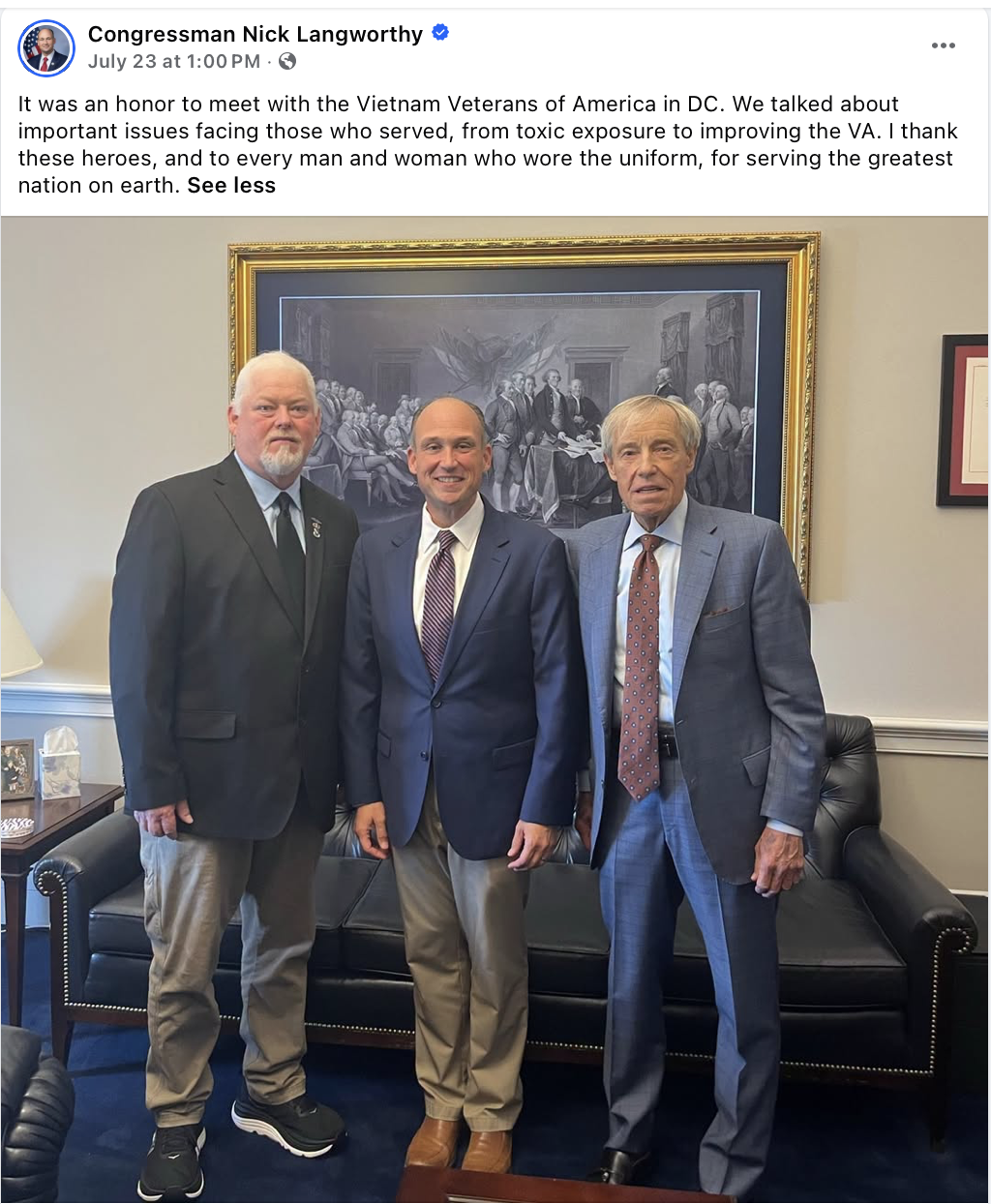
Facebook, verified official page, July 23, 2026. The post is login-walled and has no Wayback capture; this screenshot is the preservation artifact.
A clarification that cuts in his favor: Vietnam Veterans of America backed H.R. 9237. VVA is a named signatory to the June 29, 2026 letter of support signed by more than twenty organizations, which told the committee chairmen: “we express our support for S. 4744 and H.R. 9237… and urge Congress to continue advancing this critical legislation.” It would be false to suggest he met with VVA and then voted against their position on that bill. The groups opposing Section 108 were DAV, VFW, IAVA and others.
Two limits on that clarification, in fairness to both sides. The letter was signed before the July floor action, and VVA issued no statement after it; and the letter itself calls the support conditional, saying that legislating rating-schedule changes “is not an approach we would support” under ordinary circumstances. VVA’s own website carries nothing on the bill — its numbered releases run 26-13, 26-14, 26-15 with no H.R. 9237 item — so the signed coalition letter is the source, not a VVA release.
What Is Still Unaddressed
| Question | Status |
|---|---|
| Why he voted against all seven war powers resolutions, five on Iran and two on Lebanon | No public explanation; no floor remarks located |
| Whether he believes an AUMF is required for Operation Epic Fury | No statement |
| Whether the wounded count is accurate | Senate response due Jul. 30, 2026 |
| Whether casualties since July 6 are being counted under a separate operation | Asked by 12 senators (Question 3); unanswered |
| Whether the administration considers the July fighting a new operation for War Powers purposes | No statement from the administration or from Langworthy |
| How many TBI screenings and diagnoses have occurred in this operation | Asked by 12 senators; unanswered |
| Why VA cancelled VASP before its replacement existed | VA did not respond to NPR’s questions |
| How many NY-23 veterans lost homes in the 13-month gap | No district-level figure published |
| Whether he supports the fee increases in §104(b) given the foreclosure rate | No statement |
| How many Bath VA employees were dismissed in Feb. 2025 | VA has said only “a small number” |
| Whether VA facilities in NY-23 are operating under FTE caps today | Not disclosed at facility level |
| Why no veterans communication was issued May–July 2026 | Unexplained |
| Whether he has raised the casualty-reporting discrepancy in the Oversight Committee | No hearing request, committee letter, or statement located |
| Whether he has raised VA staffing caps or the claims backlog in Oversight | None located |
| Whether he will sign the discharge petition on the Major Richard Star Act | Has not signed; 215 of 218 signatures |
| CBO score for H.R. 9237 | None located; the bill’s record shows no markup and no committee report |
Editorial status at publication. This entry was published on July 29, 2026 with three items still open, and we would rather say so than leave the impression they are settled. A request for comment had not yet been sent to Rep. Langworthy’s office on the war powers votes, the seven H.R. 9237 votes, the §104(b) fee increases against the foreclosure rate, or the May–July 2026 communication gap; if the office responds, this entry will be updated to carry it. The Senate casualty-reporting response is due July 30, 2026 and could change the killed and wounded figures in Section B. The 10,000 foreclosure count is ICE Mortgage Technology data reported by NPR on April 2, 2026, the most recent public cumulative figure; the next refresh point is the Mortgage Bankers Association’s Q2 2026 survey in mid-August.
A Note on What the Record Does — and Doesn’t — Show
Documented:
- Seven votes against war powers resolutions to end hostilities Congress never authorized — five on Iran, two on Lebanon. Two of the Iran measures passed the House anyway, and one passed the Senate as well.
- The Pentagon’s published wounded count fell while officials described roughly 100 new injuries; twelve senators, including New York’s, have formally questioned it.
- The Defense Department’s own Inspector General found TBI reporting failures after the last Iran strike and warned they could cost service members VA benefits.
- Seven votes preserving offsets that tighten future disability ratings for sleep apnea and tinnitus and raise two VA home loan fees; the decisive motion failed by one vote.
- VASP was rescinded effective May 1, 2025, after the mortgage industry warned a House committee in March 2025 that the result would be “foreclosure”; the replacement Congress authorized in July 2025 did not launch until June 15, 2026.
- More than 10,000 veterans lost homes to foreclosure in that window, the highest pace for VA loans in a decade, with roughly 90,000 more behind or in the foreclosure process.
- ~2,400 VA probationary employees dismissed in February 2025; vacancies then left unfilled by policy; 1,102 fewer VBA claims examiners; 67,849 claims beyond 125 days.
- VA research staffing down 5.1% in the FY2027 request, following a ~3% decline.
Not documented, and not claimed:
- Any PACT Act vote by Langworthy. He was not in Congress.
- Any cut to toxic exposure funding. It rose, and he voted for the increase.
- Any cut to VA research in the bill the House passed. The House passed $996 million, above FY2026, and he voted for it. The cut is in the President’s request.
- Any cancellation of burn-pit or PACT Act research.
- Any mass firing of VA employees after February 2025. The later decline is attrition plus unfilled vacancies.
- Any Inspector General or GAO finding of casualty undercounting in the current operation. That question is open.
- Any NY-23 facility closure. The Bath VA story is February 2025 and carries no published number.
- Any Langworthy vote on the VASP replacement. H.R. 1815 passed both chambers by voice vote; no recorded vote exists for anyone. He is not a cosponsor, and neither is any other member — the bill was introduced with zero.
- Any refreshed foreclosure count. The 10,000 figure is dated April 2, 2026, and no newer public cumulative number exists; MBA’s Q1 2026 survey corroborates the direction, not that specific figure.
- Any claim that 10,000 foreclosures were caused by the VASP shutdown. NPR states it is unclear how many could have been prevented, and we adopt that limit.
- Any claim that the §104(b) fee increase raises costs for disabled veterans. Veterans receiving service-connected disability compensation are exempt from VA loan fees, and the bill does not change that.
On fairness: none of these votes is unusual for a member of his party, and several — the toxic exposure increase, the research funding the House passed, his original cosponsorship of the Major Richard Star Act — cut against the simple story. The home loan collapse is not his doing in any votable sense, and its origins predate this administration. What this page documents is the accumulation: a war he voted five times to continue and that was declared over while it continued, a casualty count under formal question, a rating change aimed squarely at the people fighting it, a foreclosure backstop removed thirteen months before its replacement arrived, a claims workforce shrinking by policy, and a research budget request that would slow the proof of the next generation’s injuries. And no public explanation of any of it.
Verdict: DOCUMENTED PATTERN
The United States is producing new veterans in an operation Congress has twice voted to end and never authorized [three times as of September 15, 2026 — see the update below] — one the administration told Congress was “terminated” in May while the strikes went on, under a label a Republican member calls an “absurd ruse.” The count of who is being hurt in it is formally disputed by twelve senators, and the Pentagon’s own published numbers went down, taking a New York soldier’s name off the list. The disability ratings those service members will one day claim under are the ones H.R. 9237 would tighten, and Langworthy voted seven times to keep that provision alive, including on a motion that failed by a single vote. The mortgage backstop that keeps veterans in their homes was cancelled thirteen months before its replacement opened, and VA-loan foreclosures ran at their highest rate in a decade in the gap. The VA workforce that will process their claims is smaller by policy, and the research that would prove what this war did to them is budgeted to shrink again.
And he sits on the committee that investigates exactly this. A majority member of House Oversight, at a moment when a federal department’s own casualty database contradicts its own spokesman, has tools that twelve senators in the minority do not: hearings, subpoenas, witnesses under oath. He has used committee power decisively before, sponsoring and floor-managing an omnibus rule that closed six bills to amendment. On this, we found no hearing request, no committee letter, and no public statement.
Rep. Langworthy voted to increase toxic exposure funding and for the appropriations bill that raised VA research above last year’s level. He has said nothing publicly about any of the rest.
Update — September 17, 2026: An Eighth War Powers Vote, a Price Tag, and “Not Technically a War”
Three things happened after this entry was published that bear on it directly. Two are new records; one is a claim now circulating that this entry should address precisely, because the popular version of it is wrong.
1. An eighth vote, and the third one to pass
On September 15, 2026, the House adopted H.Con.Res. 93 (Rep. Seth Moulton, D-MA-6), directing the President under §5(c) of the War Powers Resolution to remove U.S. forces from hostilities against Iran. It passed 220–204. Langworthy voted Nay.
| Roll call | Date | Measure | Result | His vote |
|---|---|---|---|---|
| 307 | Sep. 15, 2026 | H.Con.Res. 93 (Iran) | PASSED 220–204 | Nay |
That makes eight war powers votes in this series — six on Iran, two on Lebanon — and Langworthy has voted No on every one. It is the third to pass the House, after H.Con.Res. 86 and H.Con.Res. 89. So the sentence in the verdict below should now read that Congress has voted three times to end this operation.
The context that matters for reading this fairly: Roll 307 was close to a party-line vote. Seven Republicans voted yes — Barrett (MI), Davidson (OH), Fitzpatrick (PA), Mace (SC), Massie (KY), Miller-Meeks (IA) and Nunn (IA) — and all seven New York Republicans voted no: Garbarino, LaLota, Langworthy, Lawler, Malliotakis, Stefanik and Tenney. On this vote Langworthy is not an outlier in his conference or his state delegation. What remains specific to him, and unchanged since July, is the absence of any explanation.
The resolution was debated for one hour on September 14 under a unanimous-consent order controlled by Reps. Mast and Moulton. On the voice vote the Chair announced the noes had prevailed; Moulton demanded the yeas and nays, and the recorded vote came the next evening. Langworthy made no remarks in that debate. His name appears in the September 14 Congressional Record only in vote tallies and in one Extension of Remarks — a tribute honoring Six Nations Cemetery in the Town of Orange, Schuyler County, submitted the same day. His office issued no press release on the resolution.
2. CBO has now priced the war, and says DoD would not answer its questions
On September 15, 2026 — the same day as the vote — the Congressional Budget Office published “Estimating the Cost of Combat Operations Against Iran,” a letter to House Budget Committee Ranking Member Brendan F. Boyle. Its findings:
- The conflict has cost the Department of Defense approximately $38 billion as of August 1, 2026, and CBO notes that “less intense combat operations are still ongoing.”
- Each additional month costs $2 billion at the level of violence seen in May and June, or $3 billion at July’s intensity.
- Replacing expended munitions is the single largest component at $21.7 billion — $13.1 billion of it missile defense interceptors, $7.3 billion land-attack cruise missiles.
- The United States “has probably used between one-half and two-thirds of its inventory” of missile defense interceptors since June 2025, and rebuilding that inventory “would probably take at least five years.”
- “DoD did not respond to CBO’s requests for information.” CBO states this twice, and says its estimates are “subject to considerable uncertainty” as a result.
Two cautions on how these numbers should be used. CBO warns that its categories “are not directly comparable or summable.” And the $38 billion is a Defense Department figure only.
The exclusion is the part that belongs in this entry. CBO writes that its analysis “does not assign financial costs to U.S. military personnel killed or injured in the conflict, nor does it include longer-term costs associated with future increases in outlays for veterans’ health care and disability compensation.” The price tag now being quoted in the press leaves out precisely the costs this entry documents — the claims, the ratings, the research, and the workforce that will process them.
CBO also found the conflict has raised energy prices, and through them consumer prices generally. That analysis is treated separately from this entry.
3. “Not technically a war” — what is true, and what is not
A claim is circulating that service members’ families are being denied benefits because Congress never declared war. The documented case is narrower than that, and the correction is on the record.
What happened. Maj. John “Alex” Klinner, 33, was one of six crew members killed when a KC-135 refueling aircraft crashed in western Iraq in March 2026 while supporting operations against Iran. His widow, Libby Klinner, posted that the Air Force had told her she was ineligible for additional combat-related benefits because Congress had not declared war. She told the Associated Press: “My husband lost his life because we’re in a war, and then I was told that because it’s not technically a war, we lose out on something… It all comes down to principle.”
What followed. After the post circulated widely, the Air Force acknowledged that the information she had been given was inaccurate. Her husband’s final paycheck had already included — but had incorrectly itemized — the $225 per month combat-related hazard pay and the associated tax exclusion. That pay is not conditioned on a declaration of war; it turns on service in an area of grave danger of physical injury, or on being killed or wounded by hostile fire. Asked about the case at a White House briefing, Vice President Vance said, “We want to be as helpful as we can and ensure she gets everything that she is entitled to,” and in the same appearance declined to call the conflict a war, saying there was “no active shooting.” The President said: “A lot of people don’t call it a war. I call it a military conflict, because it’s small potatoes for us.”
So the accurate statement is this: a Gold Star family was given the wrong answer, and the wrong answer came out of the same terminological dispute this entry documents in Section B. It was corrected after it became public. It was not a policy of denying benefits.
And on VA benefits specifically, the premise does not hold at all. Under 38 U.S.C. §101(11), a “period of war” includes the Persian Gulf War, which §101(33) defines as beginning August 2, 1990 and ending “on the date thereafter prescribed by Presidential proclamation or by law.” No such proclamation or law has ever been issued. Service today therefore already falls within a statutory period of war for VA purposes, and VA benefits that depend on wartime service do not require a new declaration. Anyone repeating the broader version of this claim is overstating it.
What is genuinely unresolved is the question this entry raised in Section B and that the twelve senators’ July 23 letter raised: how casualties and injuries in this operation are being classified and counted. Families have accused the Pentagon of not treating injuries as combat casualties. The Army denies it. That dispute is live, and this site does not resolve it here.
Sources added in this update
- U.S. House Clerk, Roll Call 307, Sep. 15, 2026: https://clerk.house.gov/evs/2026/roll307.xml (archived)
- U.S. House Clerk, floor proceedings for Sep. 14–16, 2026: https://clerk.house.gov/floorsummary/HDoc-119-2-FloorProceedings.xml
- govinfo BILLSTATUS, H.Con.Res. 93 (119th Congress): https://www.govinfo.gov/bulkdata/BILLSTATUS/119/hconres/BILLSTATUS-119hconres93.xml
- Congressional Record, Sep. 14, 2026, Extensions of Remarks E903 (Six Nations Cemetery): https://www.govinfo.gov/content/pkg/CREC-2026-09-14/html/CREC-2026-09-14-pt1-PgE903-4.htm
- Congressional Budget Office, “Estimating the Cost of Combat Operations Against Iran,” Sep. 15, 2026: https://www.cbo.gov/publication/62756 (archived) (PDF: https://www.cbo.gov/system/files/2026-09/62756-Iran.pdf)
- 38 U.S.C. §101 (definitions of “period of war” and “Persian Gulf War”): https://uscode.house.gov/view.xhtml?req=granuleid:USC-prelim-title38-section101&num=0&edition=prelim (archived)
- The Jerusalem Post, “US Air Force widow initially denied benefits because Iran conflict ’not technically a war’”: https://www.jpost.com/international/article-907840 (archived)
- The Telegraph (via AOL), “Pentagon refused payout for soldiers who died in Iran conflict ‘because it isn’t a war’”: https://www.aol.com/articles/pentagon-refuses-payout-soldiers-died-135214000.html
A note on archiving these sources. The CBO report page and PDF, House Clerk Roll Call 307, 38 U.S.C. §101 and the Jerusalem Post article were captured to the Wayback Machine and verified by playback on September 17, 2026. Four could not be: the two EIA price series (the only captures predate the September 2026 figures cited here), the Congressional Record page E903, and the Telegraph article as syndicated. Save Page Now was rate-limiting at the time of writing. The full retrieved text of every source above is retained in the repository at research/sources/iran-cost-2026-09-17/, and the EIA figures were re-derived from those retained tables before publication.
Update compiled September 17, 2026. Retained source text: research/sources/iran-cost-2026-09-17/.
Related Entries
- On H.R. 9237, His Rules Vote Kept Off the Floor the Amendment That Would Have Dropped the Veterans’ Benefit Cuts
- VA Rural Impact Summary
- Rules Committee Gatekeeper Pattern
- Missed Votes
Sources
- House Clerk roll call XML, rolls 85, 114, 170, 199, 201, 232, 282 (2026): https://clerk.house.gov/evs/2026/
- U.S. Department of War, “Operation Epic Fury” spotlight (start date; Jul. 13, 2026 strike-wave news item): https://www.war.gov/Spotlights/Operation-Epic-Fury/
- Jack Goldsmith, “Trump’s Interpretation of the War Powers Resolution Is Wrong But Not Crazy,” Executive Functions, May 4, 2026: https://www.execfunctions.org/p/trumps-interpretation-of-the-war
- Tess Bridgeman and Oona A. Hathaway, “At the 60-Day Mark, the Iran War is Triply Illegal,” Just Security, May 1, 2026: https://www.justsecurity.org/137669/60-day-mark-iran-war-triply-illegal/
- U.S. Senate Roll Call Vote 184, Jun. 23, 2026 (H.Con.Res. 86): https://www.senate.gov/legislative/LIS/roll_call_votes/vote1192/vote_119_2_00184.htm
- U.S. Senate Roll Call Vote 207, Jul. 23, 2026 (motion to discharge S.J.Res. 180, rejected 47-49): https://www.senate.gov/legislative/LIS/roll_call_votes/vote1192/vote_119_2_00207.htm
- ABC News, “Pentagon lowers count of Iran war dead and wounded, sparking questions and outrage,” Steven Beynon and Luis Martinez, Jul. 24, 2026: https://abcnews.go.com/Politics/pentagon-lowers-count-iran-war-dead-wounded-sparking/story?id=125421887
- Congressional Record, Jul. 22, 2026, H5160-H5165 (House debate on H.Con.Res. 89; Meeks and Jayapal remarks at H5162): https://www.govinfo.gov/content/pkg/CREC-2026-07-22/html/CREC-2026-07-22-pt1-PgH5160-6.htm
- VA, FY2025 Annual Benefits Report (service-connected disability totals as of Sept. 30, 2025): https://www.benefits.va.gov/REPORTS/abr/
- 38 C.F.R. Part 4, current rating schedule (DC 6847 sleep apnea, DC 6260 tinnitus): https://www.ecfr.gov/current/title-38/chapter-I/part-4
- VSO letter of support for H.R. 9237, Jun. 29, 2026 (signatories incl. VVA, MOAA, AMVETS, TAPS): https://www.legion.org/getmedia/55ca767e-ba69-4845-8967-99f8faa7fd45/Take-Care-of-Americas-Veterans-Act_VSO-Letter-of-Support_June-29-2026-v2.pdf
- VA OIG Report 25-01135-196, Aug. 12, 2025 (full PDF): https://www.vaoig.gov/sites/default/files/reports/2025-08/vaoig-25-01135-196-final.pdf
- Letter from 12 U.S. Senators to Secretary of Defense Hegseth on casualty reporting, Jul. 23, 2026: https://www.hirono.senate.gov/imo/media/doc/senator_hirono_iran_oefu_casualty_reporting_letter_f9smy2742sbw.pdf
- ABC News, “Pentagon lowers count of Iran war dead and wounded, sparking questions and outrage,” Steven Beynon and Luis Martinez, Jul. 24, 2026
- DoD Inspector General, DODIG-2022-006, “Evaluation of Traumatic Brain Injuries in the U.S. Central Command Area of Responsibility,” Nov. 3, 2021: https://www.dodig.mil/
- H.R. 9237 as introduced: https://www.govinfo.gov/content/pkg/BILLS-119hr9237ih/html/BILLS-119hr9237ih.htm
- House Rules Committee record votes: https://rules.house.gov/bill/119/hr-9237
- H. Rept. 119-622 (FY2027 MilCon-VA): https://www.govinfo.gov/content/pkg/CRPT-119hrpt622/pdf/CRPT-119hrpt622.pdf
- VA, “VA dismisses more than 1,000 employees,” Feb. 13, 2025: https://news.va.gov/press-room/va-dismisses-more-than-1000-employees/
- VA, “VA dismisses more than 1,400 probationary employees,” Feb. 24, 2025: https://news.va.gov/press-room/va-dismisses-more-than-1400-probationary-employees/
- Senate Veterans’ Affairs Committee minority report, “Breaking the PACT,” Jan. 22, 2026: https://www.veterans.senate.gov/services/files/A08A4C86-DB56-4A01-B98F-6ED1CF3F2B7A
- Secretary Collins’ response to Sen. Blumenthal on research staffing, Nov. 25, 2025: https://www.veterans.senate.gov/services/files/59B1A8A6-26A6-44ED-8138-BB57C8A1E87B
- Senate Appropriations MilCon-VA hearing on the FY2027 VA budget request, Apr. 30, 2026 (official committee video; no printed transcript published): https://www.appropriations.senate.gov/hearings/a-review-of-the-presidents-fiscal-year-2027-budget-request-for-the-department-of-veterans-affairs
- Testimony of Dr. Glenn D. Graham, Senate Veterans’ Affairs Committee, Jul. 22, 2026: https://www.veterans.senate.gov/services/files/E0CFC10F-54D2-48E4-90BE-73A9F4268669
- Letter of Sens. Blumenthal, Murray and Gallego to Secretary Collins, Jul. 18, 2025: https://www.murray.senate.gov/wp-content/uploads/2025/07/2025-07-18-Letter-to-SecVA-re-Research.pdf
- VA Workforce Dashboard: https://department.va.gov/employees/va-workforce-dashboard/
- VBA Monday Morning Workload Report, Jul. 18, 2026: https://www.benefits.va.gov/REPORTS/mmwr/2026/MMWR-07-18-2026.xlsx
- VA OIG Report 25-01135-196, Aug. 12, 2025
- VA FY2027 Budget in Brief: https://department.va.gov/wp-content/uploads/2026/04/2027-BiB.pdf
- Mortgage Bankers Association, “Mortgage Delinquencies Increase in the First Quarter of 2026,” May 14, 2026: https://www.mba.org/news-and-research/newsroom/news/2026/05/14/mortgage-delinquencies-increase-in-the-first-quarter-of-2026
- VA, Partial Claims Program and Loss Mitigation Waterfall FAQs for Servicers, updated Jun. 16, 2026: https://www.benefits.va.gov/HOMELOANS/partial-claims-servicer-faqs.asp
- VA Circular 26-25-2, “Veterans Affairs Servicing Purchase (VASP) Program Wind Down,” Apr. 23, 2025: https://www.benefits.va.gov/HOMELOANS/documents/circulars/26-25-02.pdf
- NPR, “Trump’s VA killed a home loan program. Vets are now losing their homes because of it,” Chris Arnold and Quil Lawrence, Apr. 2, 2026: https://www.npr.org/2026/04/02/nx-s1-5750814/veterans-mortgages-foreclosure-va-rescue
- govinfo BILLSTATUS, H.R. 1815 (119th Congress), enacted as P.L. 119-31: https://www.govinfo.gov/bulkdata/BILLSTATUS/119/hr/BILLSTATUS-119hr1815.xml
- VA, “VA launches Partial Claim Program to help Veterans avoid home foreclosure,” Jun. 15, 2026: https://news.va.gov/press-room/va-launches-partial-claim-program-to-help-veterans-avoid-home-foreclosure/
- 38 U.S.C. §3729 (loan fee table and waiver): https://uscode.house.gov/view.xhtml?req=granuleid:USC-prelim-title38-section3729&num=0&edition=prelim
- Langworthy on WLEA, May 24, 2026: https://wlea.net/langworthys-memorial-day-thoughts/
All data from public primary sources. Disability rating comparisons are against 38 C.F.R. Part 4 as currently in force. Where a figure comes from a partisan committee report or an advocacy organization, it is identified as such. Methodology available on request.