Fracking, Explained: What New York Banned, What Pennsylvania Got, and What It Cost. Checked Against His Claim That the Border Counties Are 'East and West Berlin.'
Why this matters
The Southern Tier sits on the northern edge of the Marcellus Shale, the formation that made Pennsylvania the country’s second-largest natural gas producer. New York has not allowed the drilling method that unlocked it. That difference is now a campaign issue: the Republican nominee for governor says he will overturn the ban, the EPA administrator came to upstate New York in June to urge the same, and Rep. Langworthy has made the comparison with Pennsylvania a theme of his energy messaging for two years.
In December 2024 he wrote that Pennsylvania “transformed its rural economies,” that drilling there led to “growing populations,” and that the difference between the border counties “have often been likened to East and West Berlin.” In October 2026 his campaign page captioned a debate clip: “Pennsylvania prospers. Our great state suffers.”
This entry explains what fracking is, what New York banned and when, and then lets the Pennsylvania record speak: production, money, jobs, population, prices, and the health and regulatory findings Pennsylvania’s own institutions have published. The border-county numbers are the test of his claim.
What he has said
Source: Op-ed, The Post-Journal, December 21, 2024:
“While Pennsylvania has embraced energy development and transformed its rural economies, creating jobs and opportunities for working families, New York’s Democrat-led state government has shut the door on this desperately needed economic opportunity for our struggling region. Pennsylvania, and many other parts of the US have been safely extracting natural gas for years, but in 2014, a politicized health department and a governor who was desperate to appease the radicals on his left, issued a bogus, pre-determined study to give them cover for a ban. … We’ve had to stand by and watch while our neighbors in Pennsylvania harnessed this resource to revitalize entire communities, leading to new businesses and growing populations. The difference between the border counties of New York and Pennsylvania have often been likened to East and West Berlin.”
Source: Campaign Facebook page, October 14, 2026, captioning a clip of the Republican nominee for governor:
“Pennsylvania drills for natural gas, creates jobs, grows its economy, and enjoys cheaper energy. Right across the border, all along NY23 that I represent. Kathy Hochul bans it. … Pennsylvania prospers. Our great state suffers.”
The claim that Gov. Hochul banned fracking was rated FALSE ATTRIBUTION in an earlier entry; the ban predates her. The claims checked here are the ones about what happened in Pennsylvania.
Part 1: What fracking is, and what New York banned
The method. Shale gas sits in rock too tight to flow on its own. Operators drill down a mile or more, turn the bore horizontal for thousands of feet, then pump water, sand and chemical additives in at high pressure to crack the rock and prop the fractures open. “High-volume hydraulic fracturing,” the term in New York law, means a well using 300,000 gallons of water or more. A single Marcellus well typically uses millions.
The timeline in New York.
- 2008. The Department of Environmental Conservation begins a supplemental environmental review of high-volume fracturing and issues no high-volume permits while it runs.
- December 2014. The Department of Health completes a public health review. Its conclusion, in the acting commissioner’s words: “the overall weight of the evidence from the cumulative body of information contained in this Public Health Review demonstrates that there are significant uncertainties about the kinds of adverse health outcomes that may be associated with HVHF, the likelihood of the occurrence of adverse health outcomes, and the effectiveness of some of the mitigation measures in reducing or preventing environmental impacts which could adversely affect public health. Until the science provides sufficient information to determine the level of risk to public health from HVHF to all New Yorkers and whether the risks can be adequately managed, DOH recommends that HVHF should not proceed in NYS.”
- June 2015. The Department of Environmental Conservation issues its findings statement: high-volume hydraulic fracturing “will be prohibited in New York State.”
- April 2020. The Legislature writes the prohibition into statute in the state budget, Environmental Conservation Law section 23-0501(3).
- December 21, 2024. After a Texas company, Southern Tier Solutions, mailed lease offers to landowners in Tioga, Broome and Chemung counties proposing to fracture the shale with liquid carbon dioxide instead of water, Gov. Hochul signs a bill adding “and carbon dioxide” to the ban.
What is not banned. Conventional, low-volume drilling remains legal. As the earlier entry documented from state well records, the DEC issued 52 oil-well development permits in 2024 and 58 in 2025. New York still produces gas from older wells, about 8.8 billion cubic feet in 2025, down from a peak of 56 billion in 2006.
What lifting the ban would take. Because the prohibition is in statute, a governor cannot lift it alone. It would take a bill passed by both houses of the Legislature and signed by the governor, followed by new DEC rules and permits. Gov. Hochul said in June 2026: “I don’t have any guarantee that the technology has gotten any better or more secure. I’ve not seen that.”
Part 2: What Pennsylvania got
Production. In 2008 Pennsylvania produced 198 billion cubic feet of gas. In 2019 it produced 6,897 billion. In 2025, 7,676 billion, about 16 percent of all the gas produced in the United States and roughly 870 times what New York produced. Output has been flat since 2020, moving between 7.2 and 7.7 trillion cubic feet a year; the state’s utility commission attributes the year-to-year swing in new wells to the price of gas.
Money to governments. Pennsylvania does not tax gas production. It charges a per-well impact fee under its 2012 drilling law. For 2025 the Public Utility Commission distributed $243.9 million, of which $133.8 million went to the counties and municipalities where drilling happens and $89.2 million to a statewide environmental fund. The cumulative total since 2012 is $3.12 billion. The 2025 figure was $79 million higher than 2024 because operators drilled 444 new wells instead of 309 and the gas price rose from $2.27 to $3.43 per million BTU. The fee rises and falls with the market.
Jobs. The Bureau of Labor Statistics counts, for 2024, 3,311 private jobs in oil and gas extraction in Pennsylvania, 1,021 in drilling wells, and 6,848 in support activities for oil and gas operations, about 11,200 in all, at average pay between $100,000 and $144,000. That is about two-tenths of one percent of the state’s 6.0 million jobs. Industry-funded studies produce far larger numbers by counting pipeline construction, trucking, suppliers, and the spending of workers’ wages. A Penn State economist who co-authored a 2016 study of the industry’s employment told WHYY in 2024 that “typically anything over [twice] the number of direct jobs is looked at as unreasonable by economists who do this type of economic impact analysis.” The 11,200 figure is the direct count. New York’s equivalent is 565.
Prices. The earlier entry reported federal data for 2025: residential natural gas cost $17.58 per thousand cubic feet in New York and $15.04 in Pennsylvania, and residential electricity 26.39 cents per kilowatt-hour against 19.30. Pennsylvania’s energy is cheaper. How much of the gap is drilling, how much is New York City’s utility rates, taxes, and delivery costs, the data do not say; the same entry found the gap for the utilities serving NY-23 was 6 to 25 percent, not 37.
Landowners. Royalty payments to Pennsylvania landowners who leased their mineral rights are private and not reported in aggregate by the state; they are real income for the families who hold leases and are not quantified here.
Part 3: The border counties, side by side
Rep. Langworthy’s claim is specifically about the counties on either side of the line. Here they are, using the Census Bureau’s population estimates and the Bureau of Labor Statistics’ county employment files. Bradford, Susquehanna and Tioga counties in Pennsylvania are among the most heavily drilled in the state and sit directly across the border from Chemung, Steuben and Tioga counties in New York.
Population, 2010 to 2024
| County | 2010 | 2024 | Change |
|---|---|---|---|
| Bradford, Pa. | 62,700 | 59,699 | -4.8% |
| Susquehanna, Pa. | 43,318 | 38,100 | -12.0% |
| Tioga, Pa. | 41,931 | 40,698 | -2.9% |
| Chemung, N.Y. | 88,846 | 81,115 | -8.7% |
| Steuben, N.Y. | 98,946 | 92,015 | -7.0% |
| Tioga, N.Y. | 51,052 | 47,574 | -6.8% |
| Potter, Pa. | 17,445 | 15,993 | -8.3% |
| McKean, Pa. | 43,463 | 39,478 | -9.2% |
| Allegany, N.Y. | 48,923 | 47,299 | -3.3% |
| Cattaraugus, N.Y. | 80,337 | 75,475 | -6.1% |
| Chautauqua, N.Y. | 134,907 | 124,105 | -8.0% |
Every county on both sides lost population. The steepest loss in the table is Susquehanna County, Pennsylvania, home of the Dimock gas field, at 12 percent.
Private-sector jobs and average pay, 2014 to 2024
| County | Jobs 2014 | Jobs 2024 | Change | Avg. pay 2024 |
|---|---|---|---|---|
| Bradford, Pa. | 21,439 | 19,525 | -8.9% | $60,899 |
| Susquehanna, Pa. | 7,377 | 7,149 | -3.1% | $49,991 |
| Tioga, Pa. | 10,592 | 10,273 | -3.0% | $50,266 |
| Chemung, N.Y. | 30,700 | 27,562 | -10.2% | $58,195 |
| Steuben, N.Y. | 29,370 | 27,133 | -7.6% | $74,444 |
| Tioga, N.Y. | 10,081 | 10,496 | +4.1% | $69,400 |
| McKean, Pa. | 13,364 | 11,670 | -12.7% | $49,327 |
| Warren, Pa. | 13,015 | 10,996 | -15.5% | $51,022 |
| Cattaraugus, N.Y. | 20,122 | 18,724 | -6.9% | $51,655 |
| Chautauqua, N.Y. | 40,743 | 37,294 | -8.5% | $49,455 |
The 2014 baseline comes after the first years of the drilling boom, so this table does not capture the boom itself; it shows where the counties stand now. On that measure the two sides of the border are indistinguishable. The three New York counties directly across from the gas fields have higher average pay than their Pennsylvania neighbors, and Tioga County, New York, is the only county in the table that added jobs. County-level gas-industry employment is suppressed in the federal data for most of these counties to protect employer confidentiality, so the direct drilling jobs cannot be separated out at the county level.
In plain language: the numbers do not show a Pennsylvania side that grew and a New York side that emptied. Both sides shrank at about the same rate, and the New York counties across from the gas fields pay more.
Part 4: What it cost
The state’s own grand jury. In June 2020, after a two-year investigation, Pennsylvania’s 43rd Statewide Investigating Grand Jury issued a 235-page report on the unconventional gas industry and the agencies that regulate it. On the Department of Health: “our government – including its Department of Health (DOH) – does not recognize that fracking operations harm public health, citing insufficient research on the issue. However, the absence of such research, at least in part, is due to DOH’s own failure to inquire into the matter over the past decade. This ‘wait and see’ approach facilitates placing the health risks of the shale gas industry’s operations on everyday Pennsylvanians. We find this status quo unacceptable.” The jurors made eight recommendations. The first: “The closer people happen to live to a massive, industrial drilling complex, the worse it is likely to be for them,” and the legal minimum distance from a home, 500 feet, “just isn’t high enough.” It recommended 2,500 feet, and 5,000 from schools and hospitals. The second: “Stop the Chemical Cover-up,” because “under existing law, the oil and gas companies don’t have to say what chemicals they are using until after they have already used them.” The attorney general who convened it, Josh Shapiro, is now Pennsylvania’s governor.
Dimock. In Susquehanna County, methane from Cabot Oil & Gas wells migrated into residents’ water wells; one exploded in January 2009. The company long denied wrongdoing. On November 29, 2022, its successor, Coterra Energy, pleaded no contest to environmental crimes and agreed to pay $16.29 million for a public water line and 75 years of residents’ water bills.
The health studies. In August 2023 the University of Pittsburgh released three studies commissioned by Pennsylvania’s Department of Health, covering eight southwestern counties and health records from 2010 to 2020. As summarized in DEP’s own review of the findings: children living within one mile of a well had “approximately 5 to 7 x chance of developing lymphoma compared with unexposed (>5 miles) children,” with no association found for leukemia, brain or bone cancers; people with asthma had a “4-5 x greater chance of asthma attack if within 10 miles” during the production phase, with “no such link during well preparation, drilling or fracking phases”; and babies born to mothers living near producing wells were about one ounce smaller, an effect the reviewers said “in most cases, poses little health risk.” These are statistical associations from observational studies. DEP’s reviewers listed the “specific cause(s) of correlations” as an open question, and the studies do not claim to have answered it.
The wells left behind. The Department of Environmental Protection estimates that “hundreds of thousands of oil and gas wells have been drilled in Pennsylvania since 1859” and that abandoned and orphan wells “pose a risk to environmental and human health, including the potential for methane leaks, migration, and water contamination.” Most predate fracking; the shale wells now being drilled will join them when they stop producing.
Checking the claims
| Claim | What the record shows | Verdict |
|---|---|---|
| Pennsylvania “transformed its rural economies, creating jobs” | About 11,200 direct gas-industry jobs statewide in 2024; $3.12 billion in impact fees since 2012; private employment in the border counties fell 3 to 16 percent from 2014 to 2024, the same as New York’s | MISSING CONTEXT |
| Drilling led to “growing populations” | Every Pennsylvania border county lost population from 2010 to 2024; Susquehanna lost 12 percent | FALSE |
| The border counties are “East and West Berlin” | Population loss and job loss are the same on both sides; the New York counties across from the gas fields have higher average pay | NOT SUPPORTED |
| The 2014 health review was “a bogus, pre-determined study” | The review’s conclusion is quoted above; he offers no evidence of predetermination; Pennsylvania’s grand jury and the 2023 Pittsburgh studies found the health concerns it cited were not imaginary | NOT SUPPORTED |
| Pennsylvania “enjoys cheaper energy” | Federal data confirm lower gas and electricity prices | TRUE |
| The region “sits atop the vast Marcellus Shale” | The Marcellus extends into the Southern Tier; the U.S. Geological Survey’s 2011 assessment put the formation’s undiscovered gas at a mean of 84 trillion cubic feet across six states | TRUE |
The fair reading
Pennsylvania’s gas is real, large, and cheap, and it has paid for things: a quarter-billion dollars a year to local governments and state programs, more than 11,000 direct jobs at good wages, royalties to the families who leased, and lower utility bills across the state. The health findings are associations in observational studies, not proof, and the industry disputes them. The grand jury’s harshest findings were about regulators, not drillers, and the drilling went on. Nothing in the record says New York’s economy would not have gained something from the same industry.
What the record does not support is the picture he painted. The Pennsylvania counties across the border from NY-23 did not grow; they shrank faster than some of their New York neighbors. Their job counts fell at the same rate. Their average pay is lower. The drilling jobs the industry created are a fraction of one percent of Pennsylvania’s workforce. And the study he called bogus reached the same place Pennsylvania’s own grand jury and health department researchers reached years later: that the risks to people living near wells were real enough to warrant distance and disclosure, which Pennsylvania still has not fully required.
The honest version of the comparison is this: Pennsylvania chose the gas and its costs, New York chose neither, and the border counties on both sides are losing people either way.
Update, November 1, 2026: the New York Post repeats the claim, and he shares it
On October 29 the New York Post’s editorial board endorsed the state’s Republican House incumbents. Its paragraph on Rep. Langworthy:
“Nick Langworthy, repping the Southern Tier and the Buffalo suburbs in the 23rd CD, backs strong immigration enforcement and US energy independence. He’s rightly a relentless critic of Gov. Kathy Hochul’s feckless economic policies, not least the foolish ban on fracking, a technique that has enriched next-door counties in Pennsylvania.”
His campaign page posted the paragraph as a graphic on October 30 with the caption: “I’m proud to earn the endorsement from the New York Post. I’ll never stop fighting for secure borders, American energy independence, and an economy that respects hardworking New Yorkers. While Kathy Hochul holds our state back, I’ll keep fighting to move us forward.”
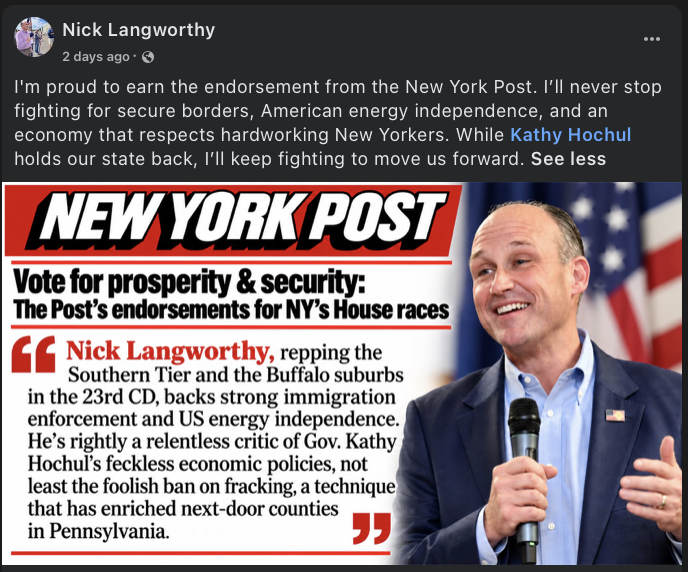
The campaign-page post, captured November 1, 2026.
Four days earlier, on October 27, the official office page had posted a Politico clip of Gov. Hochul saying of Pennsylvania’s governor, “He doesn’t have a law banning it, does he?” and “Tell that to the legislature,” captioned as her “trying to pass the buck & blame the legislature.” That post is documented, with the transcript, in the October 15 entry’s update.
Two points from the record above. First, the ban is not Gov. Hochul’s; it was imposed by the state’s health and environmental agencies in 2014 and 2015 and written into law in April 2020, before she took office. Second, “enriched next-door counties” is the claim the border-county tables test. The next-door counties, Bradford, Susquehanna and Tioga, lost 4.8, 12.0 and 2.9 percent of their population from 2010 to 2024 and 3 to 9 percent of their private jobs from 2014 to 2024, and their average pay in 2024 was below that of Chemung, Steuben and Tioga counties in New York directly across the line. The impact fees those counties received are real and are reported above; the enrichment the editorial describes does not show up in the people, the jobs or the paychecks.
Questions this raises
- Which Pennsylvania border county does he believe grew because of drilling, and by how much?
- Would he support the 2,500-foot setback and chemical-disclosure rules Pennsylvania’s grand jury recommended as conditions of drilling in New York?
- The impact fee that funds Pennsylvania’s local governments exists because Pennsylvania has no severance tax. Which model does he favor?
- His December 2024 op-ed called the 2014 review “pre-determined.” What in the 2023 Pittsburgh findings, or the 2020 grand jury report, would he dispute?
Sources
- Rep. Nick Langworthy, “Unleashing the Southern Tier’s Energy Potential,” The Post-Journal, December 21, 2024: https://www.post-journal.com/opinion/local-commentaries/2024/12/unleashing-the-southern-tiers-energy-potential/ (archived: https://web.archive.org/web/20261102004101/https://www.post-journal.com/opinion/local-commentaries/2024/12/unleashing-the-southern-tiers-energy-potential/)
- U.S. Energy Information Administration, natural gas gross withdrawals, annual, Pennsylvania: https://www.eia.gov/dnav/ng/hist/n9010pa2a.htm (archived: https://web.archive.org/web/20261102004819/https://www.eia.gov/dnav/ng/hist/n9010pa2a.htm); New York: https://www.eia.gov/dnav/ng/hist/n9010ny2a.htm (archived: https://web.archive.org/web/20260606224847/https://www.eia.gov/dnav/ng/hist/n9010ny2a.htm); United States: https://www.eia.gov/dnav/ng/hist/n9010us2a.htm (archived: https://web.archive.org/web/20261024044253/https://www.eia.gov/dnav/ng/hist/n9010us2A.htm)
- Pennsylvania Public Utility Commission, “PUC Announces $243.8 Million in Natural Gas Impact Fees for Pennsylvania Communities,” June 15, 2026: https://www.puc.pa.gov/press-release/2026/puc-announces-2438-million-in-natural-gas-impact-fees-for-pennsylvania-communities-06152026 (archived: https://web.archive.org/web/20261102004129/https://www.puc.pa.gov/press-release/2026/puc-announces-2438-million-in-natural-gas-impact-fees-for-pennsylvania-communities-06152026)
- U.S. Bureau of Labor Statistics, Quarterly Census of Employment and Wages, 2024 annual averages, private ownership, NAICS 211, 213111 and 213112, by state: https://data.bls.gov/cew/data/api/2024/a/industry/211.csv and companion files (retained); county files for area codes 42015, 42115, 42117, 42105, 42083, 42123, 36015, 36101, 36107, 36003, 36009, 36013, 2014 and 2024 (retained)
- U.S. Census Bureau, county population totals, 2010-2020 intercensal estimates and vintage 2024 estimates, New York and Pennsylvania (co-est2020int-pop and co-est2024-pop files, retained): https://www2.census.gov/programs-surveys/popest/tables/
- New York State Department of Health, “A Public Health Review of High Volume Hydraulic Fracturing for Shale Gas Development,” December 2014: https://www.health.ny.gov/press/reports/docs/high_volume_hydraulic_fracturing.pdf (PDF retained; the Wayback capture of this file could not be verified by playback)
- NYS DEC, High-Volume Hydraulic Fracturing Findings Statement, June 2015: https://extapps.dec.ny.gov/docs/materials_minerals_pdf/findingstatehvhf62015.pdf (archived: https://web.archive.org/web/20261015203942/https://extapps.dec.ny.gov/docs/materials_minerals_pdf/findingstatehvhf62015.pdf)
- NY Environmental Conservation Law section 23-0501: https://www.nysenate.gov/legislation/laws/ENV/23-0501 (archived: https://web.archive.org/web/20250306150052/https://www.nysenate.gov/legislation/laws/ENV/23-0501)
- Food & Water Watch, “Legislators, Environmental & Health Leaders Applaud Gov. Hochul for Signing the CO2 Fracking Ban Bill,” December 22, 2024 (A8866/S8357): https://www.foodandwaterwatch.org/2024/12/22/legislators-environmental-health-leaders-applaud-gov-hochul-for-signing-the-co2-fracking-ban-bill/ (text retained)
- FingerLakes1.com / WaterFront, “Plan for gas drilling spree in Southern Tier draws muted response from DEC and state reps,” November 18, 2023 (Southern Tier Solutions): https://www.fingerlakes1.com/2023/11/18/plan-for-gas-drilling-spree-in-southern-tier-draws-muted-response-from-dec-and-state-reps/ (archived: https://web.archive.org/web/20250809204809/https://www.fingerlakes1.com/2023/11/18/plan-for-gas-drilling-spree-in-southern-tier-draws-muted-response-from-dec-and-state-reps/)
- Spectrum News, “Hochul defends fracking ban as Blakeman presses for it to be overturned,” June 12, 2026: https://spectrumlocalnews.com/nys/central-ny/news/2026/06/12/hochul-defends-fracking-ban-as-blakeman-presses-for-it-to-be-overturned (archived: https://web.archive.org/web/20261102004306/https://spectrumlocalnews.com/nys/central-ny/news/2026/06/12/hochul-defends-fracking-ban-as-blakeman-presses-for-it-to-be-overturned)
- Pennsylvania Office of Attorney General, Report 1 of the Forty-Third Statewide Investigating Grand Jury (unconventional oil and gas), June 2020 (235 pp.): https://web.archive.org/web/2020/https://www.attorneygeneral.gov/wp-content/uploads/2020/06/FINAL-fracking-report-w.responses-with-page-number-V2.pdf (Wayback copy; text retained)
- DeSmog, “Coterra Pleads No Contest in Landmark Dimock Fracking Case,” November 30, 2022: https://www.desmog.com/2022/11/30/fracking-coterra-cabot-pleads-case-dimock-water-contamination/ (archived: https://web.archive.org/web/20261102004636/https://www.desmog.com/2022/11/30/fracking-coterra-cabot-pleads-case-dimock-water-contamination/); Pennsylvania State Association of Township Supervisors, “Cabot Successor Accepts Plea, Funds Water Line Construction in Dimock Township,” December 2, 2022: https://www.psats.org/cabot-successor-accepts-plea-funds-water-line-construction-in-dimock-township/ (archived: https://web.archive.org/web/20261102004700/https://www.psats.org/cabot-successor-accepts-plea-funds-water-line-construction-in-dimock-township/)
- University of Pittsburgh for the Pennsylvania Department of Health, Hydraulic Fracturing Epidemiology Research Studies, final reports, July 2023: asthma outcomes: https://paenv.pitt.edu/assets/Report_Asthma_outcomes_revised_2023_July.pdf (archived: https://web.archive.org/web/20261102004437/https://paenv.pitt.edu/assets/Report_Asthma_outcomes_revised_2023_July.pdf); birth outcomes: https://paenv.pitt.edu/assets/Report_Birth_outcomes_Revised_2023_July.pdf (archived: https://web.archive.org/web/20261102004454/https://paenv.pitt.edu/assets/Report_Birth_outcomes_Revised_2023_July.pdf)
- Pennsylvania DEP, Air Quality Technical Advisory Committee, “Pitt Study Review 2023,” October 12, 2023 (summary of the three studies, quoted above): https://crawler.dep.state.pa.us/Air/AirQuality/AQPortalFiles/Advisory%20Committees/Air%20Quality%20Technical%20Advisory%20Committee/2023/10-12-23/Pitt%20Study%20Review%202023.pdf (archived: https://web.archive.org/web/20261102004508/https://crawler.dep.state.pa.us/Air/AirQuality/AQPortalFiles/Advisory%20Committees/Air%20Quality%20Technical%20Advisory%20Committee/2023/10-12-23/Pitt%20Study%20Review%202023.pdf)
- Pennsylvania DEP, “Abandoned and Orphan Wells in Pennsylvania”: https://www.dep.pa.gov/Business/Energy/OilandGasPrograms/OilandGasMgmt/LegacyWells/Pages/default.aspx (text retained; archive pending)
- U.S. Geological Survey, “Assessment of Undiscovered Oil and Gas Resources of the Devonian Marcellus Shale of the Appalachian Basin Province, 2011,” Fact Sheet 2011-3092: https://pubs.usgs.gov/fs/2011/3092/pdf/fs2011-3092.pdf (archived: https://web.archive.org/web/20261102004537/https://pubs.usgs.gov/fs/2011/3092/pdf/fs2011-3092.pdf)
- New York Post Editorial Board, “Vote for prosperity & security: The Post’s endorsements for NY’s House races,” October 29, 2026: https://nypost.com/2026/10/29/opinion/vote-for-prosperity-security-the-posts-endorsements-for-nys-house-races/ (archived: https://web.archive.org/web/20261102005644/https://nypost.com/2026/10/29/opinion/vote-for-prosperity-security-the-posts-endorsements-for-nys-house-races/)
- Nick Langworthy campaign Facebook page (ChairmanNickLangworthy), photo post sharing the Post graphic, October 30, 2026 (98 reactions, 97 comments when captured November 1): https://www.facebook.com/photo/?fbid=1746984034099582 (screenshot retained; Facebook is login-walled, caption confirmed from the photo permalink in a logged-out browser)
- WHYY, “Fracking in Pennsylvania hasn’t gone as well as some may think,” October 1, 2024: https://whyy.org/articles/fracking-pennsylvania-shale-gas-workforce-health-environmental-damage (text retained)
- EIA residential price data for 2025 and the NY-23 utility comparison, as cited in the October 15 entry
Related
- His Opponent Said on Stage He Will ‘Never Support’ a Propane or Gas Ban. Four Energy Posts Checked. (FALSE; “Kathy Hochul bans it” FALSE ATTRIBUTION)
- Energy Policy: Oil and Gas
- Energy Costs in Dunkirk
- The Energy Choice Act
- Energy Choice Act Supporter Money
- NYS Utility Rates: A Data Investigation
Note: This entry documents publicly available information from federal statistical agencies, Pennsylvania’s Public Utility Commission, Department of Environmental Protection and Office of Attorney General, the University of Pittsburgh’s reports for the Pennsylvania Department of Health, and New York’s Departments of Health and Environmental Conservation. The health findings are reported as the studies and the state’s reviewers characterized them, as associations, with the limitations they stated. The county comparison uses the earliest year for which the federal county employment files are available on the statistical agency’s open-data service, 2014, and the entry says so; the 2010 to 2024 population comparison covers the full period. The entry makes no claim about what would have happened in New York had the ban not been imposed.
Last updated: November 1, 2026 (update added the same day)