'Strong Support From Congressman Langworthy' for the Disability Bill. He Signed On October 22, Two Days Before Early Voting, After Voting Twice for the Law That Cuts the Services the Bill Protects.
Why this matters
For a disabled adult in the Southern Tier, the difference between living at home and living in a nursing home is usually a Medicaid program called home- and community-based services. On June 18, 2026, the Justice Department’s Office of Legal Counsel said federal disability law does not require states to serve disabled people in “the most integrated setting.” On September 23 a federal court in Texas, at the Justice Department’s own request, struck the Health and Human Services rules that said it does. The Latonya Reeves Freedom Act, introduced June 23, is Congress’s answer: it would write the right to community-based services into statute.
On October 27, disability advocates rallied outside Rep. Langworthy’s Elmira office and thanked him for his “strong support.” The official page shared the praise the next day. The congressional record shows what the support is: he added his name to the bill on October 22, four months after it was introduced, two days before early voting opened, and five days before the rally. He has said nothing in public, as far as this site can find, about the Justice Department reversal the bill responds to. And in 2025 he voted twice for the law that makes the largest cut in Medicaid’s history, the program that pays for the services the bill is meant to protect.
Statement
Source: Official Facebook page, about October 28, 2026, sharing WENY’s October 27 story.
ICYMI from WENY TV News:
“Having the strong support from Congressman Langworthy and so many others is so heartening to make sure that we continue to have the ability to live in our community and be active participants that contribute to society,” said Bryan O’Malley, vice president for external affairs at the Center for Disability Rights.
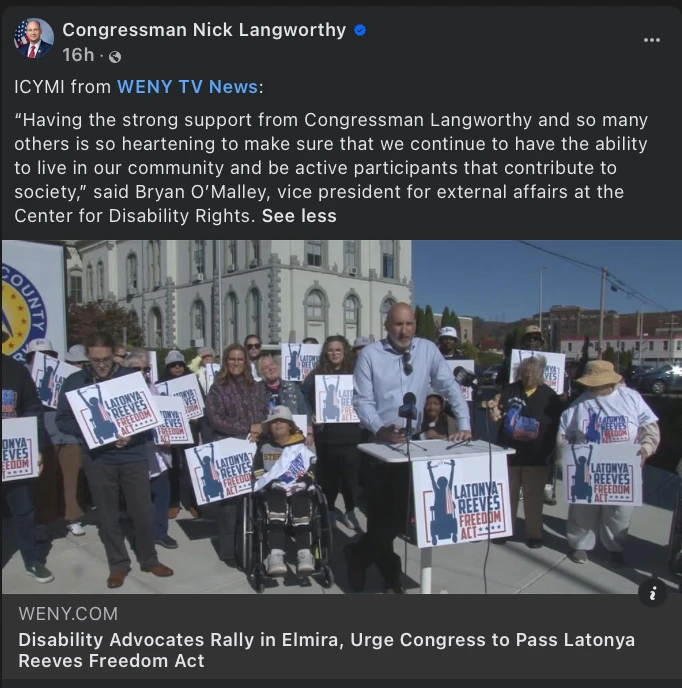
The official-page post, captured October 29, 2026.
WENY’s story, by Renata Stiehl, reports that advocates “rallied outside Congressman Nick Langworthy’s Elmira office Tuesday afternoon” and that “those at the rally said Rep. Langworthy supports the bill.” The story does not report a cosponsorship, quote the congressman, or say when his support began. Neither does the post.
What the bill is, and why it exists now
The bill. H.R. 9401, the Latonya Reeves Freedom Act of 2026, was introduced June 23, 2026, by Rep. Steve Cohen (D-Tenn.) with 48 cosponsors. Its stated purposes include “to affirm that every individual who is eligible for long-term services and supports has a federally protected right to be integrated into that individual’s community and receive community-based long-term services and supports,” and “to clarify and strengthen the integration mandate of the Americans with Disabilities Act of 1990, held by the Supreme Court in Olmstead v. L.C.” It was referred to Energy and Commerce, where Rep. Langworthy sits, and to Judiciary. It has not had a hearing.
Why June 23. Five days earlier, on June 18, the Justice Department’s Office of Legal Counsel issued an opinion that, in NPR’s description, said the department no longer interpreted disability law to “require states to treat mentally disabled patients in the most integrated setting appropriate to their needs,” and acknowledged its position was “out of step with the common understanding” of the Supreme Court’s 1999 Olmstead decision. In July the department stopped relying on its own enforcement guidance for the integration mandate. Then it switched sides in a lawsuit that seventeen states had brought against the Biden administration’s Section 504 rules. On September 23, 2026, the U.S. District Court for the Northern District of Texas, in Texas v. Kennedy, granted a joint motion from the Justice Department and the states and vacated the HHS regulations requiring services “in the most integrated setting,” nationwide. The Americans with Disabilities Act and the Olmstead decision itself were not changed.
Bruce Darling, president of the Center for Disability Rights, the organization that ran the Elmira rally, told NPR the ruling felt “like a knife in your chest. Because what we’re hearing, what people are hearing, is that the federal government has made a determination that [disabled people] don’t have a right to live in freedom, that they can be locked up against their will.” His organization, NPR reported, “is putting its energy behind a proposed law that would cement protections around integration.” That law is H.R. 9401. On June 24 a Senate resolution called on the department to rescind the opinion; House Democrats’ ranking members on three committees wrote to the acting attorney general asking the same.
When the support arrived
The House’s official cosponsor record for H.R. 9401, as of October 29, 2026, lists 83 cosponsors, 11 of them Republicans.
| Cosponsor | Party, district | Date added |
|---|---|---|
| Don Bacon, Brian Fitzpatrick, Jefferson Van Drew, Derrick Van Orden | R | June 23, 2026 (at introduction) |
| Daniel Meuser | R-Pa. | June 29 |
| Michael Lawler | R-N.Y. 17 | July 9 |
| Glenn Thompson | R-Pa. | September 2 |
| Bryan Steil | R-Wis. | September 24 |
| August Pfluger | R-Texas | October 15 |
| Nick Langworthy | R-N.Y. 23 | October 22 |
| Pete Stauber | R-Minn. | October 26 |
New York’s early-voting period for the general election runs October 24 through November 1. The cosponsorship was entered October 22. The rally that thanked him was October 27. The post was October 28.
Three weeks earlier, on October 1, he also added his name to H.R. 2540, the SSI Savings Penalty Elimination Act, which would raise the asset limits for Supplemental Security Income recipients. That bill was introduced April 1, 2025. Three of his New York Republican colleagues were already on it.
In plain language: the support the advocates thanked him for is real. It is also ten days old. Both disability bills he has cosponsored this Congress were signed in the final five weeks before the election.
What the post leaves out
1. His votes for the law that cuts the program the bill protects. Rep. Langworthy voted Aye on H.R. 1, the One Big Beautiful Bill Act, at both stages: May 22, 2025 (Roll Call 145) and July 3, 2025 (Roll Call 190, 218-214). The Congressional Budget Office estimated the law’s Medicaid provisions reduce federal Medicaid spending by $840 billion over ten years and that 10 million people lose health coverage by 2034, including 1.3 million people enrolled in both Medicare and Medicaid, the group that includes most disabled adults and seniors in long-term care. Medicaid is the dominant payer for home- and community-based services.
The National Health Law Program’s October 2025 analysis of the law’s effect on people with disabilities lists what takes effect: work requirements for Medicaid expansion adults ages 19 to 64 starting January 1, 2027, with exemptions on paper for people who are “medically frail,” receive services through a home- and community-based waiver, or care for a disabled family member; eligibility redeterminations every six months instead of twelve, which the analysis says “increases risk of procedural terminations” and “increases burden on people with disabilities”; shortened retroactive coverage; copays of up to $35 per service for expansion adults starting October 2028; and a freeze on the provider taxes states use to fund the program, which the analysis says “will impact HCBS funding.” The law also included a ten-year block on the federal nursing-home minimum-staffing rule.
The American Association of People with Disabilities, whose representatives he met on May 18, 2026, responded to the law’s passage with a statement titled “This Is A Devastating Day for Disabled Americans.” This site has documented that meeting and the vote here.
Providers in the district were saying so before the law’s provisions took effect. Suburban Adult Services, Inc., headquartered in Elma in the district’s Erie County portion, serves nearly 2,000 people with intellectual and developmental disabilities across the state. Its president, Jeff Paterson, told Spectrum News in August 2025 that inflation was already stretching the agency’s budget, that “it might mean that you can’t go out and do as many things in the community,” and that “on top of inflation, cuts to SNAP and Medicaid are also an issue.”
The Reeves Act would guarantee a right to receive long-term services in the community. H.R. 1 cuts the money that pays for them. A reader of the post would not know he voted for the second before signing the first.
2. No public word on the reversal the bill answers. This site searched his office’s press-release index (70 releases, August 25, 2025, through October 15, 2026), his X timeline for October 16 through 27, and the web for any statement by him on the June 18 opinion, the July guidance withdrawal, or the September 23 court order. None was found. The press index contains no release on any disability topic in that period; the word “accessibility” appears once, in a release about a community center. He is a member of the House Oversight Committee. His Facebook posts and radio appearances were not systematically searched, so this is a statement about where this site looked, not proof he never spoke.
3. The disability bills he has not joined. The same cosponsor records show he is not on:
- H.R. 2598, the IDEA Full Funding Act (introduced April 2, 2025), which would phase federal special-education funding up to the 40 percent share Congress promised in 1975. It has 175 cosponsors, including 16 Republicans, among them three fellow New York Republicans: Lawler, Garbarino and LaLota.
- H.R. 6617, the Keeping All Students Safe Act (December 11, 2025), which would limit the restraint and seclusion of students. This site has documented rising restraint counts in NY-23 schools here.
- H.R. 10232 (September 2, 2026), a bipartisan bill by Reps. John Mannion (D-N.Y.), Bobby Scott (D-Va.) and Brian Fitzpatrick (R-Pa.) to bar the Education Department from transferring its special-education office to other agencies. On June 16, 2026, the department announced an agreement handing administration of grants under the Individuals with Disabilities Education Act to Health and Human Services, and moving disability-discrimination complaint handling to the Justice Department. Rep. Langworthy has endorsed “streamlining” the department and “bringing it closer to home.”
4. The other pending cut to disabled adults who live at home. The Social Security Administration listed in its Spring 2025 regulatory agenda a rule to rescind the 2024 definition of a “public assistance household,” which would again count a bedroom in a relative’s home as income against a disabled adult’s SSI check even when the household is poor enough for SNAP. ProPublica reported on April 28, 2026, that White House and Department of Government Efficiency officials were still pushing the change, that it could cut or end benefits for as many as 400,000 recipients, and that the cut would be up to a third of the check, about $330 a month in the case it profiled. As of October 29, 2026, no proposed rule has been published in the Federal Register and the item has not reappeared in later agendas. No statement from him on it was located.
The fair reading
Cosponsoring the Reeves Act is a real act, and it puts him on the right side of a bill that most of his party has not joined. The advocates who thanked him were thanking him for something he actually did. Signing on late is still signing on; one Republican joined after him.
The SSI cosponsorship is also real, and that bill has broad Republican support. He signed the New York delegation’s 2023 letter against Medicare home-health payment cuts. He voted for the FY2026 spending law that funded special education and the Education Department’s civil-rights office at roughly flat levels, and for the Social Security Fairness Act in November 2024. He is not a cosponsor of the bill to abolish the Education Department, nor of the ACCESS Act that disability groups oppose because it would require notice before an ADA lawsuit.
H.R. 1’s work requirements do exempt people with disabilities in the statute’s text; the documented concern of disability lawyers is not the exemption but the paperwork that will cost eligible people their coverage. And nothing in this entry suggests his October 22 signature was anything other than sincere.
What the post omits is the sequence. The reversal came in June. The bill came five days later. Most of its Republican cosponsors signed by September. His signature came the week early voting opened, after a year in which he voted twice for the law that cuts the program the bill protects and said nothing, that this site can find, about the Justice Department’s change of position. The advocates were “heartened” by strong support. The record shows recent support.
Questions this raises
- What changed between June 23, when the bill was introduced, and October 22, when he signed it?
- Does he agree with the Justice Department’s June 18 opinion that federal law does not require states to serve disabled people in the most integrated setting? If not, why has he not said so?
- How does he reconcile a cosponsorship guaranteeing community-based long-term services with two votes for a law that the Congressional Budget Office says removes $840 billion from the program that funds them?
- Three fellow New York Republicans cosponsored the IDEA Full Funding Act eighteen months ago. Why not him?
Sources
- WENY, “Disability Advocates Rally in Elmira, Urge Congress to Pass Latonya Reeves Freedom Act,” Renata Stiehl, October 27, 2026: https://www.weny.com/news/disability-advocates-rally-in-elmira-urge-congress-to-pass-latonya-reeves-freedom-act/article_5d02d322-85bb-4eb0-b39f-c9b08ab21c95.html (archived: https://web.archive.org/web/20261029104123/https://www.weny.com/news/disability-advocates-rally-in-elmira-urge-congress-to-pass-latonya-reeves-freedom-act/article_5d02d322-85bb-4eb0-b39f-c9b08ab21c95.html)
- H.R. 9401, Latonya Reeves Freedom Act of 2026, bill status and cosponsors (govinfo BILLSTATUS XML; Langworthy entry dated 2026-10-22): https://www.govinfo.gov/bulkdata/BILLSTATUS/119/hr/BILLSTATUS-119hr9401.xml (archived: https://web.archive.org/web/20261029104540/https://www.govinfo.gov/bulkdata/BILLSTATUS/119/hr/BILLSTATUS-119hr9401.xml)
- H.R. 9401 text as introduced, Sec. 2 (purposes): https://www.govinfo.gov/content/pkg/BILLS-119hr9401ih/html/BILLS-119hr9401ih.htm (text retained)
- Rep. Steve Cohen, “Congressman Cohen Introduces the Latonya Reeves Freedom Act,” June 23, 2026 (“48 bipartisan House cosponsors”): https://cohen.house.gov/media-center/press-releases/congressman-cohen-introduces-latonya-reeves-freedom-act-0 (archived: https://web.archive.org/web/20261029160401/https://cohen.house.gov/media-center/press-releases/congressman-cohen-introduces-latonya-reeves-freedom-act-0)
- NPR, “Trump administration reverses stance on integration of people with disabilities,” Jonaki Mehta, October 1, 2026: https://www.npr.org/2026/10/01/nx-s1-5981375/integration-mandate-disabilities-reversed-trump (archived: https://web.archive.org/web/20261029104200/https://www.npr.org/2026/10/01/nx-s1-5981375/integration-mandate-disabilities-reversed-trump)
- LeadingAge, “Integration Mandate Provisions Vacated from HHS Section 504 Regulation,” September 24, 2026 (Texas v. Kennedy, No. 5:24-cv-00225, order of September 23, 2026): https://leadingage.org/integration-mandate-provisions-vacated-from-hhs-section-504-regulation/ (archived: https://web.archive.org/web/20261029160245/https://leadingage.org/integration-mandate-provisions-vacated-from-hhs-section-504-regulation/)
- Center for Disability Rights, Bruce Darling, “The OLC Memo, Olmstead, and the Latonya Reeves Freedom Act”: https://cdrnys.org/blog/uncategorized/the-olc-memo-olmstead-and-the-latonya-reeves-freedom-act/ (archived: https://web.archive.org/web/20261029155944/https://cdrnys.org/blog/uncategorized/the-olc-memo-olmstead-and-the-latonya-reeves-freedom-act/)
- Rep. Ritchie Torres, letter to the Justice Department on the June 18, 2026 opinion: https://ritchietorres.house.gov/posts/rep-ritchie-torres-urges-doj-to-reverse-opinion-threatening-the-right-to-community-living-for-people-with-disabilities (text retained; archive pending)
- New York State Board of Elections, “Early Voting”: “2026 General Election Early Voting: October 24th through November 1st”: https://elections.ny.gov/early-voting (text retained; page blocks automated capture)
- House Roll Call 145, May 22, 2025, H.R. 1 (Langworthy: Aye): https://clerk.house.gov/evs/2025/roll145.xml (archived: https://web.archive.org/web/20261029160427/https://clerk.house.gov/evs/2025/roll145.xml)
- House Roll Call 190, July 3, 2025, H.R. 1, 218-214 (Langworthy: Aye): https://clerk.house.gov/evs/2025/roll190.xml (archived: https://web.archive.org/web/20261029160423/https://clerk.house.gov/evs/2025/roll190.xml)
- Congressional Budget Office, Medicaid provisions of H.R. 1 ($840 billion): https://www.cbo.gov/publication/61510
- National Health Law Program, “Impact of OBBBA on People With Disabilities,” webinar slides, October 23, 2025: https://healthlaw.org/wp-content/uploads/2025/11/OBBBA-Impact-on-PWD-Webinar-10-28-25-CLEAN-1.pdf (PDF retained)
- Spectrum News, “Inflation stretching N.Y. disability service agencies thin,” Brianne Roesser, August 21, 2025: https://spectrumlocalnews.com/nys/central-ny/news/2025/08/21/inflation-stretches-disability-service-agencies-thin (archived: https://web.archive.org/web/20261029162843/https://spectrumlocalnews.com/nys/central-ny/news/2025/08/21/inflation-stretches-disability-service-agencies-thin)
- Suburban Adult Services, Inc., headquarters 960 W. Maple Ct., Elma, NY 14059: https://www.sasinc.org/ (text retained; ZIP 14059 is in NY-23)
- H.R. 2540, SSI Savings Penalty Elimination Act, cosponsors (Langworthy entry dated 2026-10-01): https://www.govinfo.gov/bulkdata/BILLSTATUS/119/hr/BILLSTATUS-119hr2540.xml (archived: https://web.archive.org/web/20261029104546/https://www.govinfo.gov/bulkdata/BILLSTATUS/119/hr/BILLSTATUS-119hr2540.xml)
- H.R. 2598, IDEA Full Funding Act, cosponsors (175; Langworthy not listed): https://www.govinfo.gov/bulkdata/BILLSTATUS/119/hr/BILLSTATUS-119hr2598.xml (archived: https://web.archive.org/web/20261029160417/https://www.govinfo.gov/bulkdata/BILLSTATUS/119/hr/BILLSTATUS-119hr2598.xml)
- H.R. 6617, Keeping All Students Safe Act, and H.R. 10232 (Mannion/Scott/Fitzpatrick), cosponsors (Langworthy not listed): https://www.govinfo.gov/bulkdata/BILLSTATUS/119/hr/BILLSTATUS-119hr6617.xml and https://www.govinfo.gov/bulkdata/BILLSTATUS/119/hr/BILLSTATUS-119hr10232.xml (XML retained)
- K-12 Dive, “Bipartisan House bill aims to stop outsourcing of some Education Department offices,” September 3, 2026: https://www.k12dive.com/news/bipartisan-house-bill-aims-to-stop-Education-Department-outsourcing-special-education/829604/ (archived: https://web.archive.org/web/20261029104619/https://www.k12dive.com/news/bipartisan-house-bill-aims-to-stop-Education-Department-outsourcing-special-education/829604/)
- Disability Scoop, “Ed Department Strikes Deal To Offload Special Education,” June 16, 2026: https://www.disabilityscoop.com/2026/06/16/ed-department-strikes-deal-to-offload-special-education/32051/ (text retained; archive pending)
- ProPublica, “The Trump Administration Aims to Penalize Disabled Adults Who Live With Their Families,” Eli Hager, April 28, 2026: https://www.propublica.org/article/trump-social-security-ssi-disability-benefits-cuts-parents-children (archived: https://web.archive.org/web/20261029104318/https://www.propublica.org/article/trump-social-security-ssi-disability-benefits-cuts-parents-children)
- Office of Information and Regulatory Affairs, Unified Agenda, Spring 2025, RIN 0960-AI94, “Rescission of Changes to the Definition of a Public Assistance Household” (Proposed Rule Stage; NPRM target 08/2025): https://www.reginfo.gov/public/do/eAgendaViewRule?pubId=202504&RIN=0960-AI94 (archived: https://web.archive.org/web/20261029160240/https://www.reginfo.gov/public/do/eAgendaViewRule?pubId=202504&RIN=0960-AI94)
- Rep. Ritchie Torres, New York delegation letter on home health cuts, October 2023 (signers include “Nicholas A. Langworthy”): https://ritchietorres.house.gov/posts/u-s-rep-ritchie-torres-leads-ny-congressional-delegation-in-bipartisan-letter-advocating-preservation-of-access-to-home-health-care (text retained)
- Rep. Langworthy, official press-release index, August 25, 2025, through October 15, 2026 (70 releases; retained at research/sources/triage-2026-10-28/)
Related
- Disability: “I’ll Keep Working to Protect Critical Support Systems” (AAPD meeting, May 18, 2026) (CONTRADICTION)
- The Federal Watchdog for Disabled Students Was Dismantled. NY-23 Schools Kept Restraining Them. (CONTRADICTION)
- Home Care: The Meeting Is Real, and So Is the Letter He Signed. The “Stewardship” Framing Omits What His Vote Did. (MISSING CONTEXT)
- On H.R. 9237, His Rules Vote Kept Off the Floor the Amendment That Would Have Dropped the Veterans’ Benefit Cuts (DOCUMENTED PATTERN)
- Medicaid: Claiming “Not a Single Person” Will Lose Coverage While Voting for $911 Billion in Cuts (FALSE)
Note: This entry documents publicly available information from the House’s official bill-status records, the House Clerk, the Congressional Budget Office, the Federal Register and regulatory agenda, a federal court order as reported by a national provider association, and local and national news coverage, and a local provider’s public remarks. It makes no allegation of unlawful conduct and does not speculate about why the cosponsorship was entered on October 22. The cosponsorship, the SSI bill, the 2023 letter and the other items in “The fair reading” are credited because the record supports them. The statement that no public comment by Rep. Langworthy was found describes the places this site searched, listed above, and nothing more.
Last updated: October 29, 2026