'I Can Deliver for NY23 Taxpayers': His Energy and Commerce Record, by the Numbers. Productive in Committee; No Bill of His Has Become Law.
Why this matters
Rep. Langworthy joined the House Energy and Commerce Committee in January 2025 and sits on three of its subcommittees: Energy, Environment and Health. His office said at the time that he would be the “first member of Congress in modern history to represent the Southern Tier counties” on the committee.
On October 15 he told constituents that his seat “means I can deliver for NY23 taxpayers,” and listed three energy bills. This entry checks those three bills, then lays out his full record on the committee: what he sponsored, how far it got, how he voted, and where he spoke. Some of the record is strong. None of it, so far, is law.
Statement
Source: Official Facebook page, October 15, 2026:
“Serving on the Energy and Commerce Committee means I can deliver for NY23 taxpayers: [bullet] POWER Act: speeds up pipeline and power plant construction. [bullet] GRID Power Act: prioritizes reliable power plants [bullet] State Energy: Accountability Act exposes the cost of green mandates.”
(Each item in the original is marked with a lightning-bolt symbol.)
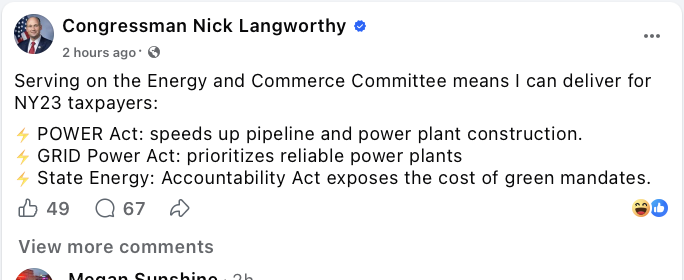
The October 15, 2026 post on the official page.
A second screenshot of the post, taken on a phone, shows the top of a fourth bulleted line that is too cut off to read. We could not find the full text elsewhere, so this entry checks the three lines that are legible.
The three bills in the post
| Bill | What his post says | Where it stands (govinfo, Oct 16, 2026) | His role |
|---|---|---|---|
| POWER Act | “speeds up pipeline and power plant construction” | A discussion draft released by Committee Chairman Brett Guthrie on July 22, 2026, bundling 19 bills. It has no bill number and has not been introduced. (Other, unrelated House bills use the name “POWER Act.”) | Not the sponsor; the draft folds in both of the other two bills in his post |
| GRID Power Act (H.R. 1047) | “prioritizes reliable power plants” | Passed the House September 18, 2025, 216 to 206. In the Senate Energy Committee since September 19, 2025. Not law. | Cosponsor (signed on June 17, 2025); voted Yea in committee and on the floor |
| State Energy Accountability Act (H.R. 3157) | “exposes the cost of green mandates” | Reported by the committee, 27 to 20 (H. Rept. 119-301). On the House calendar since September 17, 2025. No floor vote. | Sponsor |
His descriptions of what each bill would do broadly match the committee’s own summaries. The State Energy Accountability Act would require state utility regulators to “consider and make a determination” on publishing the costs and reliability effects of certain clean-energy policies, which is milder than “exposes.”
In plain language: one of the three has passed the House, one is waiting for a floor vote, and one, a package that would include the other two, has not been introduced. None has become law.
The scorecard
Where he sits
The House elected him to Energy and Commerce on January 9, 2025 (H.Res. 21). The House Clerk lists him on three of its subcommittees: Energy, Environment and Health. He also serves on Rules, where he chairs the Subcommittee on Legislative and Budget Process, and on Oversight.
Bills he wrote
He has sponsored 50 bills and resolutions in this Congress. Twenty were sent to Energy and Commerce.
| Stage reached | His 20 E&C bills | All 2,193 E&C House bills (H.R.) | Republican-sponsored E&C House bills (1,057) |
|---|---|---|---|
| Full-committee markup | 6 (30%) | 6.4% | 9.9% |
| Reported or ordered reported | 6 (30%) | ||
| Passed the House | 1 (5%) | 4.9% | 7.7% |
| Became law | 0 | 2 | 1 |
(The markup figures include the committee’s September 2, 2026 markup, which the govinfo bill-status data had not yet recorded as of October 16.)
Only Rep. Latta sponsored more E&C bills that reached a full-committee markup; Reps. Evans, Harshbarger and Miller-Meeks tied him.
His six:
- Reliable Federal Infrastructure Act (H.R. 4690): passed the House April 22, 2026, 215 to 202. In the Senate Environment and Public Works Committee.
- State Energy Accountability Act (H.R. 3157): reported; no floor vote.
- Energy Choice Act (H.R. 3699): reported, 24 to 21; no floor vote. (See the site’s February and October entries.)
- American Quantum Competitiveness Act (H.R. 10163): ordered reported 36 to 0 on September 16, 2026.
- Recycled Materials Attribution Act (H.R. 7502): ordered reported on a recorded vote on September 16, 2026. (The committee’s roll-call sheet and its vote summary give different margins.) The committee lists it as co-led with Democratic Rep. Gonzalez.
- BUSES Act (H.R. 9317): ordered reported by the full committee September 2, 2026, 26 to 22, per the committee’s vote summary, which lists him and Democratic Rep. Gottheimer as its sponsors. The govinfo record has not caught up.
Fourteen others have had no committee action. None of his 50 measures has passed the Senate or become law.
Bills he cosponsored
He has cosponsored 87 bills sent to Energy and Commerce. Nineteen passed the House. Six became law: five Congressional Review Act resolutions overturning federal rules, and the Hydropower Licensing Transparency Act (P.L. 119-112), a bill led by Democratic Rep. Kim Schrier.
How he votes in committee
The full committee posted member-by-member results for 221 recorded votes between February 2025 and September 2026. He voted Yea 92 times and Nay 107 times, and did not vote 22 times.
His 10 percent missed-vote rate is typical for the committee’s Republicans: the median among its 30 Republicans missed 11.1 percent, and 16 of them missed more votes than he did. Democrats missed fewer (median 3.2 percent); across all 54 members the median was 6.3 percent, and 23 missed more than he did. In the Energy and Environment subcommittees he missed none of the 40 recorded votes that list members; the Health Subcommittee posted no member-by-member roll calls. (The full committee’s July 20 and September 2, 2026 markups posted summaries without member-by-member votes, so his votes there are not in this count.)
Amendments
We found two amendments he offered, both to his own bills at a November 2025 Energy Subcommittee markup, and both adopted by voice vote. We found none from him at a full-committee markup, including the May 2025 markup that wrote the committee’s share of the 2025 tax-and-spending law’s Medicaid changes. The site’s July entry covers that markup.
Hearings
We found no official attendance record for committee hearings, so we counted the hearings where he spoke, using the transcripts the Government Publishing Office has published (through March 26, 2026):
| Subcommittee | Hearing transcripts published | He spoke at |
|---|---|---|
| Energy | 11 | 8 |
| Health | 5 | 3 |
| Environment | 6 | 1 |
Not speaking does not mean a member was absent.
In plain language: he moves his own bills through committee more often than most members, he shows up for committee votes about as often as the typical Republican on the panel, and his work there is concentrated on energy. Twenty-one months in, none of the bills he wrote has become law, and the three he cited as delivering for NY-23 are still pending or not yet introduced.
The fair reading, at full strength
- Getting bills through committee is hard, and he does it. Thirty percent of his committee bills reached a full markup, about three times the rate for Republican-sponsored bills.
- Some of his work is bipartisan. His quantum bill was approved 36 to 0, two of his bills are co-led with Democrats, and he cosponsored a Democrat’s hydropower bill that became law.
- The Senate is not his to control. His infrastructure bill and the GRID Power Act both passed the House and stopped in the Senate.
- Committee seats matter beyond bills. Members can shape legislation in drafting and negotiation, which these records don’t capture.
- His committee attendance is ordinary for a Republican on the panel, not poor.
Questions this raises
- The POWER Act has not been introduced. When will it be, and what in it would reach NY-23?
- What was the fourth item in the October 15 post?
- He sits on the Health Subcommittee, which oversees Medicaid and Medicare. Which of his health bills does he expect to move before the Congress ends on January 3, 2027?
Sources
- Official Facebook page post, October 15, 2026 (screenshot above)
- Rep. Langworthy, “Congressman Langworthy Named to House Energy and Commerce Committee,” December 13, 2024: https://langworthy.house.gov/media/press-releases/congressman-langworthy-named-house-energy-and-commerce-committee (text retained under research/sources/ec-record-2026-10/activity/press-releases/)
- govinfo BILLSTATUS bulk data, 119th Congress House measures, downloaded October 16, 2026: https://www.govinfo.gov/bulkdata/BILLSTATUS/119/hr
- H.R. 1047 status: https://www.govinfo.gov/bulkdata/BILLSTATUS/119/hr/BILLSTATUS-119hr1047.xml (archived: https://web.archive.org/web/20261015202520/https://www.govinfo.gov/bulkdata/BILLSTATUS/119/hr/BILLSTATUS-119hr1047.xml)
- H.R. 3157 status: https://www.govinfo.gov/bulkdata/BILLSTATUS/119/hr/BILLSTATUS-119hr3157.xml (archived: https://web.archive.org/web/20261015202643/https://www.govinfo.gov/bulkdata/BILLSTATUS/119/hr/BILLSTATUS-119hr3157.xml)
- H.R. 3157 reported text: https://www.govinfo.gov/content/pkg/BILLS-119hr3157rh/html/BILLS-119hr3157rh.htm (archived: https://web.archive.org/web/20261015204731/https://www.govinfo.gov/content/pkg/BILLS-119hr3157rh/html/BILLS-119hr3157rh.htm)
- H.R. 4690, H.R. 7502, H.R. 10163, H.R. 3699 and H.R. 3657 status: govinfo BILLSTATUS (files retained under research/sources/ec-record-2026-10/bills/xml/)
- House Clerk, Roll Call 279 (H.R. 1047, September 18, 2025): https://clerk.house.gov/evs/2025/roll279.xml (archived: https://web.archive.org/web/20261015203203/https://clerk.house.gov/evs/2025/roll279.xml)
- Energy and Commerce Committee, POWER Act discussion draft release, July 22, 2026: https://energycommerce.house.gov/posts/chairman-guthrie-releases-power-act-to-lower-electricity-costs-for-american-families (archived: https://web.archive.org/web/20261015203425/https://energycommerce.house.gov/posts/chairman-guthrie-releases-power-act-to-lower-electricity-costs-for-american-families)
- House Clerk, Committee on Energy and Commerce roster: https://clerk.house.gov/committees/IF00 (archived: https://web.archive.org/web/20261015204559/https://clerk.house.gov/committees/IF00)
- H.Res. 21 (committee election, January 9, 2025): https://www.govinfo.gov/content/pkg/BILLS-119hres21eh/html/BILLS-119hres21eh.htm
- House Committee Repository, Energy and Commerce markup roll-call sheets, February 2025 to September 2026: https://docs.house.gov/Committee/Calendar/ByMonth.aspx?Code=IF00 (all sheets and the parsed table retained under research/sources/ec-record-2026-10/activity/)
- govinfo Congressional Hearings collection, Energy and Commerce transcripts: https://www.govinfo.gov/app/collection/chrg
Related
- ‘A Seat at the Table’: His Two Committees and What He Did With Them on the Medicaid Cuts
- Energy Choice Act: What the Bill Does, Who Supports It, and What It Leaves Out
- The Trade Group That Says It ‘Helped Draft’ His Energy Choice Act Has Made Him Its Top Recipient
- The BUSES Act Cleared Subcommittee. It’s Narrower Than “National Standard for Bus Operators” Sounds.
Note: This entry documents publicly available information from the Government Publishing Office, the House Clerk, the House Committee Repository and Rep. Langworthy’s own posts. It makes no claim about motive. Corrections with sources are welcome at [email protected].
Last updated: October 17, 2026