He Says His Tax Law 'Eliminated Taxes on Social Security for Middle Class Seniors.' It Never Changed the Rules for Taxing Benefits. Seven Tax Claims Checked.
Why this matters
The Social Security Administration announced the 2027 cost-of-living adjustment on October 14; nearly 72 million beneficiaries will see it. The same day, Rep. Langworthy told WGRZ that the tax law he voted for “eliminated taxes on Social Security for middle class seniors.” He made the same claim at his October 6 debate, alongside several other claims about the law.
Some of what he said is accurate. The central claim about Social Security is not: the law created a temporary deduction for most taxpayers 65 and over, and left the rules for taxing Social Security benefits exactly as they were. Seniors deciding how to plan for next year’s taxes should know the difference.
At a glance
| # | Claim | Where | Verdict |
|---|---|---|---|
| 1 | The tax law “eliminated taxes on Social Security for middle class seniors”; “We gave no tax on Social Security for our seniors” | Statement to WGRZ, Oct 14; WETM debate, Oct 6 | FALSE |
| 2 | “Our Working Families Tax Cuts deliver $6,000 more relief” | Official page, Oct 15 | MISLEADING |
| 3 | “A 3.6% COLA means $75 more a month for retirees” | Official page, Oct 15 | TRUE |
| 4 | “We doubled the child tax credit” | WETM debate, Oct 6 | MISLEADING |
| 5 | “A larger Child Tax Credit,” “expanded tax relief for seniors and a higher standard deduction” | Official page, Oct 13 or 14 | TRUE |
| 6 | “No tax on tips or overtime” | Official page, Oct 13 or 14; debate | MISLEADING |
| 7 | “Tax refund checks went up 11% year over year” | WETM debate, Oct 6 | TRUE |
Overall: MISLEADING. The numbers he cites are mostly real. The claim he leads with for seniors is not.
The statements
WETM debate, October 6, 2026. At 2:29: “We’ve given no tax on Social Security for our middle-class seniors.” At 12:48-13:08:
“We did reduce taxes on working people. We doubled the child tax credit. We gave no tax on Social Security for our seniors, no tax on tips, no tax on overtime. That isn’t millionaires and billionaires. That’s regular people right here in our community that have their tax refund checks went up 11% year over year. That’s a matter of fact.”
Official Facebook page, October 13 or 14, 2026 (shown as “a day ago” in a screenshot taken October 15):
“The Working Families Tax Cuts that I proudly voted for puts families first with no tax on tips or overtime, a larger Child Tax Credit, expanded tax relief for seniors and a higher standard deduction. More of every hard-earned paycheck stays where it belongs: with the families who earned it.”
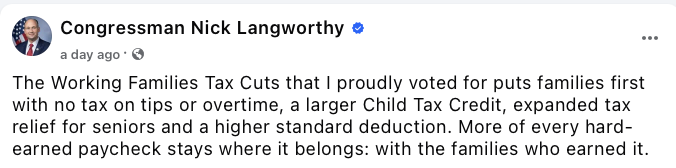
The official-page post, shown as posted a day before the October 15 screenshot.
Official Facebook page, October 15, 2026, with a graphic quoting his written statement to WGRZ:
“Our seniors worked hard, paid into Social Security, and earned every penny. A 3.6% COLA means $75 more a month for retirees, while our Working Families Tax Cuts deliver $6,000 more relief.”
Graphic (statement to WGRZ): “I’m pleased that seniors will receive a 3.6% cost-of-living adjustment next year, just as Social Security benefits have been adjusted for inflation annually for decades. That increase will mean an average of $75 more per month for retired workers to help keep pace with costs, but more importantly, the Working Families Tax Cuts we passed last year eliminated taxes on Social Security for middle class seniors.”
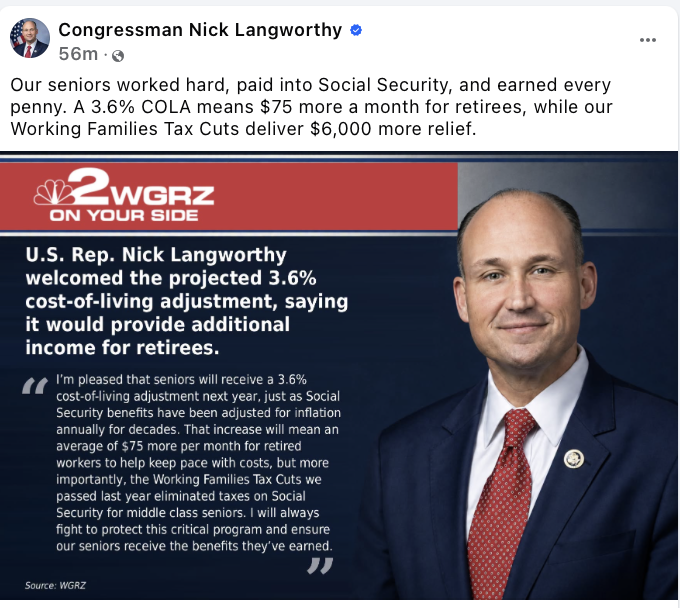
The October 15, 2026 post on the official page.
Rep. Langworthy voted for the law on May 22, 2025 (Roll Call 145, Yea) and July 3, 2025 (Roll Call 190, Aye).
Claim 1: “Eliminated taxes on Social Security for middle class seniors”
Verdict: FALSE
How much of a Social Security benefit is taxable is set by Section 86 of the Internal Revenue Code. The 2025 law did not amend it. The Congressional Research Service, in its report on the law’s senior provisions: the taxable-benefit determination is in Section 86 of the Code “and was not changed by P.L. 119-21.”
What the law did instead, in Section 70103, was create a new deduction of $6,000 for each taxpayer age 65 or older, for tax years 2025 through 2028. It is not tied to Social Security. CRS notes it is “not limited to Social Security beneficiaries,” and a 65-year-old with no benefits gets it too. It shrinks by 6 percent of income above $75,000 ($150,000 for joint filers), reaching zero at $175,000 ($250,000 joint).
Who it misses:
- Beneficiaries under 65. As of December 2023, 20.2 percent of Social Security recipients, 13.6 million people, were under 65 (CRS, from SSA data). They are not eligible for the deduction themselves (one married to a spouse 65 or older can benefit through the spouse’s deduction on a joint return).
- Seniors with low incomes. A deduction only helps someone with taxable income. CRS: it “is not a tax credit, so it by itself will not create a tax refund.”
- Seniors whose income is still taxable after the deduction. The Tax Policy Center estimated that the deduction “would benefit fewer than half of older adults,” and that about half of all Social Security recipients “will pay at least some income taxes on their benefits.” Its summary: “most would see their income taxes on Social Security benefits reduced, not eliminated.”
The Social Security Administration made a similar claim in a July 3, 2025 release (“nearly 90% of Social Security beneficiaries will no longer pay federal income taxes on their benefits”). The Tax Policy Center called that claim untrue. The site has rated Rep. Langworthy’s earlier versions of the claim MISLEADING twice and, in one sub-claim, FALSE (see Related).
The FALSE rating here rests on the categorical word: “eliminated taxes on Social Security for middle class seniors.” The debate slogan “no tax on Social Security” makes the same claim in shorter form.
In plain language: the law gave many seniors a tax cut. It did not stop Social Security benefits from being taxable, for middle-class seniors or anyone else, and beneficiaries under 65 are not eligible for it.
Claim 2: “$6,000 more relief”
Verdict: MISLEADING
The $6,000 is the size of the deduction, not the amount of tax saved. A deduction lowers taxable income; the saving is the deduction times the taxpayer’s tax rate. For a single senior who can use all of it:
| Federal tax bracket | Tax saved, one senior | Tax saved, couple both 65+ |
|---|---|---|
| 10% | $600 | $1,200 |
| 12% | $720 | $1,440 |
| 22% | $1,320 | $2,640 |
| No taxable income | $0 | $0 |
It phases out at higher incomes, as described above, and expires after 2028.
The post sets “$6,000 more relief” next to “$75 more a month” from the COLA. The COLA is cash: $75 a month works out to $900 a year for the average retiree. The $6,000 is not cash. The Tax Policy Center estimated that the seniors who gain the most, those making about $80,000 to $130,000, would see an average tax cut of about $1,100.
In plain language: for a single senior in the 10 to 22 percent brackets who can use all of it, the deduction is worth $600 to $1,320 a year. It is worth nothing to those who owe no income tax. It is not $6,000.
Claim 3: “A 3.6% COLA means $75 more a month”
Verdict: TRUE
The Social Security Administration announced on October 14, 2026: “a 3.6 percent benefit increase for 2027” and “On average, Social Security retirement benefits will increase by $75 per month.” Both of his figures match. His statement also correctly notes that benefits “have been adjusted for inflation annually for decades”: the adjustment is automatic under the Social Security Act, tied to the Consumer Price Index for Urban Wage Earners and Clerical Workers.
(WGRZ described the COLA as “projected.” SSA had announced it earlier the same day.)
Claims 4 and 5: The Child Tax Credit
“We doubled the child tax credit”: MISLEADING
The credit was doubled, from $1,000 to $2,000, by Section 11022 of the Tax
Cuts and Jobs Act (“substituting $2,000' for $1,000’”), which was
approved on December 22, 2017. That was before Rep. Langworthy took his
seat: the House Clerk’s records show him answering the first roll call of
the new Congress on January 3, 2023.
The law he voted for, Section 70104 of P.L. 119-21, struck “$2,000” and inserted “$2,200”: a 10 percent increase. It also made the credit permanent instead of letting it fall back to $1,000 after 2025, and it added a requirement that the taxpayer (or at least one spouse on a joint return) have a work-eligible Social Security number. The child’s number was already required under the 2017 law.
The fair reading: “we” in a debate can mean his party, and Republicans did pass the 2017 doubling. But in an answer defending the law he voted for, “we doubled the child tax credit” credits that law with something it did not do. Keeping the doubled credit from expiring is a real change and a fair claim. Doubling it is not.
“A larger Child Tax Credit”: TRUE. $2,000 to $2,200, as above.
“Expanded tax relief for seniors”: TRUE as worded: the $6,000 deduction described in Claim 1.
“A higher standard deduction”: TRUE. Section 70102 raised it to $15,750 for single filers for 2025 ($31,500 for joint filers, per CRS) and removed the 2025 expiration.
Claim 6: “No tax on tips or overtime”
Verdict: MISLEADING
“No Tax on Tips” and “No Tax on Overtime” are the provisions’ popular names, used across parties and in the press. The label still overstates what they do: both are deductions, not exemptions, and both are capped and temporary. The site rated the same claim MISLEADING in April. From the IRS fact sheet and the statute:
| Tips (Sec. 70201) | Overtime (Sec. 70202) | |
|---|---|---|
| Maximum deduction | $25,000 | $12,500 ($25,000 joint) |
| Phases out above | $150,000 ($300,000 joint) | $150,000 ($300,000 joint) |
| What counts | Tips in occupations the IRS lists as customarily tipped | Only the premium portion, “such as the ‘half’ portion of ’time-and-a-half’” |
| Years | 2025 through 2028 | 2025 through 2028 |
Married filers must file jointly and include a Social Security number to claim either one.
In plain language: many tipped and hourly workers will pay less income tax. “No tax” overstates it: these are capped income-tax deductions, the base pay for overtime is still taxed, and both breaks end after 2028 unless Congress extends them.
Claim 7: “Tax refund checks went up 11%”
Verdict: TRUE
IRS filing-season statistics through May 8, 2026: the average refund was $3,276, compared with $2,939 at the same point in 2025, up 11.5 percent. The figure is a national average; the IRS filing-season statistics are national only, so “right here in our community” is an inference. The site’s April entry covers what else drove larger refunds, including the higher cap on the state and local tax deduction, and why a larger refund is not the same thing as a larger tax cut.
Questions this raises
- Which middle-class seniors did the law “eliminate taxes on Social Security” for, given that Section 86 of the tax code was not changed?
- What does he tell the roughly one in five Social Security beneficiaries who are under 65 and are not eligible for the senior deduction?
- Why present a $6,000 deduction alongside a $75-a-month cash increase as though both were money in hand?
Sources
- WETM congressional debate, October 6, 2026: video and transcript retained under
research/sources/debate-2026-10-06/; quotes at 2:29-2:33 and 12:48-13:08, confirmed against a second transcription and the video frames - Official Facebook page posts, October 13 or 14 and October 15, 2026 (screenshots above)
- WGRZ, “Erie County seniors say Social Security increase won’t keep pace with costs,” October 14, 2026: https://www.wgrz.com/article/money/erie-county-seniors-say-social-security-increase-wont-keep-pace-with-costs/71-4659d26e-4f5d-4a3f-ae00-3f78bde2d98d (not archivable; see archive note)
- Social Security Administration, “Social Security Announces 3.6 Percent Benefit Increase for 2027,” October 14, 2026: https://www.ssa.gov/news/en/press/releases/2026-10-14.html (archived: https://web.archive.org/web/20261015144246/https://www.ssa.gov/news/en/press/releases/2026-10-14.html)
- Public Law 119-21, enrolled text (Secs. 70102, 70103, 70104, 70201, 70202): https://www.govinfo.gov/content/pkg/BILLS-119hr1enr/html/BILLS-119hr1enr.htm (archived: https://web.archive.org/web/20260929195846/https://www.govinfo.gov/content/pkg/BILLS-119hr1enr/html/BILLS-119hr1enr.htm)
- Congressional Research Service, R48613, August 1, 2025: https://www.congress.gov/crs_external_products/R/PDF/R48613/R48613.1.pdf (archived: https://web.archive.org/web/20250805140242/https://www.congress.gov/crs_external_products/R/PDF/R48613/R48613.1.pdf)
- Tax Policy Center, “Correcting The Social Security Administration About The Big Budget Bill,” July 9, 2025: https://taxpolicycenter.org/taxvox/correcting-social-security-administration-about-big-budget-bill (archived: https://web.archive.org/web/20250719092939/https://taxpolicycenter.org/taxvox/correcting-social-security-administration-about-big-budget-bill)
- Social Security Administration release, July 3, 2025: https://www.ssa.gov/news/en/press/releases/2025-07-03.html (archived: https://web.archive.org/web/20250814180230/https://www.ssa.gov/news/en/press/releases/2025-07-03.html)
- IRS, FS-2025-03, deductions for working Americans and seniors: https://www.irs.gov/newsroom/working-families-tax-cuts-tax-deductions-for-working-americans-and-seniors (archived: https://web.archive.org/web/20260907200808/https://www.irs.gov/newsroom/working-families-tax-cuts-tax-deductions-for-working-americans-and-seniors)
- IRS, filing season statistics for week ending May 8, 2026: https://www.irs.gov/newsroom/filing-season-statistics-for-week-ending-may-8-2026 (archived: https://web.archive.org/web/20261005021758/https://www.irs.gov/newsroom/filing-season-statistics-for-week-ending-may-8-2026)
- Tax Cuts and Jobs Act, Public Law 115-97, Sec. 11022: https://www.govinfo.gov/content/pkg/PLAW-115publ97/html/PLAW-115publ97.htm (archived: https://web.archive.org/web/20261008155746/https://www.govinfo.gov/content/pkg/PLAW-115publ97/html/PLAW-115publ97.htm)
- House Clerk, Roll Call 1, January 3, 2023: https://clerk.house.gov/evs/2023/roll001.xml (archived: https://web.archive.org/web/20260423024842/https://clerk.house.gov/evs/2023/roll001.xml)
- House Clerk, Roll Call 145 (May 22, 2025): https://clerk.house.gov/evs/2025/roll145.xml (archived: https://web.archive.org/web/20260907160954/https://clerk.house.gov/evs/2025/roll145.xml)
- House Clerk, Roll Call 190 (July 3, 2025): https://clerk.house.gov/evs/2025/roll190.xml (archived: https://web.archive.org/web/20260926053642/https://clerk.house.gov/evs/2025/roll190.xml)
Related
- Working Families Tax Cut Posts: ‘No Tax on Social Security’ Is False; Filer Counts Are Inflated
- A 76-Year-Old Asked About ‘No Tax on Social Security.’ He Told Him Three Times It Was a Tax Credit. It Is a Deduction.
- Social Security: Claiming ‘88% of Seniors Will No Longer Pay Federal Tax’ on Benefits
- The ‘Largest Tax Cut in History,’ by the Deficit
- His Opponent Said on Stage He Will ‘Never Support’ a Propane or Gas Ban. Langworthy’s Post Says He Supports It.
Note: This entry documents publicly available information from the enacted law, the Congressional Research Service, the IRS, the Social Security Administration, the House Clerk and Rep. Langworthy’s own statements. It makes no claim about motive. Corrections with sources are welcome at [email protected].
Last updated: October 15, 2026