His Opponent Said on Stage He Will 'Never Support' a Propane or Gas Ban. Langworthy's Post Says He Supports It. Four Energy Posts Checked.
Why this matters
Heating is not an abstract issue in western New York, where the December 2022 blizzard killed 47 people, most of them in Buffalo. Rep. Langworthy has made the fight over New York’s ban on fossil-fuel equipment in new buildings a central issue, and his Energy Choice Act is the bill his opponent called his “signature piece of legislation.”
In the week after his October 6 debate on WETM, his campaign page and his official page posted four energy clips and captions. This entry checks each claim in them against the debate video, state law, court records, federal energy data and the official storm records. Some of the claims hold up. The one his campaign led with does not: his opponent said, in the same exchange, that he will “never support” bans on propane or new gas hookups.
At a glance
| # | Claim | Where | Verdict |
|---|---|---|---|
| 1 | “Now you know my opponent supports [Hochul’s natural gas and propane ban]” | Campaign page, Oct 9 | FALSE |
| 2 | “My opponent OPPOSES [the Energy Choice Act]” | Campaign page, Oct 8 | TRUE (the clip around it is edited; see below) |
| 3 | “He believes that you should be mandated to be in an all-electric home” | Same clip, Oct 8 | MISLEADING |
| 4 | “We lost 69 lives in western New York” in Winter Storm Elliott | Debate clip, Oct 9 | FALSE (official count: 47) |
| 5 | Those who froze “were the people that had baseboard electric heat only” | Same clip | NOT SUPPORTED |
| 5a | “911 collapsed” | Same clip | MOSTLY TRUE |
| 5b | “There are proposals in New York to ban wood heat” | Same clip | NOT SUPPORTED |
| 6 | Pennsylvania drills for natural gas; “Kathy Hochul bans it” | Campaign page, Oct 14 | FALSE ATTRIBUTION |
| 7 | “Hochul and Albany Democrats made their disastrous green new deal the law of the land in NY and now they want to take it nationwide” | Official page, Oct 13 | MISSING CONTEXT / nationwide part NOT SUPPORTED |
Overall: FALSE. The lead claim of the campaign’s debate follow-up contradicts what his opponent said on the same stage.
Claim 1: “Now you know my opponent supports it”
Statement
Source: Campaign Facebook page (“Nick Langworthy”), October 9, 2026, with a 61-second clip of Rep. Langworthy at the debate:
“You already know that Governor Hochul’s natural gas and propane ban is a dangerous, expensive disaster. But now you know my opponent supports it. I will never stop fighting for your right to affordable, reliable, and safe energy choices. That is what’s at stake in this election.”
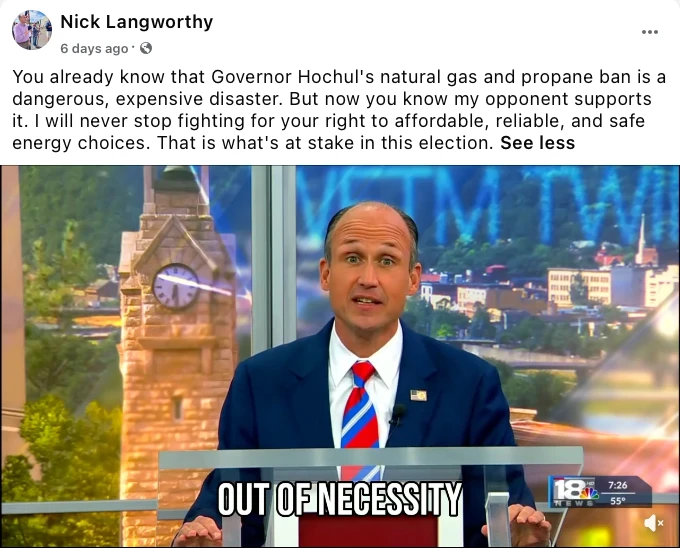
The October 9, 2026 post on the campaign page.
What his opponent said
The clip contains only Rep. Langworthy speaking. His Democratic opponent, Dr. Aaron Gies, addressed bans directly in the same exchange, less than a minute before the portion the clip uses (debate time 22:37-22:53):
“I also believe that the state’s climate law is too aggressive, and I will never support things like bans on wood-burning stoves or propane or no more hookups for natural gas. But that should be dealt with at the state level. We do not need a federal ban that would prohibit states from doing anything to diversify our energy mix.”
The moderator followed up: if the state mandates only one form of power, “is that a good or a bad thing?” Dr. Gies: “That would be a bad thing. We need a diversified energy mix.”
Rep. Langworthy responded to that answer. His next words (23:21), just before the clip begins, were: “I think that my opponent’s mistaken about the intention of New York State’s laws.”
Fair reading
Rep. Langworthy’s argument is that opposing his federal bill means leaving the state law in place. That is a real policy disagreement, and it is fair to say Dr. Gies opposes the Energy Choice Act (see Claim 2). It is a different statement to tell voters he “supports” the ban. He said on camera that he does not.
In plain language: the post says the opponent supports a gas and propane ban. On the same stage, minutes earlier, the opponent said he would never support one.
What “the ban” is, and its status
The post calls it “Governor Hochul’s natural gas and propane ban.” The law is the All-Electric Buildings Act, codified at Energy Law § 11-104(6)-(8). From the statute:
- It applies to new buildings: seven stories or fewer starting after December 31, 2025, and all new buildings after December 31, 2028.
- It covers “fossil-fuel equipment,” meaning equipment that burns fossil fuel. That includes propane as well as natural gas. Wood is not a fossil fuel.
- It does not apply to existing buildings, “including … the installation or continued use and maintenance of fossil-fuel equipment and building systems.”
- It exempts, among others, agricultural buildings, manufactured homes, emergency backup power, hospitals and commercial food establishments.
It is not in effect today. In Mulhern Gas Co. v. Mosley, the Secretary of State and the plaintiffs agreed in a stipulation, entered as a court order on November 18, 2025, to suspend the implementing code rules while the challenge was appealed. The Second Circuit upheld the law on June 30, 2026, denied rehearing on August 26 and issued its mandate on September 2. Under the stipulation, the suspension ends 120 days after the mandate, which is December 31, 2026, unless a Supreme Court petition is filed by about November 24, 2026 (a deadline the Court can extend).
In plain language: the state law bars no one from gas or propane today. When the rule takes effect, it will apply to new construction, not to any existing home.
Claims 2 and 3: “My opponent OPPOSES it” and “mandated to be in an all-electric home”
Statement
Source: Campaign Facebook page, October 8, 2026, with a 27-second clip:
“NY23 families deserve the freedom to choose how they heat their homes—and they deserve affordable options that will keep them safe in an emergency like Winter Storm Elliott. My Energy Choice Act protects that freedom from Kathy Hochul’s gas & propane ban. My opponent OPPOSES it. Don’t take my word for it. Hear him say it himself:”
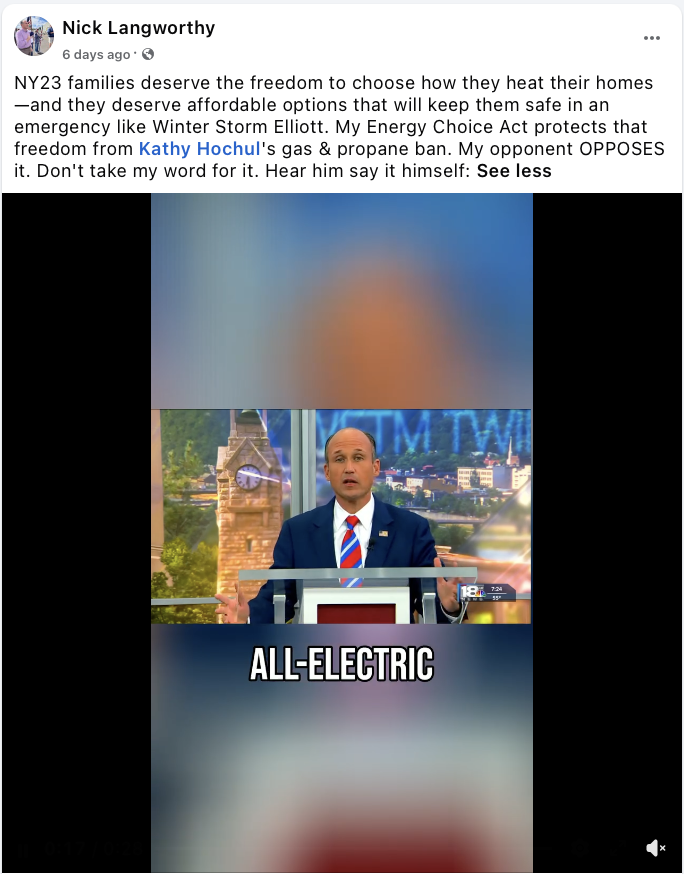
The October 8, 2026 post on the campaign page.
Claim 2 is true
The clip opens on Dr. Gies (debate time 21:35): “I oppose Nick Langworthy’s signature piece of legislation, the Energy Choice Act.” He said it, and the caption reports it accurately.
How the clip is cut
The full sentence in the debate is: “This is why I oppose Nick Langworthy’s signature piece of legislation, the Energy Choice Act, because by banning the bans, as he said, it would force consumers to pay natural gas prices forever, whatever the gas company wants to charge for them.” The clip drops “This is why” and everything after “the Energy Choice Act.” It then cuts to Rep. Langworthy’s reply and ends at 22:37, seconds before Dr. Gies’s next answer, in which he says he “will never support” bans on propane or new gas hookups.
Claim 3 is misleading
In the clip, Rep. Langworthy says of his opponent: “He believes that you should be mandated to be in an all-electric home.” This is his characterization of what Dr. Gies believes, drawn from Dr. Gies’s opposition to a federal bill. It came before Dr. Gies’s next answer, in which he said he would never support bans on wood stoves, propane or new gas hookups, and that a state mandate of one form of power “would be a bad thing.”
The characterization also overstates what any law would do. No state law or proposal we found mandates that anyone live in an all-electric home: the All-Electric Buildings Act applies to new construction and expressly leaves existing homes and their equipment alone. Opposing the Energy Choice Act is not the same as supporting a mandate.
What the Energy Choice Act does today
“My Energy Choice Act protects that freedom” describes a bill that is not law. H.R. 3699 was reported by the Energy and Commerce Committee on February 4, 2026 (H. Rept. 119-482) and has not received a floor vote. It has 157 cosponsors (154 Republicans, 3 Democrats); none have been added since February. The site’s earlier entry covers what the bill would do.
Claims 4 and 5: Winter Storm Elliott
Statement
Source: The same October 9 clip as Claim 1 (debate time 23:52-24:14):
“I mean, Winter Storm Elliott, we lost 69 lives in western New York in that horrible blizzard. It was the most desperate situation I have personally lived through. 911 collapsed. People froze to death in their homes. Those were the people that had baseboard electric heat only. The winds were so great that the power lines weren’t able to be restored for days.”
The death toll was 47
The Erie County medical examiner’s count, as reported by WIVB, was 46 deaths in Erie County, plus one in Niagara County, for 47. NYU Wagner’s after-action report on the storm (June 2023) gives the same Erie County figure: the storm killed “46 residents in Erie County.” We found no official source for 69.
What killed people
Erie County Executive Mark Poloncarz released the medical examiner’s breakdown of the 46 Erie County deaths: 18 people found outside in the snow; 12 who “died from no power or heat”; 7 from delayed EMS response; 4 found in vehicles; 4 from snow-blowing or shoveling; and a 3-year-old who drowned in a hotel pool where her family had stayed “due to loss of power.”
Some people did die in their homes because they lost power and heat, and Rep. Langworthy is right that this happened. Nothing in the county’s breakdown or the NYU report records what kind of heating those homes had. The NYU report says the outage, which reached about 20,000 customers in Buffalo from December 23 to 25, “often meant a loss of heat as well,” without distinguishing electric heat from other kinds. The one Niagara County death was a 27-year-old in Lockport who died when his furnace was buried in snow and sent carbon monoxide into his home.
“911 collapsed”
This part is supported. The NYU report documents “a backlog of 1,100 emergency calls,” county dispatch software “that could only view 25 calls at once,” and seven deaths attributed to delayed EMS response.
In plain language: the storm was a disaster and the emergency system was overwhelmed. But the death toll he gave is 22 higher than the official count, and no record shows the people who died in their homes had electric-only heat.
“Proposals in New York to ban wood heat”
In the same answer (23:31), Rep. Langworthy said “there are proposals in New York to ban wood heat.” We found no such bill. The state’s 2022 climate plan discusses wood smoke and projects less wood burning as homes electrify; we found no recommendation in it to ban wood heat. In January 2022, WHEC reported that a Department of Environmental Conservation spokesperson said the state was not considering legislation to ban heating homes with firewood. Our search of state legislation was limited because the State Senate’s site blocks automated queries, so we report this as unsupported rather than false.
Claim 6: “Kathy Hochul bans it”
Statement
Source: Campaign Facebook page, October 14, 2026, over a clip of Bruce Blakeman, the Republican candidate for governor, from the October 13 Spectrum News debate:
“Pennsylvania drills for natural gas, creates jobs, grows its economy, and enjoys cheaper energy. Right across the border, all along NY23 that I represent. Kathy Hochul bans it. Because of her failed energy policies, families get stuck with sky-high utility bills and lost opportunities. Pennsylvania prospers. Our great state suffers.”
The words in the clip are Mr. Blakeman’s. This entry checks the caption, which is Rep. Langworthy’s.
Who banned fracking
High-volume hydraulic fracturing, the drilling method used to produce gas from shale, is banned in New York. The state Department of Environmental Conservation prohibited it in a June 2015 findings statement (“high-volume hydraulic fracturing will be prohibited in New York State”). The Legislature wrote the ban into law in 2020 (Environmental Conservation Law § 23-0501(3)). Both came before Kathy Hochul became governor: she signed her first executive order as governor on August 24, 2021.
The ban covers high-volume fracturing (300,000 gallons of water or more) and fracturing with carbon dioxide. Conventional drilling is still legal. State well records show the department issued 52 oil-well development permits in 2024 and 58 in 2025, and 111 oil-development permits in Cattaraugus County since January 2024. New gas-well permits are another matter: they fell from 101 in 2010 to 23 in 2011 and have been zero to three a year since, with the last in 2017, years before Gov. Hochul took office.
“Enjoys cheaper energy”
This part is accurate. Federal Energy Information Administration data for 2025: average residential electricity cost 26.39 cents per kilowatt-hour in New York and 19.30 cents in Pennsylvania; residential natural gas cost $17.58 per thousand cubic feet in New York and $15.04 in Pennsylvania.
The statewide New York figure includes Con Edison in New York City (36.74 cents). Comparing the utilities that serve NY-23 with three large Pennsylvania utilities, using the same EIA data (full-service residential revenue divided by sales, our calculation): NYSEG 22.59 cents, RG&E 22.01, National Grid 19.89; PECO 18.02, PPL 18.60, FirstEnergy Pennsylvania 18.77. Duquesne Light in Pittsburgh, at 23.47, costs more than all three NY-23 utilities.
In plain language: New York does ban the drilling method Pennsylvania uses, and Pennsylvania’s power is cheaper. But the ban was put in place before Gov. Hochul took office, and for the utilities in NY-23 the price gap with those Pennsylvania utilities is about 6 to 25 percent, not the 37 percent the statewide averages suggest. The post offers no evidence that the remaining gap is caused by her policies.
Claim 7: “The law of the land in NY … now they want to take it nationwide”
Statement
Source: Official Facebook page (“Congressman Nick Langworthy”), October 13, 2026, with a clip from WBEN radio:
“Hochul and Albany Democrats made their disastrous green new deal the law of the land in NY and now they want to take it nationwide. I’m proud to be the tip of the spear on this fight against expensive, dangerous electrification mandates because we know all too well what’s at stake. #bantheban”
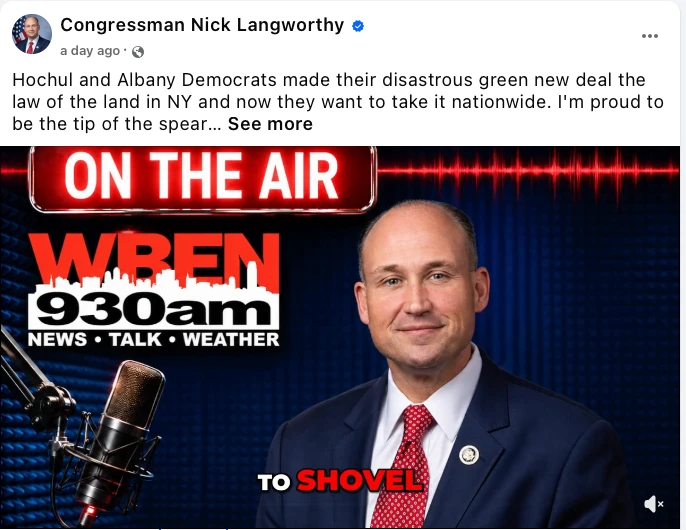
The October 13, 2026 post on the official page.
The record
We read “green new deal” as New York’s statewide climate law, the Climate Leadership and Community Protection Act (CLCPA). It was signed into law on July 18, 2019, as Chapter 106 of the Laws of 2019, more than two years before Kathy Hochul became governor.
As governor, she has since loosened it. After she sought relief from the Legislature in the budget process, the state budget enacted on May 26, 2026 amended the law. Columbia Law School’s Climate Law Blog called the changes “a substantial rollback of the Act’s ambition.” The current text of ECL § 75-0109 moves the deadline for the state’s implementing regulations to December 31, 2028, and directs them to achieve a 60 percent emissions cut by 2040 “to the maximum extent feasible and cost effective.”
We found no proposal from Gov. Hochul or the Legislature’s Democrats to apply the CLCPA or an all-electric mandate nationally.
In plain language: the climate law is real, but it predates Gov. Hochul’s time as governor, she has since weakened it, and nothing shows anyone trying to take it nationwide.
Questions this raises
- Rep. Langworthy heard Dr. Gies say he would “never support” bans on propane or new gas hookups, and answered it on stage. On what basis did the campaign then post that his opponent “supports” the ban?
- Where does the figure of 69 deaths come from? The Erie County medical examiner counted 46, and with Niagara County the total is 47.
- What record shows that the people who died in their homes had baseboard electric heat only?
- Which “proposals in New York to ban wood heat” was he referring to?
Sources
- Facebook posts (screenshots above; video files and transcripts retained, see archive note): campaign page, October 8, October 9 and October 14, 2026; official page, October 13, 2026
- WETM congressional debate, October 6, 2026: full video and transcript retained under
research/sources/debate-2026-10-06/; quoted passages at 21:35-23:17 (Gies and Langworthy on the Energy Choice Act) and 23:21-24:29 (Langworthy on Winter Storm Elliott) - CBS New York, Hochul-Blakeman debate recap (speaker of the October 14 clip), October 13, 2026: https://www.cbsnews.com/newyork/news/hochul-blakeman-immigration-economy-new-york-governors-debate/ (archived: https://web.archive.org/web/20261015202137/https://www.cbsnews.com/newyork/news/hochul-blakeman-immigration-economy-new-york-governors-debate/)
- NY Energy Law § 11-104 (All-Electric Buildings Act): https://www.nysenate.gov/legislation/laws/ENG/11-104 (archived: https://web.archive.org/web/20261015202226/https://www.nysenate.gov/legislation/laws/ENG/11-104)
- Mulhern Gas Co. v. Mosley, N.D.N.Y., Stipulation and Order, November 18, 2025 (Dkt. 75): https://storage.courtlistener.com/recap/gov.uscourts.nynd.140479/gov.uscourts.nynd.140479.75.0_1.pdf (archived: https://web.archive.org/web/20261015203729/https://storage.courtlistener.com/recap/gov.uscourts.nynd.140479/gov.uscourts.nynd.140479.75.0_1.pdf)
- Mulhern Gas Co. v. Mosley, Second Circuit opinion, June 30, 2026: https://dos.ny.gov/system/files/documents/2026/07/decision-mulhern-gas-v.-mosley-2d-cir.pdf (archived: https://web.archive.org/web/20261015203540/https://dos.ny.gov/system/files/documents/2026/07/decision-mulhern-gas-v.-mosley-2d-cir.pdf)
- Second Circuit order denying rehearing en banc, August 26, 2026: https://storage.courtlistener.com/recap/gov.uscourts.ca2.4c5fbab7-9ae9-4276-8d05-4b42e5bdf354/gov.uscourts.ca2.4c5fbab7-9ae9-4276-8d05-4b42e5bdf354.86.0.pdf (archived: https://web.archive.org/web/20261015203835/https://storage.courtlistener.com/recap/gov.uscourts.ca2.4c5fbab7-9ae9-4276-8d05-4b42e5bdf354/gov.uscourts.ca2.4c5fbab7-9ae9-4276-8d05-4b42e5bdf354.86.0.pdf)
- Second Circuit docket, No. 25-2041 (entry 87, “JUDGMENT MANDATE, ISSUED,” September 2, 2026): https://www.courtlistener.com/docket/71197226/mulhern-gas-co-inc-v-mosley/ (Wayback save failed; page-text copy retained under
research/sources/triage-2026-10-15/energy/) - H.R. 3699, Energy Choice Act, status: https://www.govinfo.gov/bulkdata/BILLSTATUS/119/hr/BILLSTATUS-119hr3699.xml (archived: https://web.archive.org/web/20261015203056/https://www.govinfo.gov/bulkdata/BILLSTATUS/119/hr/BILLSTATUS-119hr3699.xml)
- Erie County medical examiner breakdown, via WIVB: https://www.wivb.com/weather-news/buffalo-blizzard-2022/erie-county-medical-examiner-confirms-three-more-blizzard-related-deaths-bringing-total-to-47/ (archived: https://web.archive.org/web/20240529140246/https://www.wivb.com/weather-news/buffalo-blizzard-2022/erie-county-medical-examiner-confirms-three-more-blizzard-related-deaths-bringing-total-to-47/)
- NYU Wagner, “Lessons Learned from the Buffalo Blizzard,” 2023: https://wagner.nyu.edu/files/faculty/publications/NYU%20Buffalo%20Blizzard%20Report%20-%20June2023_0.pdf (archived: https://web.archive.org/web/20250612030731/https://wagner.nyu.edu/files/faculty/publications/NYU%20Buffalo%20Blizzard%20Report%20-%20June2023_0.pdf)
- NYS Climate Action Council, Final Scoping Plan, 2022: https://climate.ny.gov/-/media/Project/Climate/Files/NYS-Climate-Action-Council-Final-Scoping-Plan-2022.pdf (archived: https://web.archive.org/web/20261015202402/https://climate.ny.gov/-/media/Project/Climate/Files/NYS-Climate-Action-Council-Final-Scoping-Plan-2022.pdf)
- WHEC, “Fact Check: No more firewood in New York?”, January 6, 2022: https://www.whec.com/archive/fact-check-no-more-firewood-in-new-york/ (archived: https://web.archive.org/web/20261015203158/https://www.whec.com/archive/fact-check-no-more-firewood-in-new-york/)
- NYS DEC, High-Volume Hydraulic Fracturing Findings Statement, June 2015: https://extapps.dec.ny.gov/docs/materials_minerals_pdf/findingstatehvhf62015.pdf (archived: https://web.archive.org/web/20261015203942/https://extapps.dec.ny.gov/docs/materials_minerals_pdf/findingstatehvhf62015.pdf)
- NY Environmental Conservation Law § 23-0501: https://www.nysenate.gov/legislation/laws/ENV/23-0501 (archived: https://web.archive.org/web/20250306150052/https://www.nysenate.gov/legislation/laws/ENV/23-0501)
- NYS DEC oil and gas well data (data.ny.gov dataset szye-wmt3), permits by year, type and county, queried October 15, 2026: https://data.ny.gov/d/szye-wmt3 (queries and results retained in
research/sources/triage-2026-10-15/energy/data-ny-dec-queries-reproducible.txt) - EIA, Electric Power Monthly, February 2026 (Table 5.6.B, 2025 residential prices): https://www.eia.gov/electricity/monthly/archive/february2026.pdf (archived: https://web.archive.org/web/20261015204449/https://www.eia.gov/electricity/monthly/archive/february2026.pdf)
- EIA, natural gas residential prices by state, annual: https://www.eia.gov/dnav/ng/ng_pri_sum_a_EPG0_PRS_DMcf_a.htm (archived: https://web.archive.org/web/20261015204051/https://www.eia.gov/dnav/ng/ng_pri_sum_a_EPG0_PRS_DMcf_a.htm)
- EIA Form 861, 2025 utility-level sales and revenue: https://www.eia.gov/electricity/data/eia861/zip/f8612025.zip (per-utility calculation retained under
research/sources/triage-2026-10-15/energy/) - CLCPA, S6599 (2019), signed as Chapter 106: https://www.nysenate.gov/legislation/bills/2019/S6599 (archived: https://web.archive.org/web/20250118012856/https://www.nysenate.gov/legislation/bills/2019/S6599)
- Governor Kathy Hochul, Executive Order No. 1, August 24, 2021: https://www.governor.ny.gov/executive-order/no-1-review-continuation-and-expiration-prior-executive-orders (archived: https://web.archive.org/web/20261008160353/https://www.governor.ny.gov/executive-order/no-1-review-continuation-and-expiration-prior-executive-orders)
- Columbia Law School Climate Law Blog, “Unpacking New York State’s Rollback of its Landmark Climate Law,” June 5, 2026: https://blogs.law.columbia.edu/climatechange/2026/06/05/unpacking-new-york-states-rollback-of-its-landmark-climate-law/ (archived: https://web.archive.org/web/20261016003628/https://blogs.law.columbia.edu/climatechange/2026/06/05/unpacking-new-york-states-rollback-of-its-landmark-climate-law/)
- NY Environmental Conservation Law § 75-0109, as revised May 29, 2026: https://www.nysenate.gov/legislation/laws/ENV/75-0109 (archived: https://web.archive.org/web/20261015202119/https://www.nysenate.gov/legislation/laws/ENV/75-0109)
Related
- Energy Choice Act: What the Bill Does, Who Supports It, and What It Leaves Out
- Energy: ‘All-of-the-Above’ Framing Omits His Votes Against Clean Energy for Rural NY
- Federal Preemption Pattern: Three Bills, One Playbook
- Langworthy Blames Clean Energy for Costs That Natural Gas and Utility Profits Actually Drive
- Who’s Really Driving Your Electric Bill? A Data Investigation into NY Utility Rates
- “Albany Pushes Wind Turbines in Lake Erie”: There Is No State Lake Erie Wind Project
Note: This entry documents publicly available information from New York statutes, federal and state court records, the Energy Information Administration, the Department of Environmental Conservation, Erie County and the WETM debate video. It makes no claim about motive. Corrections with sources are welcome at [email protected].
Last updated: October 15, 2026