He Did It Again: "$1M Secured" for Olean Police That Congress Has Not Funded
Why this matters
Three weeks ago we documented Langworthy announcing money for two hospital radiology labs as “delivered” and “secured” when it was only a request in a draft bill. He has now used the same past tense for the Olean Police Department. This one has gotten further — it passed the House on June 4 — but it is still not law, and the reason that matters is not hypothetical: the last time he “secured” a batch of these earmarks, Congress wiped out every one of them.
Statement
Source: Facebook, Rep. Nick Langworthy, July 2026 (screenshot archived below)
“Proud to be in Olean today to announce I secured $1 million through Community Project Funding for the Police Department to upgrade their 67 year old facility. … This funding passed the House last month and now the Senate must act so we can get this worthy project moving.”
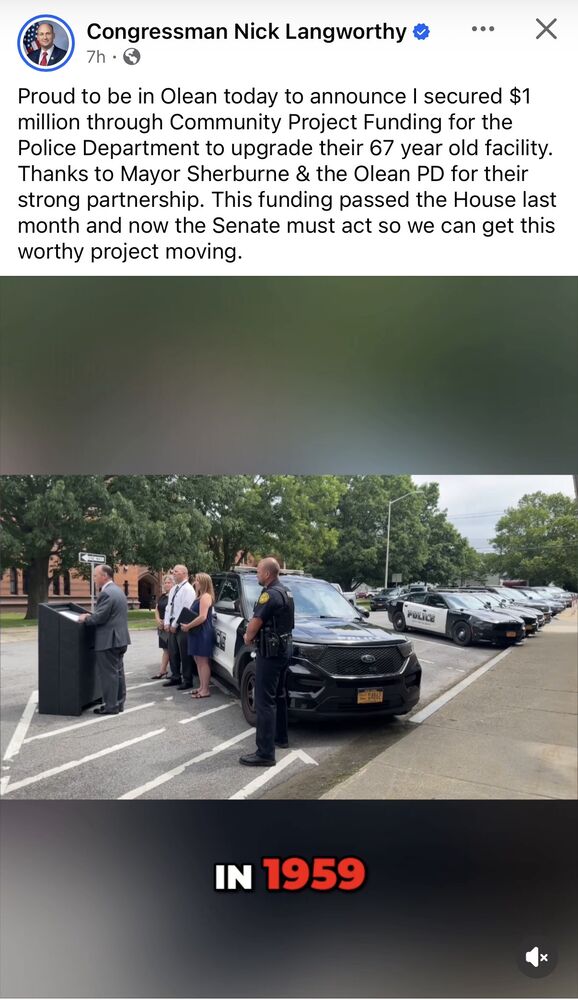
Rep. Langworthy’s July 2026 Facebook post. He says he ‘secured’ the money in the same sentence that says the Senate has not yet acted. Captured July 2026.
The Facts
What is true: it did pass the House. The City of Olean Police Department Modernization Project is on Langworthy’s official FY2027 Community Project Funding disclosure. His own federal-nexus letter (March 19, 2026) shows the money would flow through the USDA Rural Development Community Facilities program (7 U.S.C. §1926(a)) — that is, the FY2027 Agriculture-Rural Development appropriations bill. That bill is H.R. 8646, and it passed the House on June 4, 2026, by 213-210 (Roll Call 205; Langworthy voted yes). The project is named in the Community Project Funding table of the accompanying report, H. Rept. 119-632: “Olean, NY — City of Olean — Police Department Modernization — 1,000,000 — Langworthy.” His post’s line “this funding passed the House last month” is accurate.
What is not true is “secured.” H.R. 8646 was received in the Senate on June 8, 2026, and the Senate has taken no action on it since. No FY2027 appropriations bill has become law. By his own words in the same post, “the Senate must act.” The Olean Times Herald described it, accurately, as “House movement.” (The nexus letter also confirms this is a single federal request to modernize a 1959 facility that has “reached critical failure” — there is no separate, already-secured funding stream for it.)
The same announcement bundled a second request that has not passed anything. On the same day, he also touted the Cattaraugus County Emergency 911 Center Modernization and Upgrade Project (303 Court St., Little Valley) — another item on his official FY2027 CPF disclosure, part of what the Olean Times Herald summarized as “House movement” on more than $2 million in local public-safety requests. Unlike the police facility, the 911 project is not in H. Rept. 119-632’s project table, and it is not in the only other FY2027 appropriations bill the House has passed (H.R. 8595, National Security and State, H. Rept. 119-631). It has cleared neither chamber. His Facebook post says the money “will strengthen our 911 system” for Cattaraugus County — future tense doing the work the past-tense headline (“secured”) skips.
This is the third documented instance of the same past-tense framing — after the FY2026 appropriations credit-claim and the June 2026 hospital-radiology posts (UPMC Chautauqua $300K, Arnot $500K), where he said “delivered” and “secured” for identical not-yet-enacted FY2027 requests.
And here is why “secured” is the wrong word. For FY2025, Congress never passed full-year appropriations; it enacted a full-year continuing resolution (P.L. 119-4) that funded zero Community Project Funding. Every FY2025 earmark sitting in the House and Senate bills — Langworthy’s own included — received nothing, and he had to re-file the same projects for FY2026 to get them enacted. Being in a bill did not “secure” a dollar. Olean is at that same, vulnerable stage now.
In plain language: He told a police department he “secured” their money. He filed a request for it. His last batch of identical requests was erased before it became law.
Context
The request is genuine, the project (a 67-year-old police facility) is real, filing earmarks is a legitimate part of the job, and Langworthy did disclose in the same post that “the Senate must act.” The issue is not that he is doing anything improper — it is the recurring gap between the headline (“I secured”) and the reality (a request that has not passed, in a process that erased his last batch). “Requested $1 million for next year’s budget” is accurate. “Secured” is not, not yet.
Questions This Raises
- Is money that has passed one chamber, awaits the other, and is not law — money his own post says still needs Senate action — accurately called “secured”?
- Given that his FY2025 earmarks were zeroed out at this same stage, what assurance does Olean have that this survives?
- Will he tell Olean if the funding is reduced or dropped, as the FY2025 items were?
Sources
- FY2027 CPF requests (lists “City of Olean Police Department Modernization Project”): langworthy.house.gov appropriations requests FY27
- Federal-nexus letter for the Olean project — routed through USDA Rural Development / Community Facilities (7 U.S.C. §1926(a)); a single federal request, dated March 19, 2026: langworthy.house.gov (PDF)
- Local reporting: Langworthy touts House movement on aid to 911 system, Olean police projects (Olean Times Herald, July 9, 2026)
- FY2025 full-year CR (P.L. 119-4) funded no CPF: CRS R48517
- H.R. 8646, FY2027 Agriculture-Rural Development appropriations — bill status and actions (passed House June 4, 2026; received in Senate June 8, 2026): govinfo BILLSTATUS
- Roll Call 205, June 4, 2026, On Passage, 213-210, Langworthy “Yea”: clerk.house.gov
- H. Rept. 119-632, Community Project Funding table (Olean Police Department Modernization, $1,000,000, Langworthy): govinfo (PDF)
- H. Rept. 119-631 (H.R. 8595, the other House-passed FY2027 bill; contains no Langworthy project): govinfo (PDF)
- Continuing Appropriations and Extensions Act, 2027 (P.L. 119-103), §106 — funding through December 11, 2026: govinfo, enrolled text
Related: The June 2026 hospital-radiology credit-claim · FY2026 appropriations credit-claim
Correction and Update
September 8, 2026. A routine re-check of the FY2027 appropriations record against primary sources found an error in this entry, now corrected.
What was wrong. This entry originally described the FY2027 Agriculture-Rural Development bill as “one of the twelve FY2027 bills the House has been moving through committee, one at a time,” and asked in Question 1 whether money “that has not passed the House floor” could be called secured. Both were incorrect. The bill is H.R. 8646, and it had passed the House on June 4, 2026 — five weeks before this entry was published — by 213-210 on Roll Call 205, with Langworthy voting yes. The Olean project is named in the Community Project Funding table of the accompanying report, H. Rept. 119-632, at the full $1,000,000. Langworthy’s statement that “this funding passed the House last month” was accurate, and this entry wrongly implied otherwise. The error came from treating the twelve-bill process as still being at the committee stage without checking the roll-call record. Both passages have been rewritten.
What did not change. The verdict stands. H.R. 8646 has sat in the Senate since June 8, 2026 with no action; no FY2027 appropriations bill has become law; and his own post said “the Senate must act.” “Secured” still describes money that does not yet exist. The Olean Times Herald’s “House movement,” quoted here from the start, was the accurate description then and now.
And the FY2025 risk this entry warned about is now live again. On September 2, 2026, Congress enacted a stopgap (P.L. 119-103) funding the government at FY2026 levels through December 11, 2026. It carries no Community Project Funding — the phrase does not appear in the enacted text. That is the same posture that erased his FY2025 earmarks: projects sitting in an unfinished appropriations bill while a continuing resolution carries the government past them. The Olean money remains unappropriated.
Two other Langworthy projects appear in the same House-passed report and were not previously noted here: Hornell fire truck replacement ($896,646) and Village of Angola snow removal equipment ($500,000). Like Olean, both passed the House and await the Senate.
Note: This entry documents publicly available information about a member’s appropriations request and how it was described. Requesting earmarks is a legal, disclosed part of the process; this addresses the accuracy of “secured.” Last updated: September 8, 2026 (corrected: the bill had passed the House on June 4, 2026).