Northern Border Bill: What H.R. 5517 Does, and What the Watchdog Actually Found
Verdict: MISSING CONTEXT. Langworthy did introduce a real northern-border bill (H.R. 5517) and it did advance out of committee — but the post sells a reporting-and-review measure as enforcement, and it leans on a GAO “watchdog” report while answering just one of that report’s three recommendations and ignoring its headline finding.
Update, September 18, 2026: H.R. 5517 passed the House by voice vote on September 16, and a different Senate version had already passed the Senate on August 5. Neither has passed both chambers. Two of his posts since then describe the bill accurately; three do not. See the update below.
Rep. Langworthy shared a Just the News graphic and wrote that “cartels and other bad actors are desperate to exploit” the northern border, adding: “My Northern Border Security and Enforcement Act will ensure we are protected on all fronts.” Two pieces of context change the impression the post leaves. First, the bill is a review-and-reporting measure — it directs DHS to study the border, update a strategy, brief Congress, and build performance metrics. It does not deploy agents, appropriate money, or create new enforcement powers. Its actual title — the “Northern Border Security Enhancement and Review Act” — describes it more accurately than the “Security and Enforcement Act” label in the post. Second, the “government watchdog” the graphic invokes found that the northern border’s headline problem is a 6% decline in Border Patrol agents there between 2019 and 2024 — a staffing gap the bill does not address.
Why This Matters for NY-23
NY-23 runs along Lake Erie in Chautauqua County and abuts the Buffalo–Fort Erie crossing area, so northern-border policy is a genuine local issue, not an abstraction. Constituents deserve to know what their representative’s bill would actually do at that border. The honest answer is that H.R. 5517 is an oversight tool — it forces DHS to measure and report on its own performance — which is a real and defensible thing to want. It is not, however, the resource-and-enforcement package the phrase “protected on all fronts” implies.
Statement
Source: Facebook Post, July 2026
“We can’t afford to neglect security at our Northern Border where cartels and other bad actors are desperate to exploit any vulnerability they can find. My Northern Border Security and Enforcement Act will ensure we are protected on all fronts.”
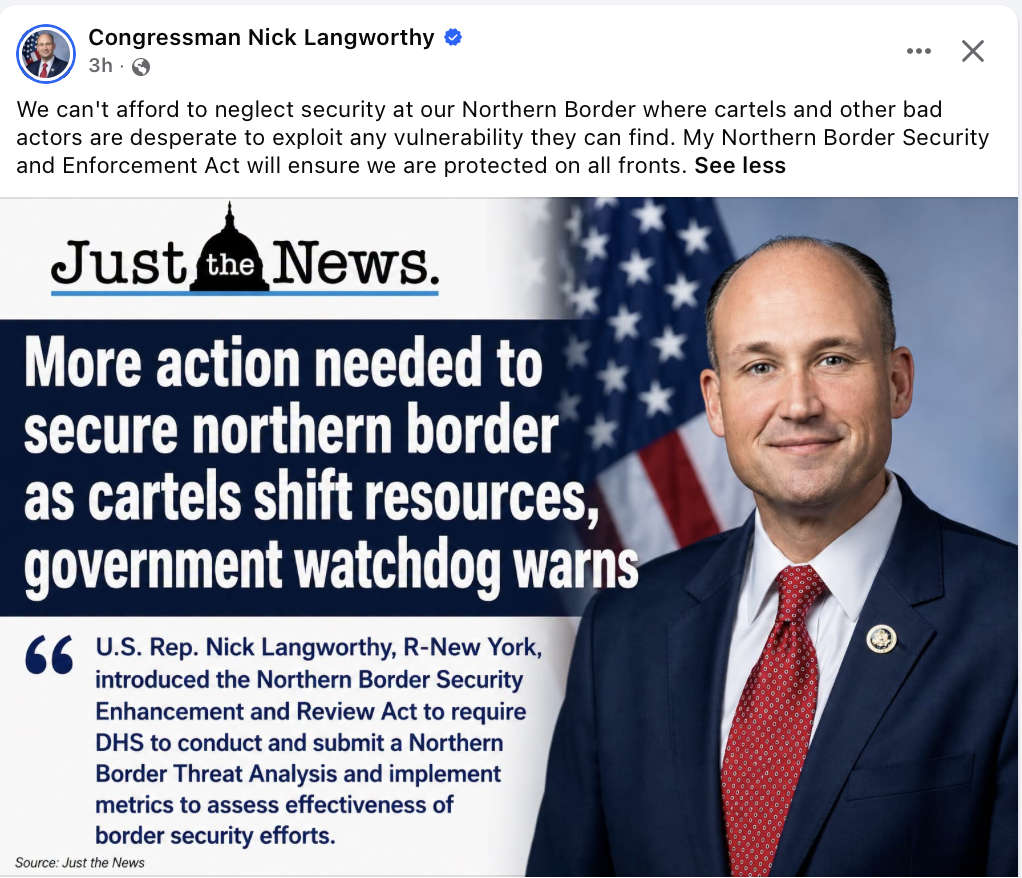
Rep. Langworthy’s July 2026 Facebook post. Source: Congressman Nick Langworthy (verified page), facebook.com.
The attached graphic, sourced to Just the News, reads:
“U.S. Rep. Nick Langworthy, R-New York, introduced the Northern Border Security Enhancement and Review Act to require DHS to conduct and submit a Northern Border Threat Analysis and implement metrics to assess effectiveness of border security efforts.”
What the Bill Actually Does
The bill is H.R. 5517, the Northern Border Security Enhancement and Review Act, introduced September 19, 2025, with 26 cosponsors (a Senate companion, S. 850, was introduced separately). According to Langworthy’s own press release and the bill’s summary, it directs the Department of Homeland Security to:
- Conduct and submit a Northern Border Threat Analysis to Congress.
- Update the Northern Border Strategy within 90 days of that analysis — or submit a justification if no update is needed.
- Provide classified briefings to Congress within 30 days of submitting the threat analysis.
- Develop performance measures to assess the effectiveness of Air and Marine Operations at the northern border.
What the bill does not do is equally important: it does not appropriate any funding, does not authorize or hire any additional Border Patrol agents or CBP personnel, and does not create any new enforcement authority. Every operative provision is a requirement to analyze, strategize, brief, or measure — the tools of congressional oversight, not border deployment.
In plain language: This is a bill that tells DHS to do its homework and show its work. That can be worthwhile. But it is a reporting bill, not a manpower or barrier bill, and “will ensure we are protected on all fronts” overstates what studies and metrics accomplish on their own.
Where It Stands
On June 24, 2026, the House Homeland Security Committee ordered the bill reported by a bipartisan 28–2 vote. That is a real and notable step — but it is a committee vote, not final passage. As of this writing the bill has not passed the full House and has not become law. [Update, September 18, 2026: it passed the House by voice vote on September 16, 2026. It has not become law. See the update below.] The post’s framing (“will ensure we are protected”) implies a settled outcome that has not yet occurred.
What the “Government Watchdog” Actually Found
The graphic’s headline — “More action needed to secure northern border as cartels shift resources, government watchdog warns” — refers to Government Accountability Office reporting: testimony delivered June 30, 2026 (GAO-26-109195), which drew on the GAO’s February 2026 report (GAO-26-107501). The GAO’s actual findings are more specific than the graphic suggests:
- Staffing fell, it didn’t grow. The number of Border Patrol agents assigned to the northern border decreased by roughly 6% from fiscal 2019 to 2024, even as authorized positions rose. Staffing of the specialists who monitor surveillance technology also declined.
- A measurement gap the GAO has flagged since 2019. CBP “did not have measures to assess its effectiveness at securing the northern border between ports of entry” — a shortfall the GAO first identified in a 2019 audit and found still unresolved.
- Apprehensions rose, then fell. Northern-border apprehensions climbed sharply in 2023–2024, then decreased in 2025 and stayed at those reduced levels through April 2026.
The GAO made three recommendations: (1) develop a plan to fill the staffing gap among the Law Enforcement Information Systems Specialists who monitor surveillance technology, (2) create northern-border-specific performance measures for Border Patrol, and (3) do the same for Air and Marine Operations. DHS agreed with all three. (The 6% decline in Border Patrol agents is a documented finding, not itself the subject of a formal recommendation.)
Where the Bill Matches the Watchdog — and Where It Doesn’t
To be fair to the bill: it answers one of the GAO’s three recommendations. Its one substantive metrics provision requires northern-border-specific performance measures for Air and Marine Operations — exactly what the GAO called for. That is a legitimate, evidence-responsive piece of legislating, and it deserves to be counted as such.
The gap is what’s left out. The GAO’s other two recommendations get no provision in the bill: northern-border-specific performance measures for Border Patrol (the words “Border Patrol” do not appear in H.R. 5517 at all), and a plan to fill the staffing gap among the surveillance-technology specialists. And the bill does nothing about the GAO’s headline finding — the 6% decline in Border Patrol agents on the northern border. The bill would require DHS to measure effectiveness; it would not add a single agent, or a single specialist, to reverse the staffing declines the same watchdog documented. A post that leans on the GAO to argue the border is under-secured, while promoting a bill that answers one of its three recommendations and none of its staffing concerns, is telling only part of the story.
There is also a framing point in the Just the News headline itself. The claim that cartels are “shift[ing] resources” to the north because the southwest border is now secure is a characterization offered by lawmakers at the hearing; the GAO’s own data shows the staffing decline spans 2019–2024 — a window that includes the first Trump administration — and reporting notes cartel expansion into Canada predates the current administration. The problem is structural and long-running, not a sudden post-2025 shift.
A Note on the Bill’s Name
The post calls it the “Northern Border Security and Enforcement Act.” The bill’s real name is the “Northern Border Security Enhancement and Review Act.” This is a small thing, but it cuts in a revealing direction: the actual title (“Enhancement and Review”) is the more accurate description of a bill built around threat analyses, strategy updates, and performance metrics. The post’s version (“Enforcement”) makes a reporting bill sound like a deployment.
Update — September 18, 2026: The Bill Passed the House. Two Posts Got It Right, Three Did Not.
On September 16, 2026, the House passed H.R. 5517 by voice vote under suspension of the rules, after forty minutes of debate. There was no roll call, so there is no recorded vote by member. The bill was received in the Senate the same day and placed on the Senate calendar (Calendar No. 628). It is not law.
Over the next two days, his official Facebook page posted about the bill four times. This update checks each post against the bill text and the government data it cites. Two of them describe the bill accurately. Three do not.
First, a Senate version already passed, and it is not the same bill
The July version of this entry noted that a Senate companion, S. 850, “was introduced separately.” It has since moved further than the House bill. S. 850, sponsored by Sen. Maggie Hassan (D-N.H.), passed the Senate by unanimous consent on August 5, 2026, six weeks before the House vote, and has been held at the desk in the House since August 10. The House passed its own bill, H.R. 5517, instead. Each bill has now passed one chamber. Neither has passed both.
The two passed texts share a purpose and differ in detail:
| Provision | H.R. 5517, as passed by the House | S. 850, as passed by the Senate |
|---|---|---|
| Threat analysis | Due September 2, 2026, then every two years | Due 180 days after enactment, then every three years |
| Sector-level apprehension analysis | Not included | Required: “an analysis of apprehension changes at the sector level” |
| Strategy update | Within 90 days of each threat analysis, or a notice that none is needed | Within 18 months, then every five years |
| Classified briefings | Within 30 days of each analysis | Within 30 days of each analysis |
| Air and Marine Operations performance measures | Within six months | Within 180 days |
| Border Patrol staffing, agents, funding | None | None |
Two details worth knowing. The House text sets the first threat analysis for September 2, 2026, a date that had already passed when the House voted on September 16; the text was drafted in July and was not updated. And the Senate version requires exactly the sector-by-sector breakdown discussed below — the breakdown one of his posts leaves out.
In plain language: two similar reporting bills have each passed one chamber. For either to become law, one chamber has to pass the other’s version, or both have to agree on a single text. The House is out until November 9.
What he got right
The September 17 post describing the bill says it requires “regular threat assessments, an updated security strategy, and stronger Congressional oversight.” That is accurate. It is a real improvement over the July post this entry examined, which called it the “Security and Enforcement Act” and said it would “ensure we are protected on all fronts.”
The floor speech is accurate too. We transcribed it from the video his office posted. He described the bill as requiring DHS “to regularly assess threats along our northern border,” update its strategy, and “ensure Congress has the information necessary to conduct effective oversight.” His numbers check out: Border Patrol apprehensions between ports of entry on the northern border went from “just 916 in fiscal year 2021 to more than 23,000 in fiscal year 2024” (CBP’s public data shows 916 and 23,721), and the Buffalo Sector recorded 170 drug seizure events in fiscal 2024, “nearly double” the year before (GAO’s table shows 92 → 170). He also said, on the floor, that “the situation [at] our borders has improved.”
What he got wrong: “the right resources”
On September 18, his office posted the full floor speech, as carried on WBEN, with this caption:
“My Northern Border Security Enhancement Act gives law enforcement the right resources to secure our border, stop threats and protect families.”
The bill provides no resources. Neither the House text nor the Senate text contains any funding, personnel, equipment, or new enforcement authority; the only words beginning with “appropriat-” in the House bill are two references to “the appropriate congressional committees.” And the speech under that caption says otherwise: in it, he describes the goal as making sure law enforcement has “the strategy that reflects the threats that they’re actually facing.” The caption also drops “and Review” from the bill’s name, the same direction of drift this entry noted in July.
In plain language: his own floor speech describes a planning-and-reporting bill accurately. The caption his office wrote for that speech describes a resource bill that does not exist.
“Nearly quadrupled”: an accurate number, selectively quoted
A September 17 post says: “In just five years, Border Patrol apprehensions there nearly quadrupled, from 6,618 to almost 25,000.”
The numbers are accurate. They come from GAO-26-109195 — the same watchdog report this entry examined in July — which shows northern-border apprehensions rising from 6,618 in fiscal 2019 to 24,968 in fiscal 2024, an increase of 277 percent.
The same report, in the sentences that follow, says three things the post leaves out:
| What GAO reports | Figure |
|---|---|
| Where the increase happened | Almost entirely the Swanton sector (Vermont and northeastern New York), 1,563 → 19,773, and Blaine (Washington), 600 → 2,940 |
| The other six sectors, combined | Down 49 percent, 4,455 → 2,255 |
| Buffalo Sector, which covers Western New York | Down 31 percent, 736 → 508 |
| Since then | Apprehensions fell in early fiscal 2025 and “remained generally consistent at these reduced levels from April 2025 through April 2026” |
In plain language: the northern-border surge he cites was real, but it happened mostly in Vermont and Washington State. Over the five years he describes, apprehensions in Western New York’s own sector went down. And the surge had already reversed before his bill passed.
A note on the Buffalo numbers since fiscal 2024, because they point the other way. CBP’s public encounter data shows Buffalo Sector Border Patrol encounters rising after fiscal 2024: 458 in fiscal 2024, 1,420 in fiscal 2025, and 1,741 in the first ten months of fiscal 2026. Those later numbers are not comparable to the earlier years as a measure of people crossing the border. Over the same period, CBP’s own release describes Buffalo Station agents conducting immigration inspections at more than ten locations along the western Thruway in November 2025, arresting 37 men, 30 of whom held valid commercial driver’s licenses from nine states; the release cites unlawful presence and road safety and does not mention criminal history. Reporting by NY Focus describes Border Patrol arrests of greenhouse workers about 20 miles outside Rochester in 2026; in one case, CBP said the man arrested had a 2023 deportation order and a “criminal record.” The citizenship mix changed too: Canadian citizens made up between 9 and 30 percent of Buffalo Sector encounters from fiscal 2021 through 2024 and fell out of the top five after that. The later increase reflects, at least in part, where and whom agents are stopping, not only who is crossing. CBP’s public data does not record where an encounter took place, how long a person had been in the country, or whether they had a criminal record, so it cannot settle how much of the increase is which. (GAO’s series and CBP’s public series count differently; we have not combined them in any single comparison.)
“Enough to potentially kill 270 million Americans”: not supported by CBP’s own data
A September 17 post says: “In 2024, illegal crossings surged and the amount of fentanyl seized there was enough to potentially kill 270 million Americans.”
CBP publishes its drug seizures by region. For the Northern Border in fiscal 2024, CBP reports 43.0 pounds of fentanyl seized across 82 seizure events — 0.2 percent of all the fentanyl CBP seized that year. The Drug Enforcement Administration states that “one kilogram of fentanyl has the potential to kill 500,000 people.” By DEA’s own ratio, 43.0 pounds (19.5 kilograms) comes to about 9.75 million potential doses. Reaching 270 million would take about 540 kilograms — roughly 1,190 pounds, nearly 28 times what CBP reports. Even fiscal 2025, when northern-border seizures rose to 77.1 pounds, comes to about 17.5 million by the same ratio.
The administration’s own figure is 9.5 million. On February 1, 2025, the White House’s order imposing duties to address illicit drugs crossing the northern border stated: “the amount of fentanyl that crossed the northern border last year could kill 9.5 million Americans.” That is close to what CBP’s seizure data yields, and it is roughly one twenty-eighth of the figure in his post.
Where we looked for the 270 million figure, and what we found. The post’s full text cites no source. The attached 16-second video is a WIVB news segment on the bill’s passage: we transcribed its audio, which describes the bill and mentions no fentanyl figure, and ran text recognition on every frame at two per second, which found no “270,” no “fentanyl” and no source (the same pass did pick up the on-screen words “Northern,” “Border” and “Langworthy,” so it was reading the frames). His floor speech on the bill, which we also transcribed, does not mention fentanyl at all. CBP’s published data does not support the figure, and neither the White House order nor a Manhattan Institute analysis comparing large seizures at the two borders contains it. Web searches for the phrase did not turn up a source. That is the extent of our search; it is not proof that no source exists.
Verdict on this claim: NOT SUPPORTED. CBP’s published figures contradict it by more than an order of magnitude, but we have not ruled out that the office is drawing on a dataset we have not seen. If the office identifies its source, we will publish it here.
What has not changed
The bill that passed is the bill this entry examined in July: a reporting and review measure. It still contains no Border Patrol staffing plan, no new agents, no funding, and no new enforcement authority, and it still does not address the headline finding of the GAO report it answers — a 6 percent decline in northern-border Border Patrol agents. The verdict stands: MISSING CONTEXT.
Questions this update raises
- The Senate passed a version of this bill by unanimous consent on August 5. What is the plan for reconciling the two texts, and when?
- The Senate version requires DHS to analyze apprehension changes “at the sector level.” Does he support that requirement, given that Western New York’s sector saw a decline over the period his post describes?
- What is the source of the “270 million Americans” fentanyl figure?
- His floor speech describes a strategy-and-reporting bill. Why does the caption on that same speech say it gives law enforcement “the right resources”?
Sources added in this update
- govinfo BILLSTATUS, H.R. 5517 (House passage by voice vote, Sept. 16, 2026; Senate Calendar No. 628): https://www.govinfo.gov/bulkdata/BILLSTATUS/119/hr/BILLSTATUS-119hr5517.xml (archived)
- H.R. 5517, engrossed in House: https://www.govinfo.gov/content/pkg/BILLS-119hr5517eh/xml/BILLS-119hr5517eh.xml (archived)
- govinfo BILLSTATUS, S. 850 (passed Senate by unanimous consent, Aug. 5, 2026; held at the House desk, Aug. 10): https://www.govinfo.gov/bulkdata/BILLSTATUS/119/s/BILLSTATUS-119s850.xml
- S. 850, engrossed in Senate: https://www.govinfo.gov/content/pkg/BILLS-119s850es/xml/BILLS-119s850es.xml (archived)
- GAO-26-109195 (full text, including Tables 1 and 2): https://files.gao.gov/reports/GAO-26-109195/index.html (archived)
- CBP, Nationwide Encounters (area-of-responsibility data files): https://www.cbp.gov/document/stats/nationwide-encounters
- CBP, Nationwide Drug Seizures (data files): https://www.cbp.gov/document/stats/nationwide-drug-seizures
- The White House, “Imposing Duties to Address the Flow of Illicit Drugs Across Our Northern Border,” Feb. 1, 2025: https://www.whitehouse.gov/presidential-actions/2025/02/imposing-duties-to-address-the-flow-of-illicit-drugs-across-our-national-border/
- DEA, “Facts About Fentanyl”: https://www.dea.gov/resources/facts-about-fentanyl (archived)
- CBP, “U.S. Border Patrol led operation nets 37 illegal aliens arrested along Interstate 90 in Western New York,” Nov. 17, 2025: https://www.cbp.gov/newsroom/local-media-release/us-border-patrol-led-operation-nets-37-illegal-aliens-arrested-along (archived)
- NY Focus, “ICE and Border Patrol Are Picking Off These Tomato Plant Workers,” Isabelle Taft, Jul. 27, 2026: https://nysfocus.com/2026/07/27/ice-tomato-immigration-raids-arrests-upstate-farm (archived)
- Congressman Nick Langworthy (official Facebook page), posts of Sept. 17 and 18, 2026, including video 1820053362335557 (floor speech via WBEN), 1835459807808390 (fentanyl claim) and 1093897513097461 (bill description)
On archiving. The sources marked “archived” above were captured to the Wayback Machine and verified
by playback on September 18, 2026. Three could not be: the S. 850 status record (the only capture
predates its August 5 passage; the Senate-passed text itself is archived above and documents passage)
and the two CBP data-file pages. The Facebook posts are login-walled and cannot be captured at all;
their text, metadata and timestamps are retained, the floor speech is transcribed at
research/transcripts/2026-09-18-h5517-floor-speech-wben-fb-1820053362335557.txt, the fentanyl-claim
video’s audio at research/transcripts/2026-09-17-fentanyl-claim-reel-fb-1835459807808390-audio.txt,
and frames from that video are retained. The GAO report, the CBP data files, the CBP release, the DEA
page and the NY Focus article are retained in full at research/sources/northern-border-2026-09-18/,
and every figure above was recomputed from those files.
Update compiled September 18, 2026.
Questions This Raises
- If the GAO’s top finding is a 6% drop in northern-border Border Patrol staffing, why does H.R. 5517 require new studies and metrics but not a staffing plan?
- Does “will ensure we are protected on all fronts” accurately describe a bill that has not passed the House and that authorizes no new agents, funding, or enforcement authority?
- Would constituents describe a bill that mandates reports and classified briefings as the same thing as securing the border?
Sources
- Langworthy press release, “Congressman Langworthy Introduces Legislation to Secure the Northern Border”: langworthy.house.gov (archived)
- H.R. 5517, Northern Border Security Enhancement and Review Act, 119th Congress: congress.gov (archived)
- U.S. GAO, “Northern Border Security: Additional Actions Needed to Ensure Sufficient CBP Staffing and Improve Performance Measurement” (GAO-26-109195, testimony delivered June 30, 2026): gao.gov
- U.S. GAO, “U.S. Customs and Border Protection: Resources Deployed and Challenges Faced in Securing the Northern Border” (GAO-26-107501, February 12, 2026): gao.gov
- Just the News, “More action needed to secure northern border as cartels shift resources, government watchdog warns”: justthenews.com
Note: This entry documents publicly available information from congressional records, GAO reports, and the Congressman’s own statements. It does not dispute that northern-border security is a legitimate concern or that H.R. 5517 responds to real GAO findings; it documents the gap between the bill’s reporting-and-review provisions and the “protected on all fronts” framing used to promote it.
Last updated: September 18, 2026 (House passage; Senate version S. 850; four posts checked).