Scaffold Law Repeal Heads for the Highway Bill: An Industry Push to Attach Langworthy's Preemption to a Must-Pass Federal Bill
Why this matters in NY-23
Construction is a major employer across NY-23’s rural counties and small cities. In 2026, a coalition of construction-industry groups began working to repeal New York’s Scaffold Law — the 140-year-old worker fall-protection standard — not through Albany, but by attaching Rep. Nick Langworthy’s federal preemption bill to the must-pass surface transportation reauthorization. This entry documents that strategy, the cost case being made for it, and the worker-safety stakes that the public framing leaves out.
Statement
Source: Facebook, June 16, 2026
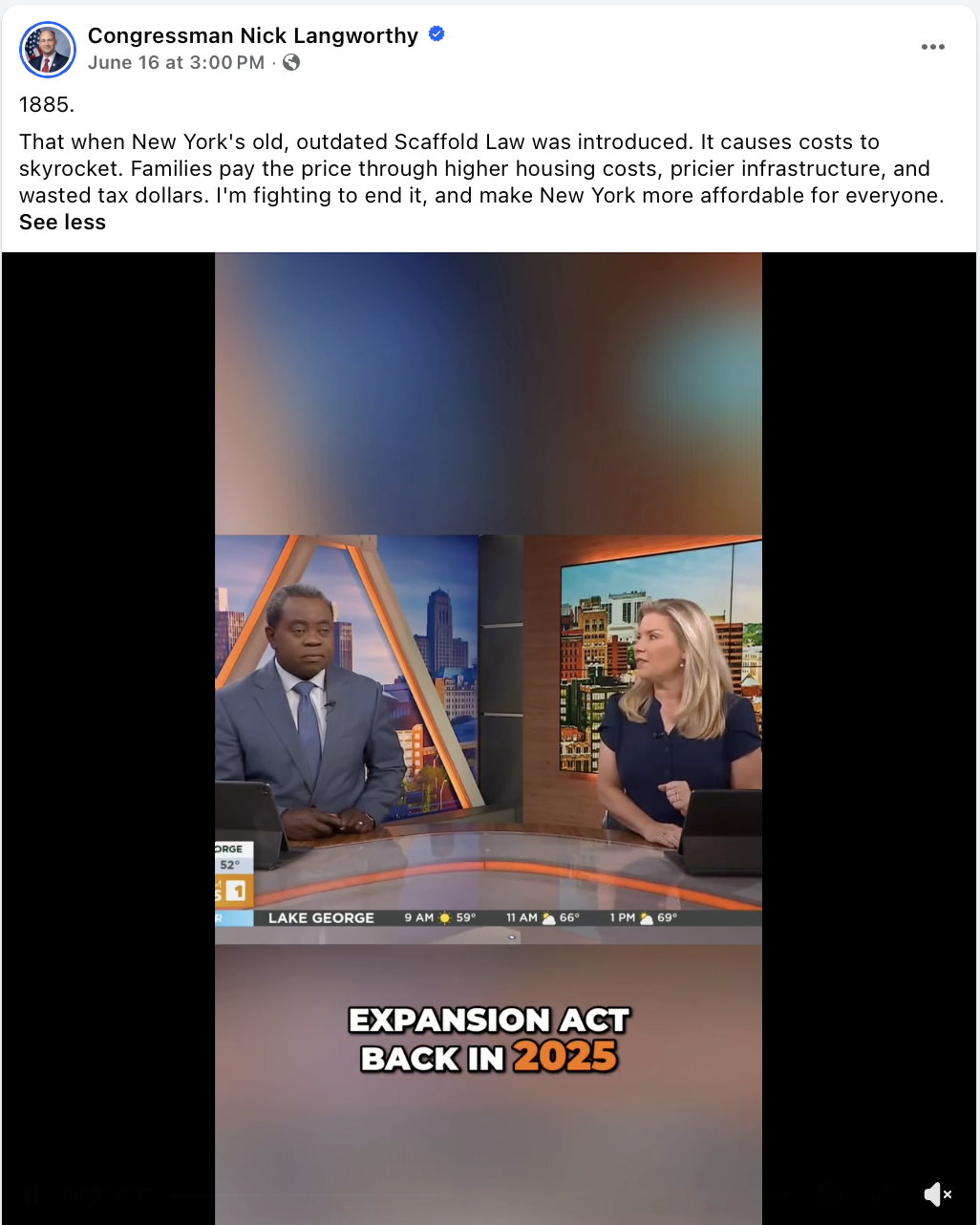
Source: Congressman Nick Langworthy Facebook, June 16, 2026
“1885. That when New York’s old, outdated Scaffold Law was introduced. It causes costs to skyrocket. Families pay the price through higher housing costs, pricier infrastructure, and wasted tax dollars. I’m fighting to end it, and make New York more affordable for everyone.”
The post is built around a Spectrum News 1 segment captioned “Expansion Act back in 2025,” referring to his Infrastructure Expansion Act (H.R. 3548), introduced May 21, 2025. The statement makes the cost case in full — housing, infrastructure, and “wasted tax dollars” — and does not mention that the law it targets is a worker fall-protection standard.
What Is Happening
New York’s current federal surface transportation law — the Infrastructure Investment and Jobs Act (IIJA) — expires in September 2026. Congress must pass a reauthorization to keep federal highway and infrastructure dollars flowing. That reauthorization is a classic “must-pass” vehicle, and industry groups are working to attach Scaffold Law preemption to it.
The “Build More New York” coalition — a statewide group of business and construction-industry organizations formed in 2025 — is backing Langworthy’s Infrastructure Expansion Act (H.R. 3548) and pushing for its provisions to be folded into the surface transportation bill. Former NY Congressman John Faso serves as a coalition advisor.
“The trial lawyers and the building trades have a hammer lock on the state legislature.” — John Faso, Build More New York advisor (The Real Deal, March 3, 2026)
Faso has been explicit that the highway bill is the intended vehicle. Asked what had changed, he told the Times Union that “in this coming session of Congress there’s some must-have legislation this thing could ride on” (Dan Clark, Times Union).
In plain language: because the coalition has not been able to change the Scaffold Law in Albany, it is seeking to override it through federal legislation tied to a bill Congress cannot easily let lapse.
The Cost Case Being Made
The public argument for the change is an insurance-cost crisis, advanced primarily by the Building Trades Employers’ Association (BTEA) and the Associated General Contractors of New York State (AGC NY):
- BTEA estimates New York construction insurance costs run 200% to 500% higher than in nearby states (BTEA impact report, cited in NY State of Politics, June 15, 2026)
- The Scaffold Law adds an estimated 5–10% to total construction costs (Langworthy’s office)
- A Washington Examiner op-ed by former House Transportation Committee chairman Bill Shuster — written on behalf of BTEA — put the added cost to public construction at roughly $785 million annually
“For a lot of contractors, they can’t get insurance because the insurers have fled the market here.” — Mike Elmendorf, AGC NY (NY State of Politics, June 15, 2026)
What the cost framing omits: these figures come from industry groups and from a Member’s office, not independent analysts. Higher New York premiums reflect, in part, that the liability is real — workers do fall, and under absolute liability those costs fall on employers and insurers rather than on injured workers or public programs. Lowering employer liability does not eliminate the cost of an injury; it shifts who bears it.
What Is Actually Being Preempted
New York Labor Law §240 — the Scaffold Law — has been in effect since 1885. It imposes absolute liability on property owners and general contractors when workers are injured in gravity-related accidents (falls from ladders, scaffolds, roofs, or floor openings; being struck by falling objects). New York is the only state with this standard; the other 49 use comparative negligence, under which a worker found partly at fault recovers less.
Falls from heights are the leading cause of construction-worker deaths. In New York, 74 construction workers died in 2023 — the highest in a decade, up from 50 in 2022, a 48% increase (NYCOSH, 2025 Deadly Skyline report).
Attaching preemption to the highway bill would replace that standard with comparative negligence on any project receiving federal funds — without a standalone vote on the merits of the worker-safety law itself.
Who Opposes It
The Building and Construction Trades Council, construction unions, the New York State AFL-CIO, and the New York State Trial Lawyers Association oppose the change.
“Big insurance and corporate real estate interests are playing fast and loose with the facts. Construction workers perform some of the most dangerous jobs in America.” — Andrew Finkelstein, President, NY State Trial Lawyers Association (NY State of Politics, June 15, 2026)
Building and Construction Trades Council President Gary LaBarbera has called the Scaffold Law “a beacon of construction site safety and contractor accountability for more than a century” (The Real Deal).
Opposition also comes from within Congress. Rep. Adriano Espaillat (D-NY) called the federal preemption approach “legally suspect,” warning it would create a “two-tiered liability system based solely on funding source,” and dismissed the cost case directly: “the oft-repeated claim that the Scaffold Law adds 10% to construction costs is advocacy math, not credible economics” (City & State, Dec. 23, 2025).
Bill Status
Bill: H.R. 3548, 119th Congress — Infrastructure Expansion Act of 2025 Sponsor: Rep. Nick Langworthy (R-NY-23), introduced May 21, 2025 Cosponsors: 5, all Republicans — Reps. Claudia Tenney (NY-24), Elise Stefanik (NY-21), Tom McClintock (CA-5), Mike Ezell (MS-4), and David Joyce (OH-14) Referred to: House Judiciary Committee Status: In committee; no markup or floor vote as of June 2026. As a standalone bill it has not advanced; the coalition’s strategy is to attach its provisions to the surface transportation reauthorization instead.
Assessment
Verdict: MISSING CONTEXT
The public case for this change is framed almost entirely as an insurance-cost crisis — premiums “200% to 500% higher,” insurers “fleeing the market,” hundreds of millions in added public costs. Langworthy’s own June 16 post is a clean example: it cites “1885,” costs that “skyrocket,” higher housing costs, and “wasted tax dollars,” with no mention of the fall-protection standard at the law’s center. Those figures come from the industry groups and the Member’s office that favor repeal, not from independent analysis. The framing omits three facts: the standard being preempted is a 140-year-old worker fall-protection law; the mechanism is a rider on a must-pass federal bill rather than a standalone vote; and the workers most directly affected — through their unions — oppose it, as do trial lawyers who represent injured workers. The cost concerns are real and documented, but they are not the whole story.
Sources
- The Real Deal: “Group pushes federal change to Scaffold Law” — March 3, 2026 (Build More New York; John Faso; IIJA September 2026 expiration; LaBarbera quote)
- NY State of Politics: “New York’s Scaffold Law spiking construction insurance by as much as 500%” — June 15, 2026 (BTEA 200–500% figure; Elmendorf and Finkelstein quotes)
- Bill Shuster, Save tax dollars by preempting New York’s outdated Scaffold Law in highway bill — Washington Examiner op-ed, May 20, 2026 (written on behalf of BTEA; $785M figure)
- H.R. 3548 — Infrastructure Expansion Act of 2025, 119th Congress (sponsor, 5 cosponsors, House Judiciary — govinfo BILLSTATUS-119hr3548)
- NY Labor Law §240 — full text
- NYCOSH 2025 Deadly Skyline report (PDF) — “increased from 50 workers in 2022 to 74 workers in 2023”; also via Construction Dive
- Congressman Nick Langworthy, Facebook post, June 16, 2026 (the “1885” statement; screenshot archived to
/images/fact-checks/2026-06-24-scaffold-law-june16-fb-post.png) - Times Union (Dan Clark): “New York faces new pressure to scrap 140-year-old Scaffold Law” — Faso quotes and the surface-transportation-bill strategy; Cilento and LaBarbera opposition (reproduced at scaffoldlaw.org)
- City & State: “The Scaffold Law isn’t the problem. Unsafe construction is.” — op-ed by Rep. Adriano Espaillat (D-NY), Dec. 23, 2025
Related Entries
- Worker Safety: Targeting 140-Year-Old Scaffold Law While Unions Warn of Harm to Workers
- Scaffold Law: Langworthy’s Bill Would Strip Worker Fall Protections on Federally Funded Sites
- State Preemption Pattern: Three Bills, One Playbook
Note: This entry documents publicly available information from official records, industry and labor organizations, and news reports. Readers may draw their own conclusions.
Last updated: June 24, 2026