Langworthy's 'Defender of Housing' Award: The Donor Behind It, and the Tariff Vote It Doesn't Mention
On June 11, 2026, Rep. Langworthy announced he had received the National Association of Home Builders’ “Defender of Housing” Award, saying Congress is “fighting to lower costs, protect energy choices, and make homeownership more attainable.” Three pieces of context the post leaves out: NAHB’s political action committee has given Langworthy’s committees $16,500; NAHB grants the award specifically for backing “NAHB positions”; and “protect energy choices” refers to a bill Langworthy sponsored that preempts local energy rules — not to lowering consumers’ energy bills. On a leading cost pressure NAHB flags — building-material tariffs — Langworthy and the group that honored him are on opposite sides.
Why This Matters for NY-23
Housing affordability is a live issue across NY-23. When a member touts an industry award for “making homeownership more attainable,” constituents have an interest in knowing who gives the award, what it rewards, and whether the member’s votes match the claim.
The Statement
Source: Facebook post, June 11, 2026
“Honored to receive NAHB’s ‘Defender of Housing’ Award. At a fireside chat, I shared how Congress is fighting to lower costs, protect energy choices, and make homeownership more attainable. Grateful for NAHB’s partnership and support.”
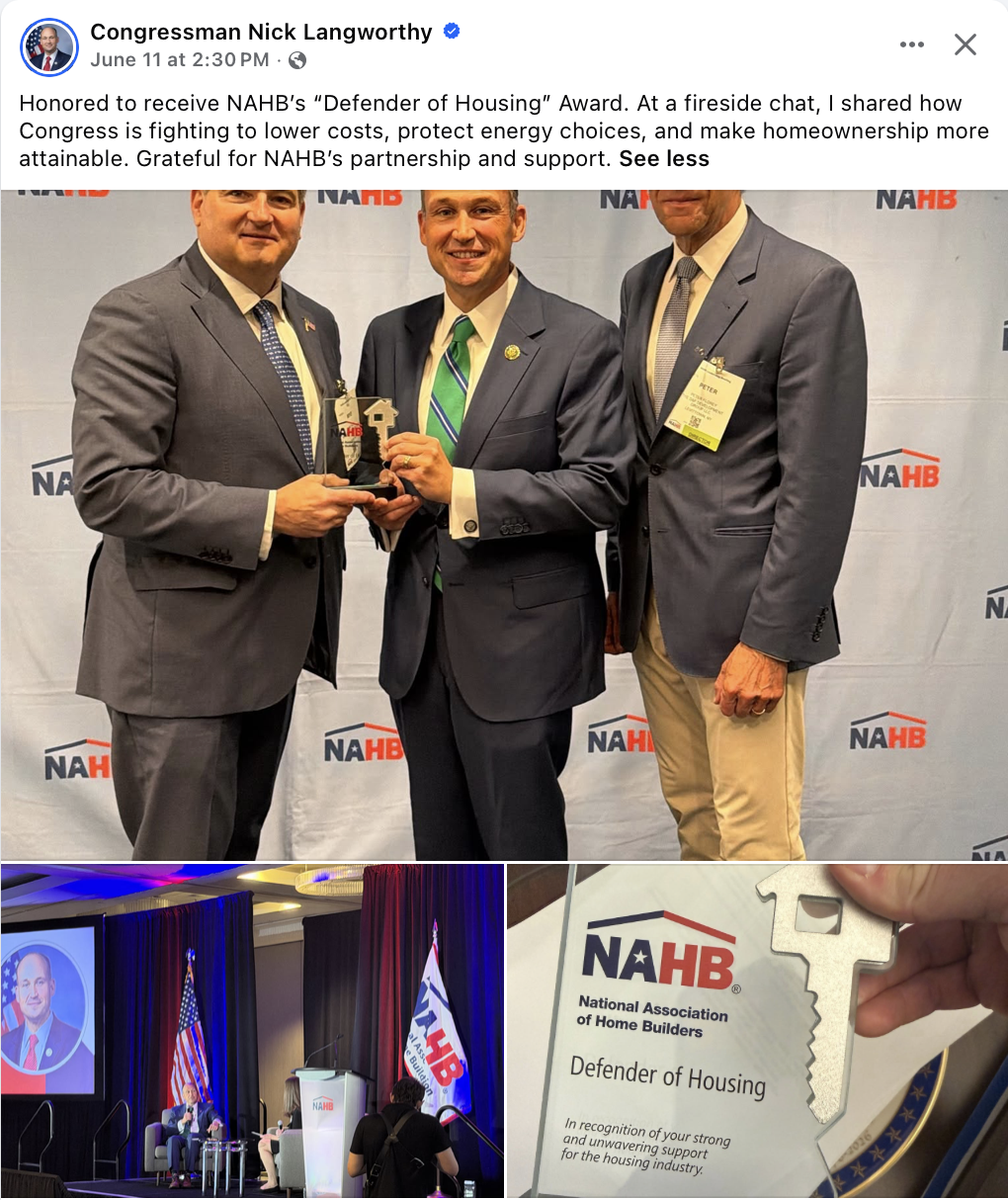
Facebook, June 11, 2026
Context: who gives the award, and the donor relationship
NAHB describes the Defender of Housing Award as recognizing legislators “who have demonstrated strong support for housing and NAHB positions on key issues facing the industry.” By the association’s own definition, it rewards alignment with its federal lobbying agenda.
That association’s PAC — BUILD-PAC — has been a recurring donor to Langworthy. Federal Election Commission records show $16,500 from BUILD-PAC (committee C00000901) to Langworthy committees across 2022–2026, including a $5,000 contribution to his leadership PAC:
| Date | Amount | Recipient | FEC transaction |
|---|---|---|---|
| 2022-09-13 | $2,500 | Langworthy for Congress | F20EA7D151068BDFCB6 |
| 2023-11-13 | $2,000 | Langworthy for Congress | 8F2A52A930764F02886 |
| 2024-09-03 | $2,000 | Langworthy for Congress | D6A277A39FFB9CF2314 |
| 2025-10-07 | $5,000 | Langworthy for Congress | 78FDEE6A5BAC4695617 |
| 2025-10-22 | $5,000 | Circle the Wagons PAC (leadership PAC) | 317A5559BF689DB0633 |
In plain language: The group giving Langworthy a “Defender of Housing” award is also a donor to his campaign and leadership committees, and says the award is for supporting the group’s positions. That doesn’t make the award improper — industry groups routinely honor allies — but it is context the post omits.
Claim 1: “Protect energy choices”
Rating: MISSING CONTEXT — industry terminology, not consumer savings
“Protect energy choices” is a specific NAHB priority, and Langworthy is its lead author. He sponsored the Energy Choice Act (H.R. 3699), which bars state and local governments from adopting any “building code, standard, or policy” that limits an energy connection “based on the type or source of energy” — in practice, a preemption of local natural-gas hookup bans. NAHB endorsed it.
The phrase points in a second direction too. NAHB has actively opposed stricter residential energy-efficiency codes — it sued, with 15 state attorneys general, to block adoption of the 2021 energy-efficiency code for federally-backed mortgages, arguing the code raises upfront construction costs. (That mandate was rescinded effective May 1, 2026.)
So “protect energy choices” describes preempting local energy rules and opposing energy-efficiency standards the homebuilding industry opposes — not a measure that lowers a homeowner’s energy bills. The Energy Choice Act contains no provision reducing consumer energy costs.
Claim 2: “Make homeownership more attainable”
Rating: MOSTLY TRUE — this part of the claim has genuine support
This is the part of the claim that holds up. Langworthy voted for the 2025 reconciliation law (Roll Call 190, July 3, 2025), which NAHB praised for “the biggest expansion of the Low-Income Housing Tax Credit in decades.” That is a real pro-supply data point and belongs in the record.
Claim 3: “Fighting to lower costs”
Rating: MISSING CONTEXT — contradicted by his tariff vote on a cost driver NAHB flags prominently
NAHB itself identifies building-material tariffs as a leading driver of higher home prices, estimating recent tariff actions add about $10,900 to the price of a typical new home, and it has specifically opposed Section 232 tariffs on lumber. Canada is a major source of building materials imported into the United States, including softwood lumber.
On February 11, 2026, the House voted on H.J. Res. 72, which would have terminated the national emergency underpinning the 25% tariffs on Canada. Langworthy voted Nay — to keep the tariffs in place (Roll Call 65; the resolution passed 219–211, with only six Republicans voting yes; Langworthy was not among them).
So on a cost pressure NAHB flags prominently, Langworthy voted to maintain it, while telling constituents Congress is “fighting to lower costs.” (This was one privileged resolution on the Canada tariff emergency, not a comprehensive tariff vote, and Langworthy has not issued an on-record statement specifically endorsing lumber tariffs; his position here is established by the recorded vote.)
Overall Verdict: MISSING CONTEXT
The award is real and the “homeownership more attainable” claim has genuine support (LIHTC, housing-supply cosponsorship). But the post omits that the award comes from a $16,500 donor that grants it for supporting the group’s positions; that “protect energy choices” means preempting local energy rules and opposing efficiency codes, not cutting energy bills; and that on a cost driver NAHB flags prominently — tariffs — Langworthy voted the opposite way from the group honoring him.
Questions This Raises
- NAHB says building-material tariffs add about $10,900 to the price of a new home. How does keeping the Canada tariffs (Roll Call 65) square with “fighting to lower costs”?
- Does “protect energy choices” refer to anything that lowers a homeowner’s energy bills, or to preempting local energy codes?
- Will Langworthy disclose, alongside the award, that the awarding organization’s PAC has contributed $16,500 to his committees?
Related Fact-Checks
- Langworthy’s “Fraud Prevention” Push: What the Bills Do
- The IDA Donor-to-Exemption Pattern — donor-relationship methodology
Sources
The award (primary):
Campaign finance (primary):
- FEC: BUILD-PAC (C00000901) committee profile — five contributions totaling $16,500 to Langworthy committees (2022–2026), confirmed via the FEC API (Schedule B for C00000901); transaction IDs listed above. Circle the Wagons PAC (C00827881) is a leadership PAC whose FEC-listed connected organization is “Langworthy.”
Energy Choice Act (primary):
- H.R. 3699 bill text (govinfo) · status (GovTrack)
- Langworthy: Congressman Nick Langworthy Introduces Energy Choice Act
- NAHB: Energy Choice Act Introduced in Congress
Energy codes (primary):
- NAHB: NAHB, 15 State AGs File Suit Against HUD’s Energy Codes Mandate
- Federal Register: Rescission of energy-code mandate, eff. May 1, 2026
Tariffs (primary):
- NAHB: How Tariffs Impact Home Building ($10,900/home estimate)
- NAHB: Section 232 tariffs on lumber
- Roll Call 65 — H.J. Res. 72, Feb. 11, 2026 (Langworthy: Nay)
Housing votes (primary):
- Roll Call 190 — 2025 reconciliation (LIHTC expansion), July 3, 2025 (Langworthy: Aye)
- NAHB: LIHTC regulatory and legislative actions
Note: This entry documents publicly available information from FEC records, congressional roll-call votes, NAHB publications, and the Federal Register. It makes no allegation of unlawful conduct. Industry endorsements and PAC contributions are lawful and routine; this entry documents them as context for the member’s public claim.
Last updated: June 13, 2026