Langworthy's 'Fraud Prevention' Push: What the Bills Do, and What the $233–$521 Billion Figure Measures
Over June 11–12, 2026, Rep. Langworthy posted three times promoting an “anti-fraud” legislative push: that “ghost students” steal education aid, that the federal government loses “$233 billion to $521 billion” a year to fraud, and that the Fraud Prevention and Accountability Act is “common sense.” Each individual claim is accurate — he voted for the bills, they passed the House, and the dollar figure is a real GAO estimate. What the posts leave out is that the GAO figure is a government-wide number GAO says cannot be attributed to any specific program, that the “ghost students” bill is a separate measure from the fraud package he references, and that none of these bills is yet law.
Why This Matters for NY-23
Rep. Langworthy sits on the House Oversight and Government Reform Committee, which produced most of the bills in this push. How he connects a headline fraud figure to specific legislation goes to whether constituents can gauge what these bills would actually do.
The Statements
Source: Three Facebook posts, June 11–12, 2026
“So-called ‘ghost students’ aren’t students at all. They’re fraudsters stealing and scamming taxpayer dollars meant for education. Stopping this fraud protects taxpayers, supports families, and ensures education funding reaches those who truly need it.” (linking WBNG: “Rep. Langworthy highlights fraud prevention legislation package passed by House of Representatives”)
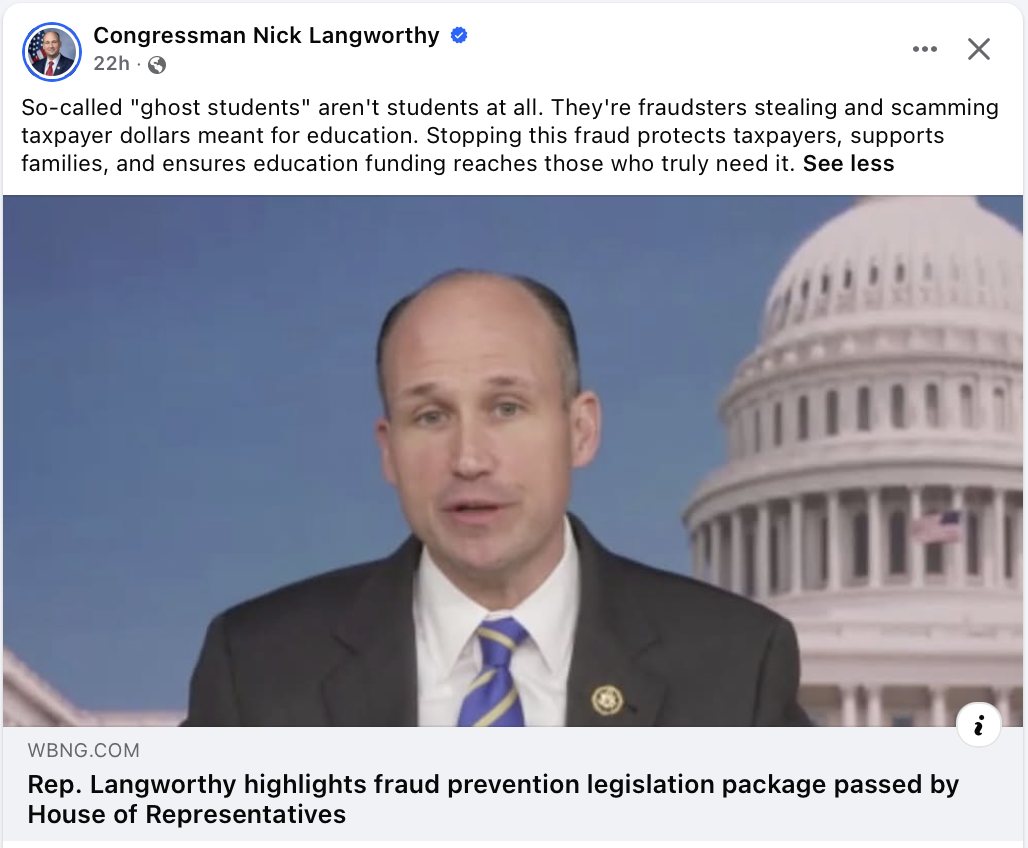
Facebook post — Rep. Nick Langworthy
“It’s estimated that every year the federal government loses $233 billion to $521 billion to FRAUD. That’s unacceptable. The Working Families Tax Cut put more money in Americans’ pockets, but we must tackle the spending side of the ledger too.”
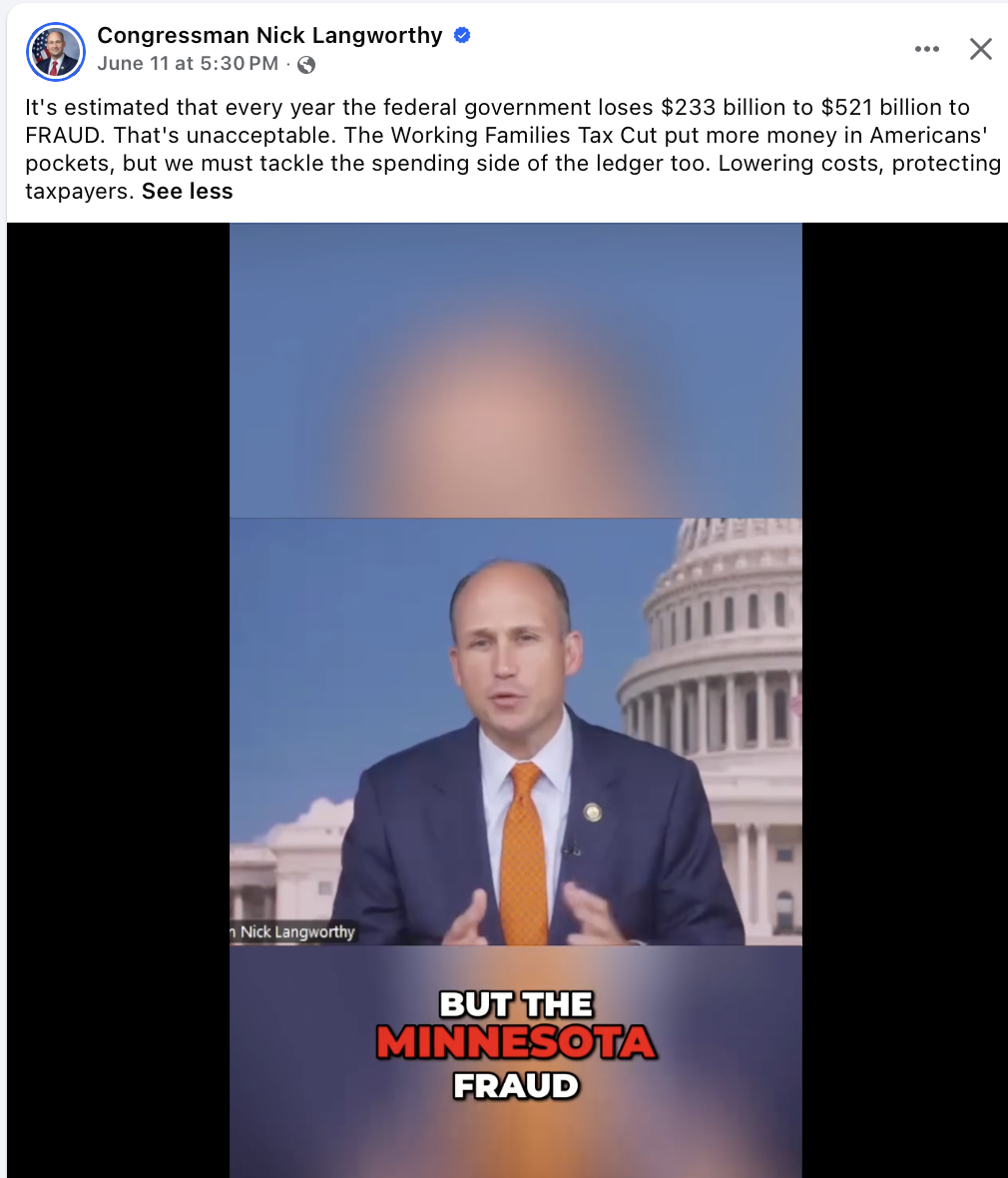
Facebook, June 11, 2026
“The Fraud Prevention and Accountability Act is common sense. You wouldn’t pay your mortgage, utility bill, or contractor without knowing the amount or verifying who gets the money. Washington shouldn’t either. Verify first. Pay second. Protect taxpayers.”
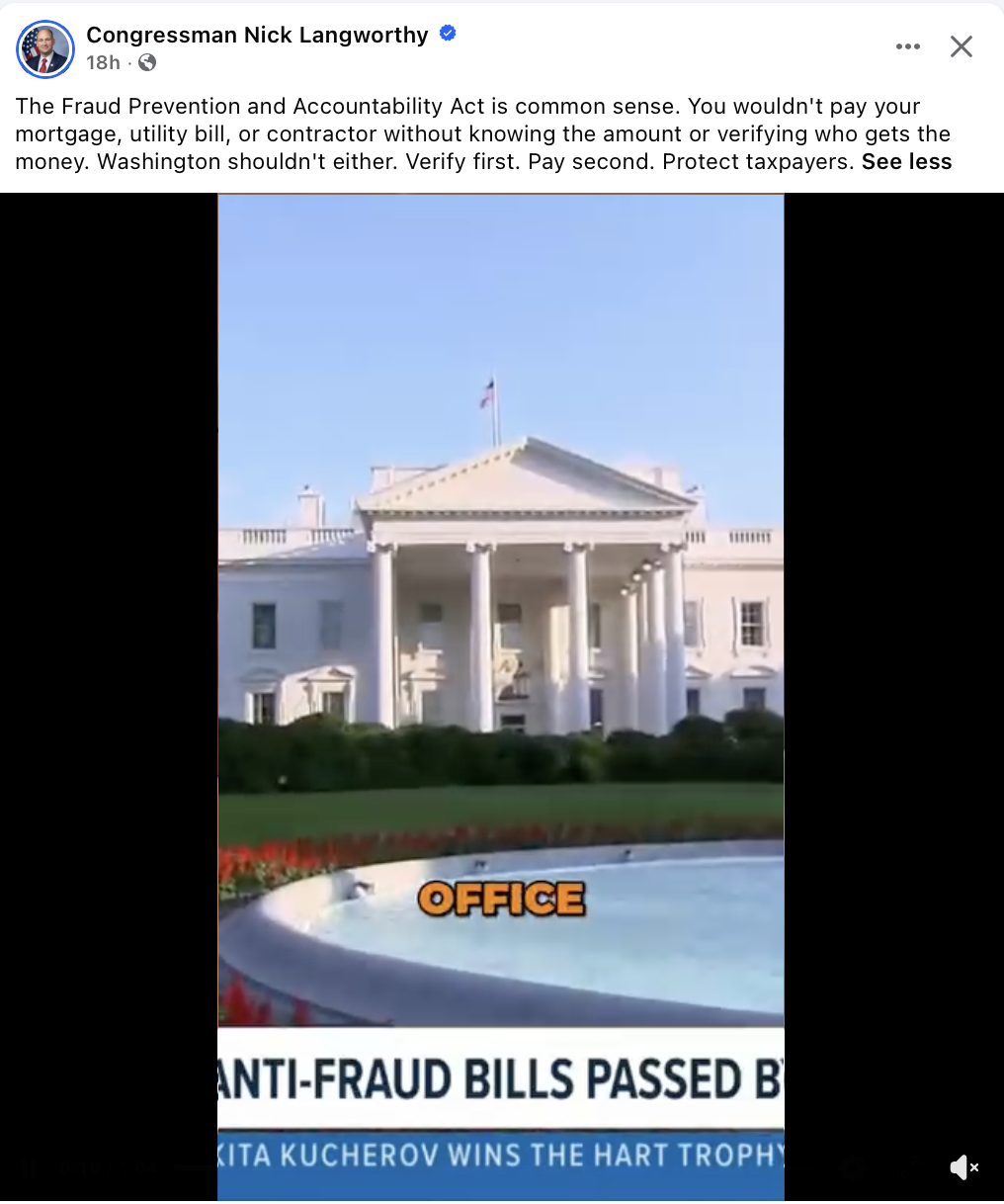
Facebook post — Rep. Nick Langworthy
Claim 1: The House passed fraud bills and Langworthy voted for them
Rating: TRUE
On June 10, 2026, the House passed two relevant bills, both of which Langworthy voted for:
| Bill | What it does | Vote | Langworthy |
|---|---|---|---|
| H.R. 8312 — Fraud Prevention and Accountability Act (Sessions) | Gives federal Inspectors General permanent access to the anti-fraud data-analytics tools developed by the Pandemic Response Accountability Committee | Roll Call 218: 240–181 | Yea |
| H.R. 7892 — No Aid for Ghost Students Act (Owens) | Requires the Department of Education to run an identity-fraud screen on every FAFSA; flagged applicants must verify their identity before federal aid is released | Roll Call 217: 249–172 | Yea |
Both passed with unanimous Republican support and some Democratic votes (36 Democrats for H.R. 7892; 28 for H.R. 8312). H.R. 8312 is one of 11 anti-fraud measures the Oversight Committee moved that week.
Both bills then went to the Senate, received June 11, 2026: H.R. 7892 was referred to the Senate Health, Education, Labor, and Pensions Committee, and H.R. 8312 awaits a committee referral. Neither has become law.
Claim 2: “The federal government loses $233 billion to $521 billion to fraud”
Rating: TRUE — but the figure means something narrower than the posts imply
The number is real. It comes from GAO-24-105833 (April 2024), the Government Accountability Office’s first-ever estimate of total direct financial losses to fraud across the federal government, based on fiscal years 2018–2022. The $233B–$521B range represents roughly 3% to 7% of average annual federal obligations.
But GAO attaches explicit limits to how that number can be used — limits the posts omit:
- It cannot be broken down by program. GAO organized the data by detection status (adjudicated, detected-potential, undetected-potential), not by agency or program. The report does not say how much of the fraud is in education, Medicare, unemployment, or any other program.
- Pandemic fraud cannot be separated out. GAO states it is “not possible to break out a subset of our government-wide estimate to describe pandemic program fraud.”
- It is not the same as “improper payments.” GAO says the fraud estimate “is not comparable to improper payment estimates” (a separate, larger metric).
- It should not be applied at the program level. GAO explicitly cautions against applying the 3–7% figures to any individual agency or program.
In plain language: GAO produced one big government-wide number and said, in the same report, that it can’t be sliced up by program. So the figure can’t be used to say how much fraud is in student aid — or to size what any single bill would recover.
Claim 3: Connecting the figure to “ghost students” and the package
Rating: MISSING CONTEXT
Two gaps:
The “ghost students” bill is not part of the fraud “package” the posts reference. H.R. 7892 came out of the Education and Workforce Committee. The 11-bill fraud package — including the Fraud Prevention and Accountability Act — came out of Oversight. Both passed the same week, but they are separate efforts. Presenting them as one package is a presentational choice.
The $233–$521B figure is doing more rhetorical work than it can support. It is a total, un-disaggregatable, government-wide estimate. The most-publicized bill in the push (the FAFSA “ghost students” screen) addresses a specific slice of student-aid identity fraud that this GAO estimate does not size. Pairing the headline number with that bill invites readers to assume the bill addresses fraud on that scale; the GAO report does not support that inference.
None of this makes the bills bad or the figure false. It means the posts pair an accurate but narrowly-defined statistic with specific legislation in a way that overstates the connection.
Overall Verdict: MISSING CONTEXT
Every discrete claim checks out: Langworthy voted for the bills, the bills passed the House, and the $233–$521B figure is a genuine GAO estimate. The missing context is what that figure can and cannot show — GAO says it cannot be attributed to any program — and that the bills are recently passed House measures, received in the Senate June 11, 2026 and not yet law.
Questions This Raises
- GAO says its $233–$521B estimate cannot be broken down by program. Which programs does Rep. Langworthy understand that figure to describe?
- The Fraud Prevention and Accountability Act extends anti-fraud analytics tools built for pandemic-era spending. How much of the cited fraud do those tools actually address?
- These bills are recently passed House measures awaiting Senate action. What is the estimated dollar amount of fraud they are projected to prevent or recover?
Related Fact-Checks
- Minnesota Fraud: Who “Pulled Back the Curtain,” and Is There Really a “50 State” Investigation?
- Minnesota Fraud Hearing: Three Claims Examined
Sources
Bills (primary):
- H.R. 8312 — Fraud Prevention and Accountability Act: congress.gov
- H.R. 7892 — No Aid for Ghost Students Act: congress.gov
- House Oversight Committee: House Passes 11 Oversight Committee Bills to Stop Fraud in Federal Programs (June 11, 2026)
Votes (primary):
- Roll Call 218 — H.R. 8312, June 10, 2026 (Langworthy: Yea)
- Roll Call 217 — H.R. 7892, June 10, 2026 (Langworthy: Yea)
GAO figure (primary):
- GAO: Fraud Risk Management: 2018–2022 Data Show Federal Government Loses an Estimated $233 Billion to $521 Billion Annually to Fraud (GAO-24-105833, April 16, 2024)
- GAO improper-payments data (distinct metric): GAO-25-108172
Note: This entry documents publicly available information from congressional records, House Clerk roll-call votes, and Government Accountability Office reports. It makes no allegation of unlawful conduct.
Last updated: June 13, 2026