Veterans Benefits Expansion Act: The Post Mentions the Benefits, Not the Veterans Who Pay for Them
Rep. Langworthy described H.R. 6047 as a bill that “expands benefits, supports survivors, and helps veterans achieve the American Dream of homeownership.” The benefit expansions are real. What the post omits is how they are paid for: the bill nearly triples the fee VA charges veterans to refinance their home loans and doubles the fee for assuming a VA loan — about $3,780 more on an average refinance, by the committee’s own figures. As a member of the Rules Committee, Langworthy also voted twice to block the full House from considering amendments that would have removed or replaced those fee increases.
Why This Matters for NY-23
A bill that raises new benefits for catastrophically disabled veterans and survivors by charging other veterans more to refinance their homes affects both groups of constituents — and a Rules Committee member’s votes determine whether the House is even allowed to debate that tradeoff.
Statement
Source: Facebook Post, June 2, 2026 (linking the Congress.gov page for H.R. 6047)
“Our veterans answered the call to serve. I was proud to vote FOR the Sharri Briley and Eric Edmundson Veterans Benefits Expansion Act. This expands benefits, supports survivors, and helps veterans achieve the American Dream of homeownership.”
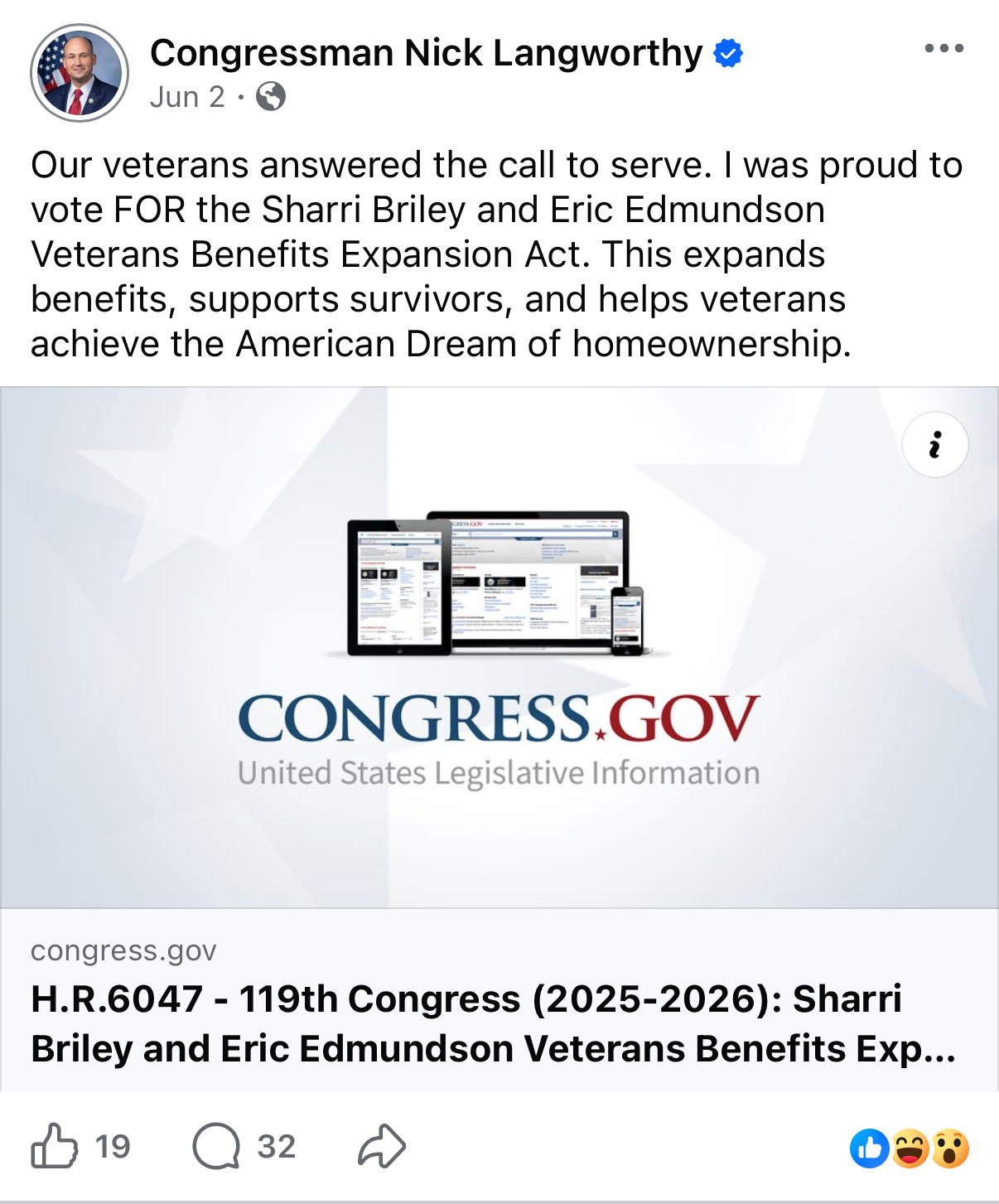
The June 2, 2026 post on the official page.
What the Bill Does — Both Halves
The benefits (what the post describes)
Per the Congressional Budget Office estimate reprinted in the committee report (H. Rept. 119-577):
| Provision | Who benefits | CBO cost, 2026–2036 |
|---|---|---|
| New $833.33/month supplemental allowance for veterans receiving aid-and-attendance under 38 U.S.C. § 1114(r)/(t) | ~8,000 catastrophically disabled veterans (rising to ~10,000 by 2036) | +$1 billion |
| Dependency and Indemnity Compensation increase (+1% above COLA in year one, +0.5% in year two) | Surviving spouses and children | +$3 billion |
| Guard/Reserve home-loan eligibility expansion (training time counts toward eligibility; access after 14 days of active duty) | Guard and Reserve members | Expands eligibility |
These are genuine expansions. The committee’s Democratic minority supported both the SMC and DIC increases on the merits.
The pay-fors (what the post omits)
The same CBO estimate shows how the bill offsets those costs — Sections 3 and 4:
| Provision | Current law | Under H.R. 6047 | Revenue, 2026–2036 |
|---|---|---|---|
| VA refinance (IRRRL) funding fee | 0.50% | 1.42% (1.40% as reported; raised to 1.42% by a self-executing amendment in the rule) | $2.4 billion |
| VA loan assumption fee | 0.50% | 1.0% | $100 million |
| Extension of current (higher) VA funding-fee table | Expires June 9, 2034 | Extended through Sept. 30, 2036 | $1.5 billion |
| Extension of the $90/month pension cap for Medicaid-covered veterans in nursing homes | Expires Jan. 31, 2033 | Extended through Sept. 30, 2036 | $44 million |
CBO: the fee provisions “would decrease net direct spending by $4 billion over the 2026–2036 period” — almost exactly the cost of the new benefits.
In plain language: The new benefits for roughly 8,000 catastrophically disabled veterans and for survivors are paid for almost entirely by other veterans — chiefly those refinancing a VA home loan. Using the committee minority’s figures from VA’s own loan data: on the average $420,000 refinance, the fee rises from $2,100 to $5,880 — $3,780 more. Unlike the other fee provisions, the refinance-fee increase has no expiration date; it does not revert at the end of the budget window.
The homeownership line, specifically
The post says the bill “helps veterans achieve the American Dream of homeownership.” The eligibility expansion for Guard and Reserve members is real. But the same bill nearly triples the fee on an interest rate reduction refinance, the standard way a veteran with a VA loan lowers a monthly payment, and newly eligible reservists with 14 to 89 days of service pay an additional 1% surcharge on top of all other fees.
Two limits belong next to that. Veterans who receive service-connected disability compensation pay no VA funding fee at all, on a refinance or anything else. And a rate-reduction refinance generally requires a loan that is current, so the higher fee falls on veterans lowering a payment, not on veterans already behind on one. Our veterans-record entry states the same limits.
The Rules Committee Votes: Blocking the Alternatives
Langworthy sits on the House Rules Committee, which decides which amendments the full House may consider. On May 19–20, 2026, the committee met on the rule for H.R. 6047 (H. Res. 1300). From the committee’s own report (H. Rept. 119-653):
| Record vote | Motion | Result | Langworthy |
|---|---|---|---|
| No. 342 | Make in order Takano amendment #4 — strike Sections 3 and 4, “the sections that would raise home loan refinancing fees for veterans” | Defeated 3–7 | Nay |
| No. 343 | Make in order Takano amendment #5 — strike Sections 3 and 4 and replace with a reduction in the estate-tax exemption from $15 million to $14.5 million | Defeated 3–7 | Nay |
The second vote is the sharper one: it presented a direct choice of who pays for the new veterans’ benefits — veterans refinancing their homes, or estates worth more than $14.5 million — and Langworthy voted against letting the House consider the question. The rule passed the House 208–207.
The committee minority’s views in H. Rept. 119-577 also document the offset’s history: the introduced bill “would have imposed a VA home loan financing fee on veterans with a disability rating of 70 percent and below for the first time ever,” dropped after opposition from the VFW and Disabled American Veterans; a January 2026 proposal to raise purchase-loan fees was also withdrawn after opposition; the refinance and assumption fee increases were what remained.
“It is unconscionable to make refinancing more difficult for those who are facing foreclosure. We will note also that contrary to common practice, this fee would not revert back to its current rate at the end of the budget window. This increase will saddle veterans with higher fees in perpetuity.” — Minority views, H. Rept. 119-577
The minority’s foreclosure language goes further than the mechanics support, for the reasons in the section above. Its point about permanence stands: the refinance fee, unlike the bill’s other fee provisions, has no end date.
The Floor Vote
H.R. 6047 passed the House 235–179 on May 21, 2026 (Roll Call 191). Langworthy voted Yea. The breakdown: Republicans 204–3 in favor; Democrats 176–30 against, with 30 Democrats joining the majority. The Senate received it on June 2, 2026 and referred it to its Veterans’ Affairs Committee, where it has had no further action as of November 10, 2026. The same refinance-fee increase, to 1.42%, was written into a later bill, H.R. 9237, as introduced; that bill and his votes on it are covered in our veterans-record entry. The committee had earlier reported the bill 13–10 on February 12, 2026, with all but one Democrat opposed — over the offset, not the benefits.
Questions This Raises
- The post describes the bill’s benefits in detail. Why does it not mention that the benefits are funded by raising fees on veterans who refinance or assume VA home loans?
- As a Rules Committee member, Langworthy voted against allowing the House to consider replacing the veteran-paid fees with a reduction in the estate-tax exemption for estates above $14.5 million. What is his explanation for preferring the veteran-paid offset?
- The refinance-fee increase does not expire with the budget window. Does Langworthy support making the near-tripled fee permanent?
- The original version of the bill would have imposed loan fees on disabled veterans with ratings of 70% or below for the first time, and was changed only after VFW and DAV objected. Did Langworthy take a position on that earlier version?
Related Fact-Checks
- Making veterans faster than we care for them: the veterans record, including H.R. 9237 and the refinance fee
- The Rules Committee gatekeeper pattern
- VA Healthcare Shortfall — earlier veterans-funding record
- Veterans Support — prior claims about veterans advocacy
Sources
Bill and votes (primary):
- H.R. 6047 — Congress.gov (archived: https://web.archive.org/web/20260522084106/https://www.congress.gov/bill/119th-congress/house-bill/6047)
- H.R. 6047 engrossed text — govinfo XML — Section 3 fee-table amendments verbatim (archived: https://web.archive.org/web/20261027105750/https://www.govinfo.gov/content/pkg/BILLS-119hr6047eh/xml/BILLS-119hr6047eh.xml)
- Roll Call 191 — Clerk of the House — 235–179; Langworthy Yea; party breakdown (archived: https://web.archive.org/web/20261110202028/https://clerk.house.gov/evs/2026/roll191.xml)
- H. Rept. 119-653 (Rules Committee report on H. Res. 1300) — govinfo PDF — record votes 342 and 343 with member-by-member tallies; Bost self-executing amendment (1.40% → 1.42%) (archived: https://web.archive.org/web/20261102164847/https://www.govinfo.gov/content/pkg/CRPT-119hrpt653/pdf/CRPT-119hrpt653.pdf)
- H. Rept. 119-577 Part 1 (Veterans’ Affairs Committee report) — govinfo PDF — CBO cost estimate; minority views including offset history and $2,100 → $5,880 fee calculation (archived: https://web.archive.org/web/20261102164846/https://www.govinfo.gov/content/pkg/CRPT-119hrpt577/pdf/CRPT-119hrpt577-pt1.pdf)
- CBO cost estimate for H.R. 6047 (archived: https://web.archive.org/web/20261027110147/https://www.cbo.gov/publication/62209)
- Rules Committee bill page — H.R. 6047 (archived: https://web.archive.org/web/20261110202205/https://rules.house.gov/bill/119/hr-6047)
- govinfo BILLSTATUS, H.R. 6047 (119th) — Senate referral June 2, 2026; no later action as of November 10, 2026 (archived: https://web.archive.org/web/20261110202133/https://www.govinfo.gov/bulkdata/BILLSTATUS/119/hr/BILLSTATUS-119hr6047.xml)
- H.R. 9237 introduced text — govinfo XML — the same IRRRL fee change (“inserting 1.42”) (archived: https://web.archive.org/web/20261102164852/https://www.govinfo.gov/content/pkg/BILLS-119hr9237ih/xml/BILLS-119hr9237ih.xml)
Coverage:
- Veterans Guide — House takes up bills that could expand VA benefits (archived: https://web.archive.org/web/20260612175025/https://veteransguide.org/news/house-takes-up-bills-that-could-expand-va-benefits-for-severely-disabled-veterans-and-survivors/)
- American Legion — House passes half-dozen veteran-friendly bills (archived: https://web.archive.org/web/20261110202235/https://www.legion.org/information-center/news/legislative/2026/may/house-passes-half-dozen-veteran-friendly-bills)
Note: This entry documents publicly available legislative records: the engrossed bill text, House Clerk roll-call data, the Rules Committee’s printed record votes, and the Veterans’ Affairs Committee report including the CBO cost estimate and minority views. The benefit expansions in H.R. 6047 are real and documented; this entry concerns what the post omits about their funding.
Last updated: November 10, 2026