Energy: 'All-of-the-Above' Framing Omits His Votes Against Clean Energy for Rural NY
Why this matters in NY-23
Propane is genuinely important infrastructure in rural NY-23. In areas without natural gas pipelines — common across the Southern Tier and Chautauqua County — propane heats homes, powers farm equipment, and runs small businesses. Langworthy’s general point is not in dispute. What this entry examines is the specific framing: whether an “all-of-the-above” energy strategy is consistent with his voting record on clean energy provisions that would have expanded rural energy choices and lowered costs.
Statement
Source: Facebook Post, May 23, 2026 Reported by: Butane-Propane News
“Propane is a critically important lifeline for the taxpayers I represent. It keeps families warm, farms running, and small businesses alive. I’ll always fight for an ‘all-of-the-above’ energy strategy that protects choice and keeps costs low for you.”
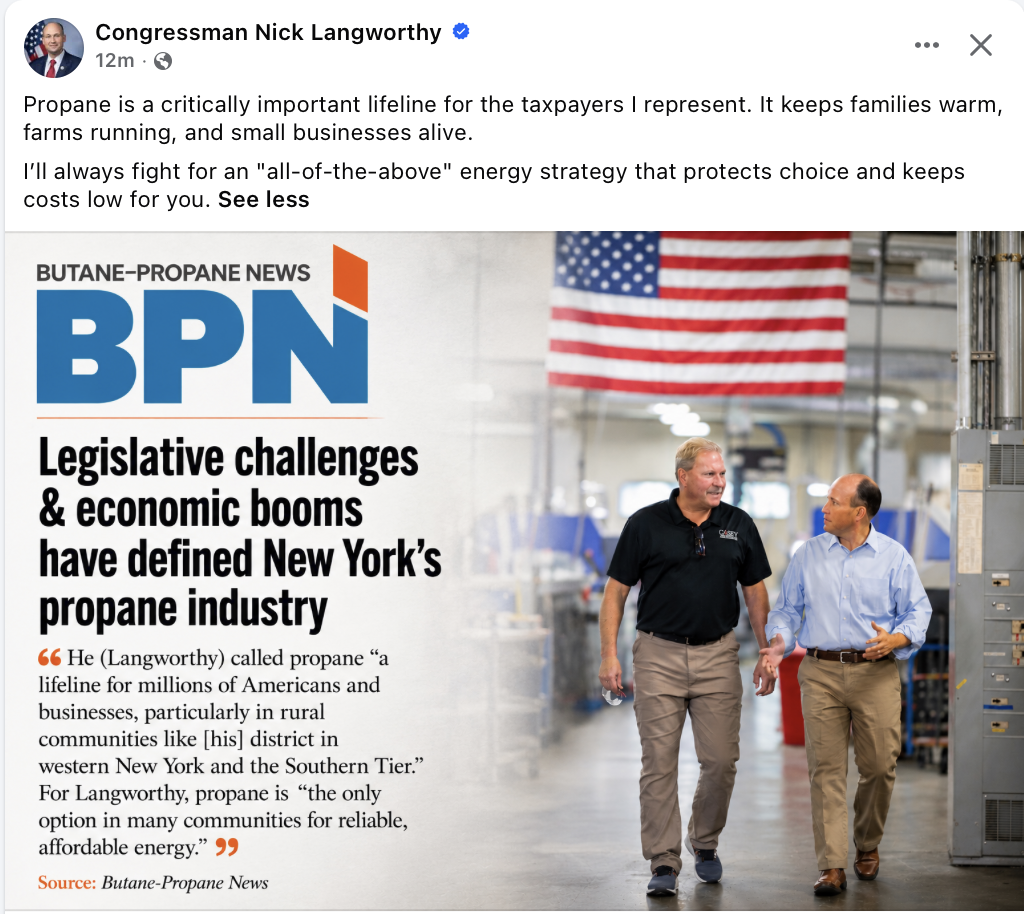
Source: Congressman Nick Langworthy Facebook, May 23, 2026
The post links to a Butane-Propane News feature quoting Langworthy calling propane “a lifeline for millions of Americans and businesses, particularly in rural communities like [his] district in western New York and the Southern Tier” and “the only option in many communities for reliable, affordable energy.”
What “All-of-the-Above” Implies
An “all-of-the-above” energy strategy is a standard political framing meaning support for all energy sources — fossil fuels and renewables — with the goal of maximizing supply, maintaining consumer choice, and lowering costs. The phrase implicitly includes clean energy investments such as solar, wind, energy efficiency, and on-farm renewable programs that can reduce rural energy costs.
His Voting Record on Clean Energy
Inflation Reduction Act (August 2022) — Voted NO. The IRA included $391 billion in clean energy investments, including:
- Investment Tax Credits for rooftop solar and battery storage (§48)
- Rural energy efficiency and clean energy programs under USDA
- USDA Rural Energy for America Program (REAP) expansion — grants for farms and rural small businesses to install solar, wind, and energy efficiency systems
- Residential clean energy credits available to rural homeowners
Langworthy was not yet in Congress when the IRA passed (House vote 220–207, August 12, 2022; he took office in January 2023). But he has consistently opposed its clean-energy provisions, and he voted YES on OBBBA, which repealed many of them.
One Big Beautiful Bill Act (H.R. 1, enacted July 4, 2025) — Voted YES. The OBBBA, which Langworthy supported on the House floor and voted for, repealed or sharply curtailed the clean energy tax provisions from the IRA:
- Repealed Clean Electricity Production Credit (§45Y) and Clean Electricity Investment Credit (§48E)
- Terminated residential clean energy tax credits
- Eliminated electric vehicle credits before year-end 2025
- Imposed new restrictions limiting wind and solar projects from claiming credits unless in service by December 31, 2027
Rural impact: At least 271 wind and solar projects across 40 rural states are affected by these tax credit changes. Farm Aid and rural policy researchers documented that “mom-and-pop energy businesses” — the type of small agricultural operations common in NY-23 — face the greatest disruption from the terminated credits.
The OBBBA extended the USDA Bioenergy Program for Advanced Biofuels through 2031, which benefits propane-adjacent liquid fuels. It did not restore rural solar, wind, or general efficiency programs.
The Committee Record
His energy record is not only floor votes. Langworthy sits on the Energy & Commerce Energy Subcommittee, the panel with jurisdiction over the energy title of the reconciliation law — so his position is recorded at the committee stage too, by name (H. Rept. 119-106, Part 1, committee vote sheets):
- At the May 13, 2025 markup, he voted Yea (Record Vote #5) to advance “Subtitle A — Energy” — the rescissions of IRA clean-energy programs (the DOE Loan Programs Office, the Advanced Industrial Facilities Deployment program, transmission financing, the state home-energy-efficiency contractor training program, and more) — to the Budget Committee, and voted Nay on the Democratic amendments to that subtitle.
- What he has affirmatively moved through his own committee on energy is not renewable access but preemption: he is the sponsor of the Energy Choice Act (H.R. 3699), which E&C ordered reported on a 24–21 vote (Dec. 3, 2025), and the State Energy Accountability Act (H.R. 3157), reported 27–20 (June 25, 2025) — both using federal power to block state and local clean-energy rules.
In plain language: on the committee where he actually helps write energy law, the record matches the floor — he voted to strip the federal clean-energy programs and has advanced bills to preempt state clean-energy rules, not to expand the renewable side of an “all-of-the-above” strategy. These committee votes broke on party lines, as most do; the point is what the record shows he used the seat for. See the fuller committee-record pattern in ‘A Seat at the Table’.
The Tension
Langworthy’s advocacy for propane access is consistent with representing rural communities. His opposition to NY’s all-electric building mandates (Energy Choice Act) is a defensible position on state overreach.
But the “all-of-the-above” framing does not describe his national legislative record:
- He voted to block $391 billion in clean energy investments, including rural solar and efficiency programs that would have expanded energy choices for NY-23 residents.
- He voted to repeal clean energy tax credits that NY-23 farmers and rural businesses were using to lower their energy costs through on-farm solar and wind installations.
- The OBBBA he supported did not expand rural energy choice — it contracted the federal investment framework for the renewable portion of any “all-of-the-above” approach.
A constituent who heats with propane and also wanted to install rooftop solar or a farm wind turbine using federal tax credits has fewer options after Langworthy’s votes than before.
Assessment
Verdict: MISSING CONTEXT
Propane is a real and important energy source for NY-23, and Langworthy’s district-level advocacy for propane access is documented. The “all-of-the-above” framing, however, omits that his two most consequential national energy votes — against the IRA and for the OBBBA — reduced, not expanded, the clean energy options available to rural NY families and farms. An energy strategy that opposes federal investment in renewables while supporting fossil fuel access is not “all-of-the-above” — it is a fossil-fuel-first approach framed in neutral language.
Sources
- Butane-Propane News: Legislative challenges & economic booms have defined New York’s propane industry — archive pending
- Inflation Reduction Act (H.R. 5376), House passage 220–207, August 12, 2022 (Roll Call 420) — predates Langworthy’s term; he took office January 2023
- Langworthy floor remarks on H.R. 1 (OBBBA) — archive pending
- Tax Foundation: How the One Big Beautiful Bill Changes Clean Energy Tax Credits — archive pending
- Daily Yonder: Energy Cuts in OBBBA Raise Costs, Threaten Jobs in Rural Communities — archive pending
- Langworthy: Energy Choice Act press release — archive pending
- H. Rept. 119-106, Part 1 (E&C reconciliation recommendations; energy subtitle pp. 473–484; committee vote sheets, Record Votes #2–#5, #39)
- H.R. 3699 (Energy Choice Act) — all actions; E&C ordered reported 24–21, Dec. 3, 2025
- H.R. 3157 (State Energy Accountability Act) — all actions; E&C ordered reported 27–20, June 25, 2025