Scaffold Law: Langworthy's Bill Would Strip Worker Fall Protections on Federally Funded Sites — Post Frames It Only as a Cost Issue
Why this matters in NY-23
Construction is a significant employer across NY-23’s rural and small-city economies. New York’s Scaffold Law — Labor Law §240 — has governed worker fall liability since 1885 and is the primary legal mechanism protecting construction workers injured in gravity-related accidents on job sites. Langworthy’s Infrastructure Expansion Act would eliminate that protection on any project receiving federal funds. The post and the op-ed it shares frame this entirely as a government savings question. This entry examines what the law does and what repeal would mean for workers.
Statement
Source: Facebook Post, May 20, 2026 Reported by: Washington Examiner
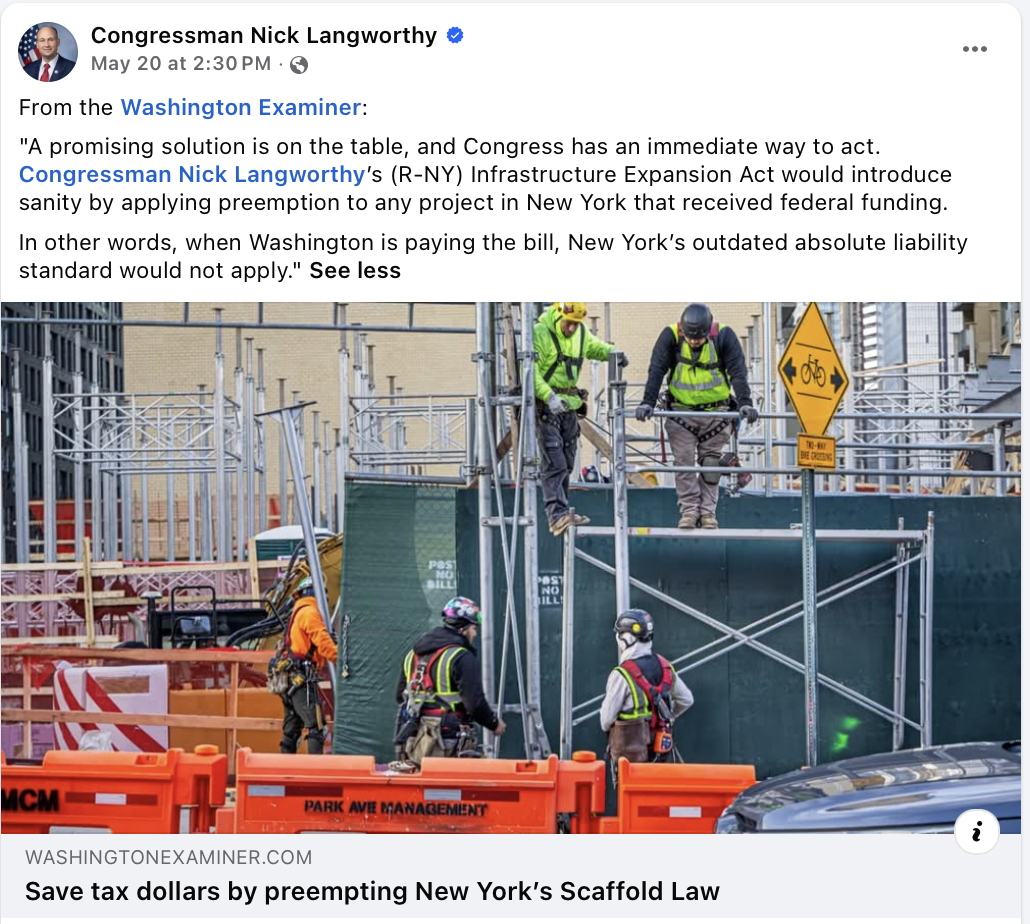
Source: Congressman Nick Langworthy Facebook, May 20, 2026
Langworthy shared a Washington Examiner op-ed with the pull quote:
“A promising solution is on the table, and Congress has an immediate way to act. Rep. Nick Langworthy’s (R-NY) Infrastructure Expansion Act would introduce sanity by applying preemption to any project in New York that received federal funding. In other words, when Washington is paying the bill, New York’s outdated absolute liability standard would not apply.”
The op-ed (May 20, 2026) was written by Bill Shuster, former chairman of the House Transportation and Infrastructure Committee, on behalf of the Building Trades Employers’ Association of New York City (BTEA) — the trade association representing the construction employers who would face reduced liability if the law were preempted. Langworthy’s post presented the piece without noting the author’s industry affiliation.
What the Scaffold Law Actually Does
New York Labor Law §240 — commonly called the Scaffold Law — has been in effect since 1885. It imposes absolute liability on property owners and general contractors when workers are injured in gravity-related accidents: falls from ladders, scaffolds, roofs, or floor openings; being struck by falling objects.
“Absolute liability” means the employer is liable regardless of whether the worker contributed to the accident. New York is the only state that applies this standard. All 49 other states use comparative negligence — where liability is divided based on each party’s share of fault.
The Scaffold Law covers all construction workers on affected projects — union and non-union, documented and undocumented. Falls from height are the leading cause of construction worker fatalities in the United States. The law’s absolute liability standard creates a strong financial incentive for employers to provide fall protection equipment and enforce safety protocols, because any failure that results in a worker injury creates full employer liability.
What the Infrastructure Expansion Act Would Do
Bill: H.R. 3548, 119th Congress — Infrastructure Expansion Act of 2025 Introduced by: Rep. Nick Langworthy, May 21, 2025 Cosponsors: 5, all Republicans — Reps. Claudia Tenney (NY-24), Elise Stefanik (NY-21), Tom McClintock (CA-5), Mike Ezell (MS-4), and David Joyce (OH-14) Referred to: House Judiciary Committee Status: In committee; no markup or floor vote as of June 2026
The bill would preempt New York’s Scaffold Law for any construction project that receives federal funding. On those projects, New York’s absolute liability standard would be replaced by comparative negligence — the same standard used in other states. A worker who is injured because their employer failed to provide a safety harness could have their recovery reduced based on their own share of fault.
What this changes for workers: Under current law, a worker who falls from an unsecured scaffold on a federally funded road project can recover full damages. Under H.R. 3548, that worker’s damages could be reduced if the contractor argues the worker was partially at fault — regardless of whether proper equipment was provided.
The Cost Argument
Supporters of Scaffold Law reform, including the “Build More New York” coalition of approximately 50 business groups, cite significant cost estimates:
- The Scaffold Law adds an estimated 5–10% to total construction costs in New York (Langworthy’s office)
- The Building Trades Employers’ Association estimates New York’s construction liability premiums run 2 to 5 times higher (200–500%) than in nearby states, and that the law adds roughly $785 million annually to public construction costs (BTEA impact report, cited in the Washington Examiner op-ed)
- Langworthy’s office projects the Infrastructure Expansion Act would save $2+ billion in federal spending over ten years on federally funded projects
These cost estimates reflect real insurance premium differentials. Whether the savings would materialize as projected depends on how contractors respond to reduced liability exposure.
What the cost argument omits: The higher insurance premiums in New York exist because the liability is real — workers do fall, and when they do, under absolute liability, the costs are borne by employers rather than by injured workers or publicly funded programs. Reducing employer liability does not eliminate the cost of injuries; it shifts who bears it.
Who Opposes the Bill
The Building and Construction Trades Council of Greater New York, representing construction unions, opposes the Infrastructure Expansion Act. Council President Gary LaBarbera has described the Scaffold Law as “a beacon of construction site safety and contractor accountability for more than a century.” The Council has argued the bill simultaneously attacks worker safety protections and state sovereignty over labor law — using federal funding as leverage to override a state standard in place since 1885.
The New York State Trial Lawyers Association also opposes reform. Its president, Andrew Finkelstein, has said: “Big insurance and corporate real estate interests are playing fast and loose with the facts. Construction workers perform some of the most dangerous jobs in America.”
Opposition extends to Congress itself. Rep. Adriano Espaillat (D-NY) called the federal preemption approach “legally suspect” — workers on federally funded projects “would be stripped of state safety protections that apply to the worker standing next to them on a privately funded job across the same scaffold” — and challenged the cost framing as “advocacy math, not credible economics.”
No House vote has occurred on H.R. 3548; it remains in the House Judiciary Committee.
Assessment
Verdict: MISSING CONTEXT
Langworthy’s post and the Washington Examiner op-ed it shares frame the Infrastructure Expansion Act entirely as a fiscal issue: it would “save tax dollars” by eliminating New York’s “outdated absolute liability standard.” The post does not mention that the standard being eliminated is a 140-year-old worker fall protection law, that the “cost savings” come from shifting injury liability from employers to workers, or that construction unions — representing the workers most directly affected — oppose the bill. The cost estimates cited are real but incomplete without the worker-safety context the post omits.
Sources
- NY Labor Law §240 — full text
- Bill Shuster, Save tax dollars by preempting New York’s outdated Scaffold Law in highway bill — Washington Examiner op-ed, May 20, 2026 (author writing on behalf of the Building Trades Employers’ Association of NYC)
- H.R. 3548 — Infrastructure Expansion Act of 2025, 119th Congress — sponsor, 5 cosponsors, referred to House Judiciary (introduced May 21, 2025; govinfo BILLSTATUS-119hr3548)
- Langworthy press release: Infrastructure Expansion Act introduction
- Finger Lakes 1: Scaffold Law reform and infrastructure bill analysis
- NY State of Politics: New York’s Scaffold Law spiking construction insurance by as much as 500% — June 15, 2026 (BTEA 200–500% figure; Finkelstein / NYS Trial Lawyers quote)
- The Real Deal: Group pushes federal change to Scaffold Law — March 3, 2026 (Build More New York; LaBarbera “beacon” quote)
- Times Union (Dan Clark): “New York faces new pressure to scrap 140-year-old Scaffold Law” — Cilento and LaBarbera opposition; the surface-transportation-bill strategy (reproduced at scaffoldlaw.org)
- City & State: “The Scaffold Law isn’t the problem. Unsafe construction is.” — op-ed by Rep. Adriano Espaillat (D-NY), Dec. 23, 2025